The usual advice for software compliance risk is to publish policies, assign annual training, and collect certificates. That creates a record of intent, not proof that anyone followed the rules. A developer can finish a security course while an unowned vulnerable dependency remains in production.
The stronger test is operational: did the right person act on the right component or behavior, and did someone recheck the result? Cloud teams should build their compliance program around that question, with records that connect requirements to decisions, changes, and verified outcomes.
Four Domains of Software Compliance Risk
Think of a building inspection. A wall may look solid, but an empty permit file leaves the inspector unable to verify how it was built. Conversely, perfect paperwork doesn't make an unsafe wall safe. Software teams need both a working control and evidence that it operated.
Software compliance risk is the chance that software your company builds, buys, configures, or runs violates a license term, an open-source obligation, a security baseline, or an applicable regulatory or contractual requirement. It also includes the risk that you can't demonstrate a repeatable control when a customer or auditor asks.
Software compliance risk by domain
The first four rows describe obligation domains. Human workflow is the fifth row because people apply, approve, or bypass controls across all of them.
| Domain | Where it breaks | Evidence that holds | First move |
|---|---|---|---|
| Commercial licenses | Seat, geography, or redistribution terms drift from actual use | Entitlement report matched to users and deployments | Reconcile the top five vendors this quarter |
| Open source and SBOMs | Unknown components, copyleft, or unowned vulnerabilities | Current SBOM, named owner, severity, and a fix-or-accept decision | Inventory production dependencies |
| Cloud configuration | Identity, encryption, logging, or change control off baseline | Timestamped configuration, exception expiry, and revalidation | List internet-facing exceptions with no expiry |
| Regulatory and contractual | Control statements with no operating record | Mapped control, performer, frequency, and retained result | Trace one framework control through one full cycle |
| Human workflow | People finish training but still mishandle data or phishing | Role, scenario score, remediation, and a repeat result | Replace one annual course with a role-based check |
Commercial license compliance starts with the contract, not the installation count. Procurement needs to reconcile purchased rights against actual users, deployment locations, and distribution methods. Engineering needs comparable visibility into open-source components, including their versions and applicable obligations.
A software bill of materials, or SBOM, inventories components. It doesn't, by itself, establish that their licenses have been reviewed or their vulnerabilities addressed.
Separate the obligation from the framework
SOC 2, ISO 27001, HIPAA, PCI DSS, and GDPR aren't interchangeable legal requirements. They represent different assurance frameworks, standards, or laws, and their relevance depends on your business, data, contracts, and jurisdiction. Use a guide to security compliance standards to organize that mapping rather than labeling every requirement a regulation.
The financial exposure isn't limited to security incidents. In 2025, approximately 32% of surveyed organizations incurred more than $1 million in financial liabilities from software audits, compared with 10% in 2023, according to Unisphere Research's software-audit survey.
Bridge Global's resource on integrating compliance into agile delivery offers a useful delivery-oriented perspective: put compliance work alongside implementation rather than leaving it for release approval.
Mark the domain you couldn't evidence this week. That gap is a better starting point than rewriting every policy.
What Breach Costs Reveal About Compliance Failures
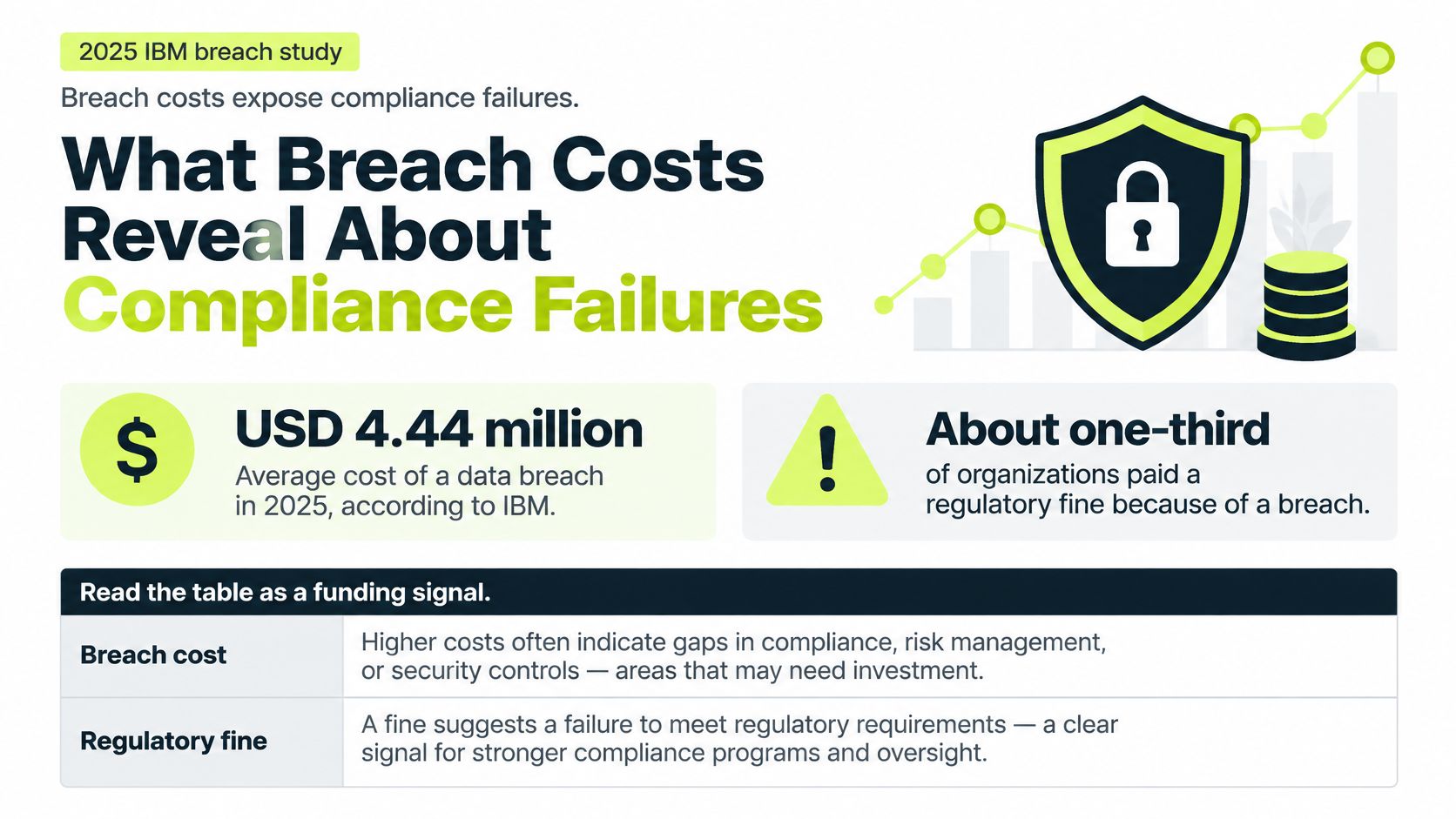
IBM's 2025 breach study reported a global average breach cost of USD 4.44 million, with about one-third of organizations paying a regulatory fine because of a breach. Its figures below, alongside Verizon's third-party and human-involvement findings, provide a practical funding map for control owners, as summarized in the 2025 breach-cost findings.
The distinction between the incident bill and the surrounding compliance work matters.
Compliance cost signals from recent breach research
| Signal | Figure | What it means |
|---|---|---|
| Global average breach cost, 2025 IBM study | USD 4.44 million | A control failure is a business loss, not only an IT ticket |
| Organizations paying a regulatory fine after a breach | About one-third | Reasonable-control evidence is part of the financial outcome |
| Supply-chain compromise | 15% of cases, average USD 4.91 million | Supplier and component governance belongs on the risk register |
| Phishing | 16% of organizations, average USD 4.8 million | Human controls need test results, not attendance alone |
| Third-party involvement in breaches, Verizon findings | Doubled from 15% to 30% | Vendor scope and shared-responsibility records must stay current |
| Human involvement in breaches, Verizon findings | About 60% | Role-based behavior evidence belongs in the control program |
These averages aren't forecasts for your company, and the rows aren't separate amounts to add together. Use them to challenge spending priorities, not to calculate a guaranteed return on a training or security purchase.
An incident creates technical work: containment, investigation, service restoration, and remediation. Compliance adds questions about notification duties, contractual commitments, regulatory inquiries, and the records needed to explain what happened. Legal and finance should distinguish these activities rather than treating every expense as a fine.
Funding rule: Pay for evidence collection during normal operations, not only for evidence reconstruction after an incident.
A policy doesn't establish whether procurement reviewed a supplier, whether engineering acted on a component alert, or whether finance verified a suspicious payment request. Investigators need the operating record, including unsuccessful checks and the corrective actions that followed.
Give finance a control-level decision
Security should present a specific gap, its owner, and the record the proposed investment will produce. For supplier risk, that might mean linking assessment findings to purchasing approval and outstanding remediation. For phishing, it might mean connecting scenario results to targeted follow-up rather than purchasing more course content.
Security and finance should prioritize the rows that resemble their last incident or most demanding customer questionnaire. Fund the missing operating evidence first, with a named owner responsible for producing it.
Cloud and Distributed Sources of Compliance Risk
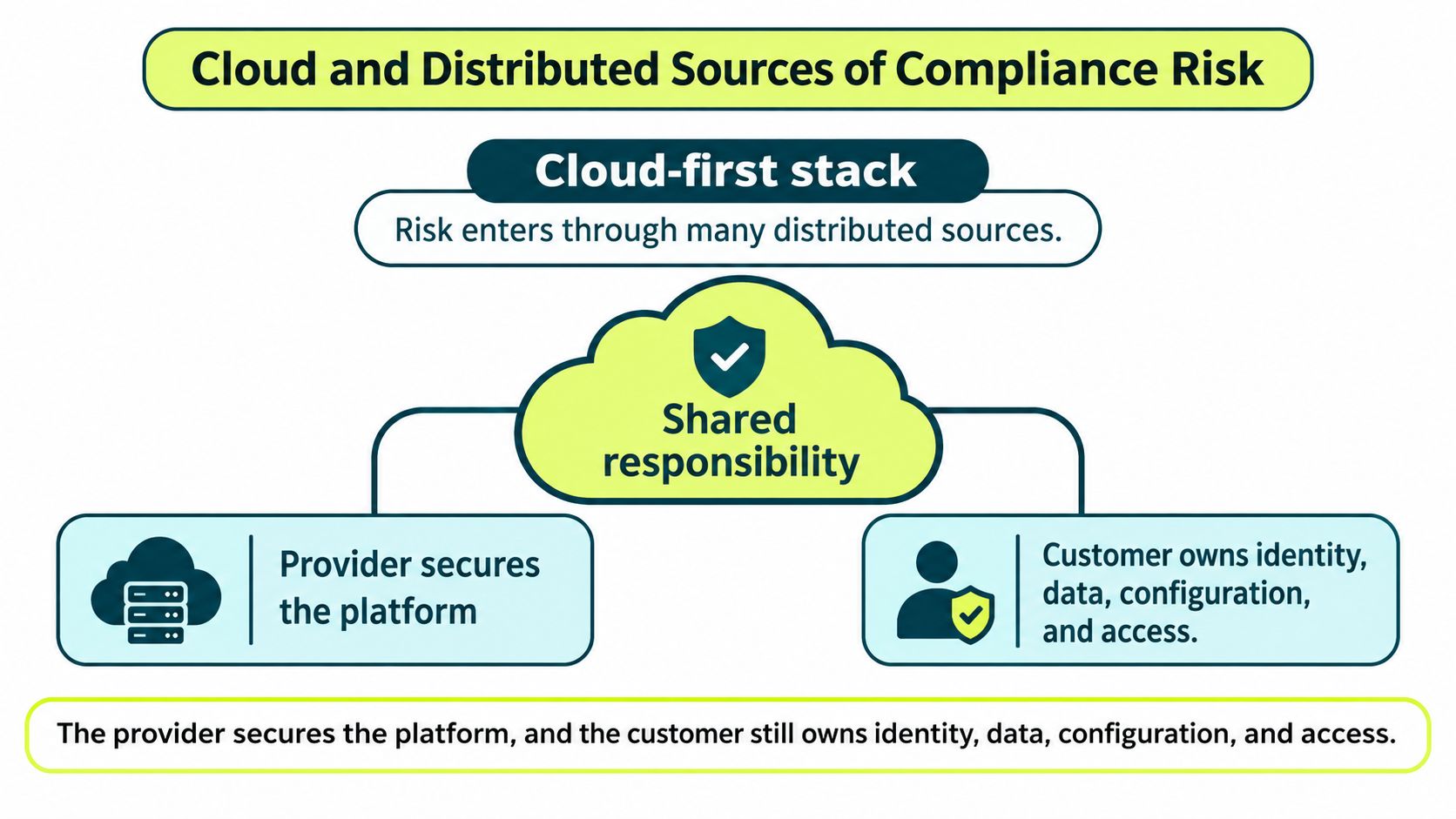
In a cloud-first stack, the provider secures the underlying platform, while the customer still manages responsibilities for identity, data, configuration, access, and deployed software. The precise boundary changes with the service and contract. Buying a managed service doesn't transfer every control obligation.
Use that boundary to assign responsibility before an incident makes it urgent.
Dependencies and perimeter exposure
Acquired software and open-source dependencies introduce components your team didn't write. Transitive packages, dependencies brought in by other dependencies, can reach production without appearing in a developer's initial selection. Link component discovery to the service that uses it and the engineering team authorized to change it.
Edge devices and perimeter services need equally explicit ownership. Verizon's 2025 DBIR found vulnerability exploitation in 20% of breaches, up 34% year over year, and reported that only about 54% of perimeter-device vulnerabilities were fully remediated, with a median remediation time of 32 days, according to Verizon's report announcement.
Those remediation findings make a point-in-time check inadequate for an ongoing control claim. A clean screenshot taken before an audit doesn't establish what happened between discovery and repair, or whether another deployment reintroduced the problem.
SaaS connections and configuration drift
SaaS and shadow integrations can bypass procurement when an employee connects a work account to a new application. Record the permissions granted, the data accessible, the business sponsor, and the conditions for revoking the connection. An approved vendor list won't reveal every active integration.
Configuration drift occurs when teams change cloud accounts, regions, or services without preserving the approved baseline. A temporary logging exception or emergency access grant can remain after the original reason disappears. Treat these as tracked changes, not informal agreements in a chat thread.
For related exposure patterns, use this overview of cloud computing security concerns when defining assessment scope.
The embedded video provides an additional reference for team discussion.
A defensible vulnerability record should connect:
- The affected asset: Inventory identifier, deployment location, and exact software version.
- The response obligation: Severity, accountable owner, remediation deadline, and compensating control.
- The verification: Approval history, timestamps, exception expiry, and authenticated rescan results.
Automate scanner-to-ticket creation where possible, but don't confuse a created ticket with resolved exposure. Ask the infrastructure owner to identify the internet-facing asset that still has an open exception without an expiry date.
How to Assess Software Compliance Risk
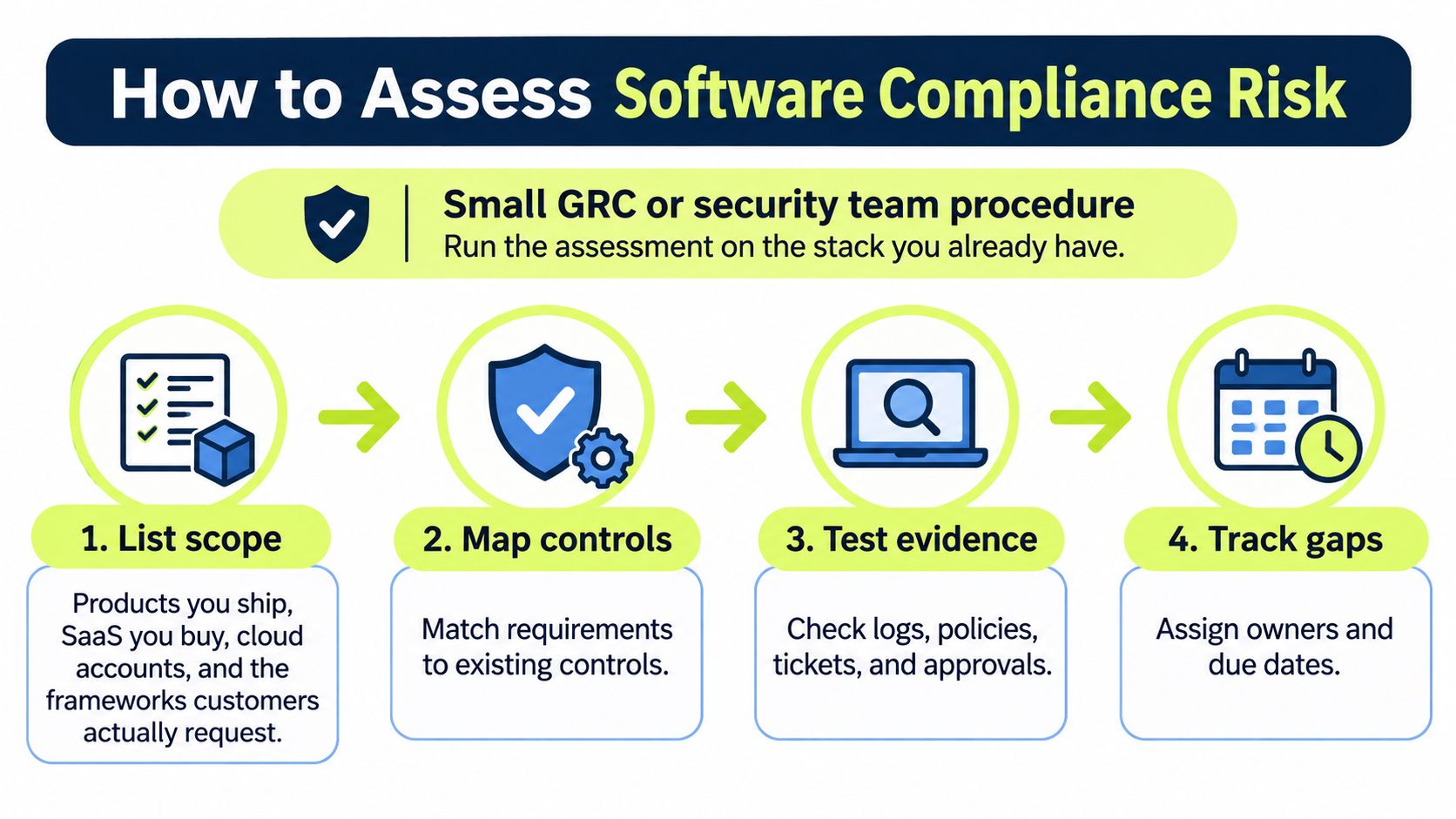
Start with your existing cloud inventory, procurement records, issue tracker, identity provider, and compliance workspace. You don't need a new scoring platform to discover that a production service has no accountable owner.
Use the following assessment to turn those records into a queue of decisions.
Assess the operating cycle
List the scope. Include products you ship, SaaS you buy, cloud accounts, and the requirements customers request. Map each requirement to an existing control so the team tests relevant obligations rather than collecting unrelated documents.
Name an accountable owner. Assign engineering, procurement, security, or a business owner to each item. A team name alone isn't enough if nobody has authority to approve a change or accept residual risk.
Record the reasons for priority. Assess internet reach, data sensitivity, supplier criticality, and license restrictions. A high-risk label should have an explanation, such as a public service processing customer data with an unsupported dependency.
Test the last full operating cycle. Select an actual completed review, deployment, or remediation event. Compare the available record against the distinction below, including what happened when the check failed.
Weak evidence versus audit-ready evidence
Control claim Weak evidence Strong evidence Critical vulnerabilities are patched A policy PDF Owner, deadline, ticket, authenticated rescan, and version Staff are trained A completion certificate Role, score against a threshold, remediation, and a repeat check SBOMs are maintained A one-time exported file Versioned inventory, named exception, and customer response when required Cloud baseline is enforced A single screenshot Timestamped history across the audit window Access is appropriate A user export Joiner-mover-leaver record and a signed review Set response deadlines and exception expiries. Give internet-facing critical issues shorter deadlines than internal low-severity issues. An exception must identify its approver, compensating measures, and expiry, otherwise temporary acceptance can become permanent drift.
Write down residual risk and the next review date. Explain what remains possible after the mitigation. Record why the authorized decision-maker accepted that exposure and what would trigger reconsideration.
Escalate overdue work to the owner. Route reminders and unresolved decisions to the accountable person, with an escalation path to their manager or risk approver. A shared inbox shouldn't become the final destination.
Test the closure claim
For a concrete vulnerability example, Stackingo's Log4j remediation checks for IT teams can help frame the difference between discovering affected software and validating remediation. Apply that distinction to your own deployed versions rather than assuming a package update reached every runtime.
Hand the record to someone outside the team. Can they establish who acted, when, on which version, and what happened when the check failed?
If they need an undocumented explanation from the original engineer, the evidence isn't complete. Capture that missing context while the decision is still fresh.
Mitigation Examples That Survive an Audit
A useful mitigation record tells a short, verifiable story. The following scenarios are illustrative, not reported customer events. Each ends with an artifact another person can inspect.
License reconciliation and component response
License true-up. Say a 400-person company discovers 60 unused seats and 15 users outside the licensed region. Procurement checks the contract, reclaims unused access, and obtains an authorized exception or amended entitlement for affected contractors before allowing continued use.
The retained record is the reconciliation beside the contract, with the affected users, approvals, and final entitlement position. Reclaimed seats alone wouldn't resolve the geographic restriction.
Open-source vulnerability. A production library receives a vulnerability notice. The readiness challenge is real: Linux Foundation research found that only 34% of manufacturers produce complete SBOMs for all products, while 46% passively rely on upstream projects for security fixes.
In the scenario, engineering identifies the shipped component and affected product versions. Security evaluates exposure, the product owner approves the remediation path, and customer-facing staff check whether the contract requires notification. Waiting for an upstream release isn't a complete decision unless someone has assessed the interim risk.
The retained record links the component inventory to the vulnerability assessment, fix-or-accept approval, deployed release, and any required customer communication. Procurement and customer success need an escalation route here, even though neither team writes the patch.
Configuration repair and behavior correction
Public storage exposure. A cloud administrator discovers that a storage bucket is publicly accessible contrary to the approved baseline. Before changing it, the administrator preserves the relevant configuration and activity records for investigation, then restricts access and checks whether other services need the same correction.
The exception ticket closes only after an authenticated configuration check confirms the intended access state. The retained record includes the original finding, change approval, validation output, and any incident assessment required by the circumstances.
Phishing response. An employee responds incorrectly to a simulated credential request. The training owner provides same-day coaching focused on the missed cue and assigns a short follow-up scenario rather than recording only an LMS completion.
The retained record connects the scenario outcome, corrective feedback, and subsequent result. A failed follow-up remains an open learning need, not a reason to erase the initial attempt.
Closure test: A person, an asset or behavior, a decision, and a timestamp should remain after the work is done.
These scenarios require coordination, not just scanning or course delivery. The control owner decides when the result satisfies the requirement and preserves the basis for that decision.
Training Evidence That Shows Behavior Change
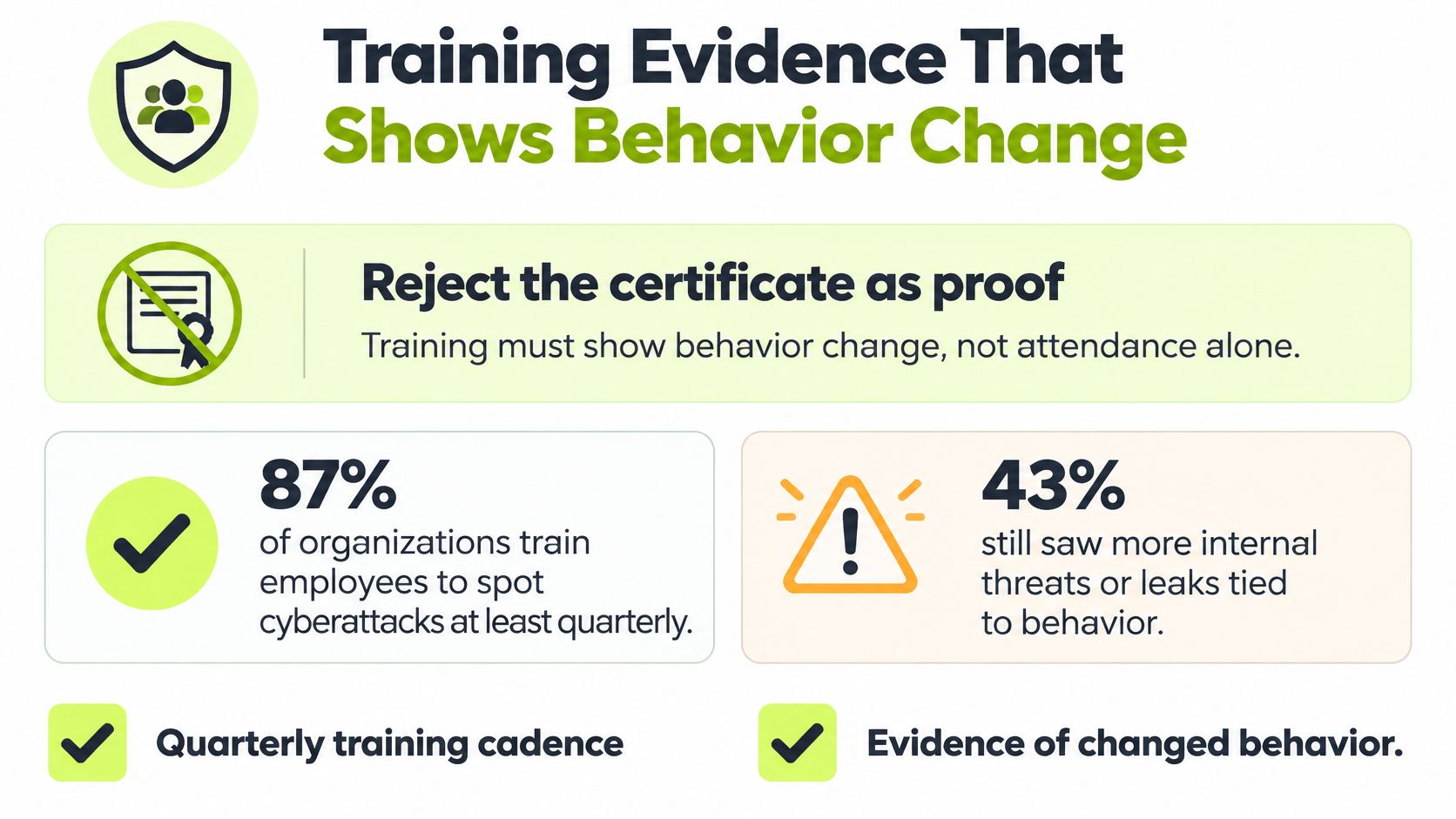
A certificate proves that someone completed the assigned activity. It doesn't prove that they can recognize a suspicious vendor request, handle customer data correctly, or escalate a vulnerable dependency.
A 2025 global survey discussed by Mimecast's State of Human Risk analysis found that 87% of organizations train employees to spot cyberattacks at least quarterly, yet 43% reported increased internal threats or data leaks linked to compromised, careless, or negligent insiders during the prior year. That doesn't prove training caused or failed to prevent those incidents, but it does show why cadence alone isn't evidence of effectiveness.
Build a role-specific learning record
Assign learning around decisions people make. Finance approvers need payment-verification scenarios, developers need component and secret-handling scenarios, and workspace administrators need exercises about permissions and integrations.
Build the learning loop in this order:
- Assign by role and requirement. Record why the person needs the lesson and which control it supports.
- Check comprehension. Grade against a defined passing standard rather than treating a viewed page as understanding.
- Test application. Use a phishing drill or an in-workflow scenario that requires a realistic decision.
- Remediate the miss. Explain the relevant cue and the correct escalation path.
- Retest the role. Preserve the follow-up outcome alongside the learner, requirement, score, timestamp, and corrective action.
For example, a finance approver might pass a course but fail a vendor bank-detail change scenario. The useful response is targeted practice in independent verification, followed by a new scenario. The completion badge shouldn't override that unresolved result.
Keep the evidence useful and proportionate
More frequent training isn't automatically better. Match refreshers to errors, changing responsibilities, and emerging workflow risks, while avoiding punitive surveillance. Explain what you measure, limit access to individual results, and use team-level patterns to improve the program.
For a Slack-first organization, Vigil Security is one delivery option for the human side of this process. We handle delivery, smart reminders, grading, and certificates without employees leaving Slack, with an 80% passing standard for assessments.
Our lessons can attach to editable framework controls mapped across SOC 2, ISO 27001, HIPAA, PCI DSS, GDPR, and more. The customer remains responsible for workspace configuration, administrator designations, and authorized users.
When designing a compliance training program, choose the behavior and follow-up test before scheduling more content. Which high-risk role currently has a scored result and a retest, rather than only an assignment date?
Build the Evidence Loop Before the Next Audit
Run a 90-day evidence loop instead of rewriting the entire program. Treat the schedule below as a practical implementation plan, not a regulatory deadline. Choose a control narrow enough for its owner to complete and verify.
Put the work on the calendar
- Week 1: Pick the framework control customers ask about most and name an accountable owner. Define the specific population, service, or workflow it covers.
- Weeks 2 to 4: Evaluate the latest operating cycle using the weak-versus-strong evidence test. Write down missing fields and assign each gap to someone who can resolve it.
- Weeks 5 to 8: Give the technical gap a deadline and any exception an expiry. Add role-based learning and a scenario or phishing check where the gap involves human decisions.
- Weeks 9 to 12: Export the record and ask an independent reviewer to follow the action, affected version, decision, and retest. Leave the control open if a required field is blank.
Use the 99tests guide to testing reports as a reference when organizing test conditions, results, and unresolved defects. Your compliance record should make the outcome understandable without requiring the reviewer to reconstruct it from chat messages.
Don't mark the control complete because the deadline arrived. Close it when the required evidence supports the result.
If your team already works in Slack, our platform can support the human-side delivery and assessment steps. The first decision still belongs to you: name the control and its owner before adding another tool.
Vigil Security offers Slack-native compliance training with graded assessments and records that help document the human side of your controls. Visit Vigil Security to evaluate the workflow with your chosen control and owner; eligible customers receive a 14-day free trial with no credit card required. Sales and demos cover pricing, rollout planning, compliance workflows, and product evaluation.