51% of respondents identified cybersecurity and data privacy or protection as top compliance priorities in PwC's Global Compliance Survey 2025. For cloud teams, the practical challenge isn't deciding whether security matters. It's producing records that show who performed a control, what they checked, and what happened when something failed.
A training certificate answers whether someone finished a course. It doesn't answer whether an administrator can recognize a suspicious access request or whether an engineer knows how to escalate exposed customer data. Strong compliance and regulatory programs preserve evidence of those decisions, not just attendance.
What Compliance and Regulatory Work Covers
IBM's 2025 Cost of a Data Breach analysis put the global average breach cost at USD 4.44 million, a 9% decrease from the previous year, according to IBM's report. These are the economic consequences of incidents, not regulatory fines. Investigation, disruption, notification, and remediation remain business exposures even when an organization has passed an audit.
Consider a cloud software company onboarding an enterprise customer. Legal reviews the customer's privacy terms, engineering documents access controls, and People Operations assigns security training. Compliance connects those activities to obligations and preserves evidence that the work happened.
A regulatory requirement is an obligation imposed by law or a regulator. Compliance is the continuing work of meeting applicable obligations and demonstrating that you meet them.
Practical rule: Treat a policy like a building code, not an inspection certificate. The written rule matters, but dated inspections and signed corrective actions show whether people followed it.
Separate obligations from assurance
GDPR is a legal regime. SOC 2 is an attestation framework, while ISO/IEC 27001 is a certifiable management-system standard. Those distinctions matter because an assurance report doesn't replace legal compliance.
Customers can also turn voluntary standards into contractual commitments. Once your company agrees to deliver a report or maintain certification, someone must manage that promise.
Every program needs concrete outputs:
- Documented controls: Describe the action, its scope, its frequency, and its acceptance criteria.
- Named owners: Identify who performs the work and who approves exceptions.
- Operating evidence: Preserve records across the review period, including failures and remediation.
A polished policy library without those outputs gives an auditor descriptions, not a testable operating history.
Which Frameworks Apply to Your Cloud Business
Compliance frameworks for cloud-first organizations
| Framework | Typical trigger | Scope | Evidence auditors request |
|---|---|---|---|
| SOC 2 | Enterprise customers request an attestation | Security, availability, confidentiality, and other chosen criteria | Policies, access reviews, training records |
| ISO/IEC 27001 | Tenders and global buyers require certification | Information security management system with applicable Annex A controls | Risk assessment, statement of applicability, management review |
| GDPR | Processing personal data involving people in the EU or EEA, subject to territorial applicability | Lawful basis, data subject rights, security of processing | Records of processing, DPIAs where required, breach logs, staff training |
| HIPAA | Handling protected health information in the US as a covered entity or business associate | Applicable privacy, security, and breach notification rules | Risk analysis, workforce training logs, business associate agreements |
| PCI DSS | Storing, processing, or transmitting card data, or affecting its security | Cardholder data environment controls | Scan reports, network diagrams, awareness training records |
| NIST CSF | Voluntary baseline, often requested by public-sector buyers | Govern, Identify, Protect, Detect, Respond, Recover | Documented risk processes and outcome profiles |
Read the trigger column as a screening question, not a legal determination. Having a healthcare customer doesn't automatically make every product subject to HIPAA; establish what information you handle and your contractual role. Likewise, assess GDPR's territorial scope rather than treating a person's location as the only test.
NIST CSF began as voluntary guidance, with Version 1.0 published on February 12, 2014, while a 2017 executive order made framework use mandatory for US federal agencies, as NIST's framework history explains. A voluntary baseline can therefore become a formal expectation through government policy, procurement, or contracts.
Choose the assurance outcome before buying tools
For SOC 2, distinguish Type I, which addresses control design at a specified date, from Type II, which also addresses operating effectiveness over a specified period. Don't promise a Type II delivery date before agreeing on the observation period and evidence expectations with your auditor.
For a broader comparison, use this guide to security compliance standards to organize the internal discussion. Then document the actual applicability decision, including exclusions and who approved them.
Cloud ownership deserves separate attention. Before assigning access-review responsibility, use the resource from By Design Law Firm & Legal Consultancy, PLLC to clarify production cloud account ownership, particularly when founders, contractors, or implementation partners created the environment.
Build once and map carefully
An access-review procedure or training workflow can support multiple requirements. Maintain a shared control library, then map each control to the relevant framework rather than creating duplicate procedures.
The mappings aren't interchangeable assurances. A training record can support security awareness, but it can't establish a lawful basis for processing personal data.
Start with these questions: Where are your customers, where is your data, and which regulators have authority over your activities? The answers determine scope more reliably than collecting certification logos.
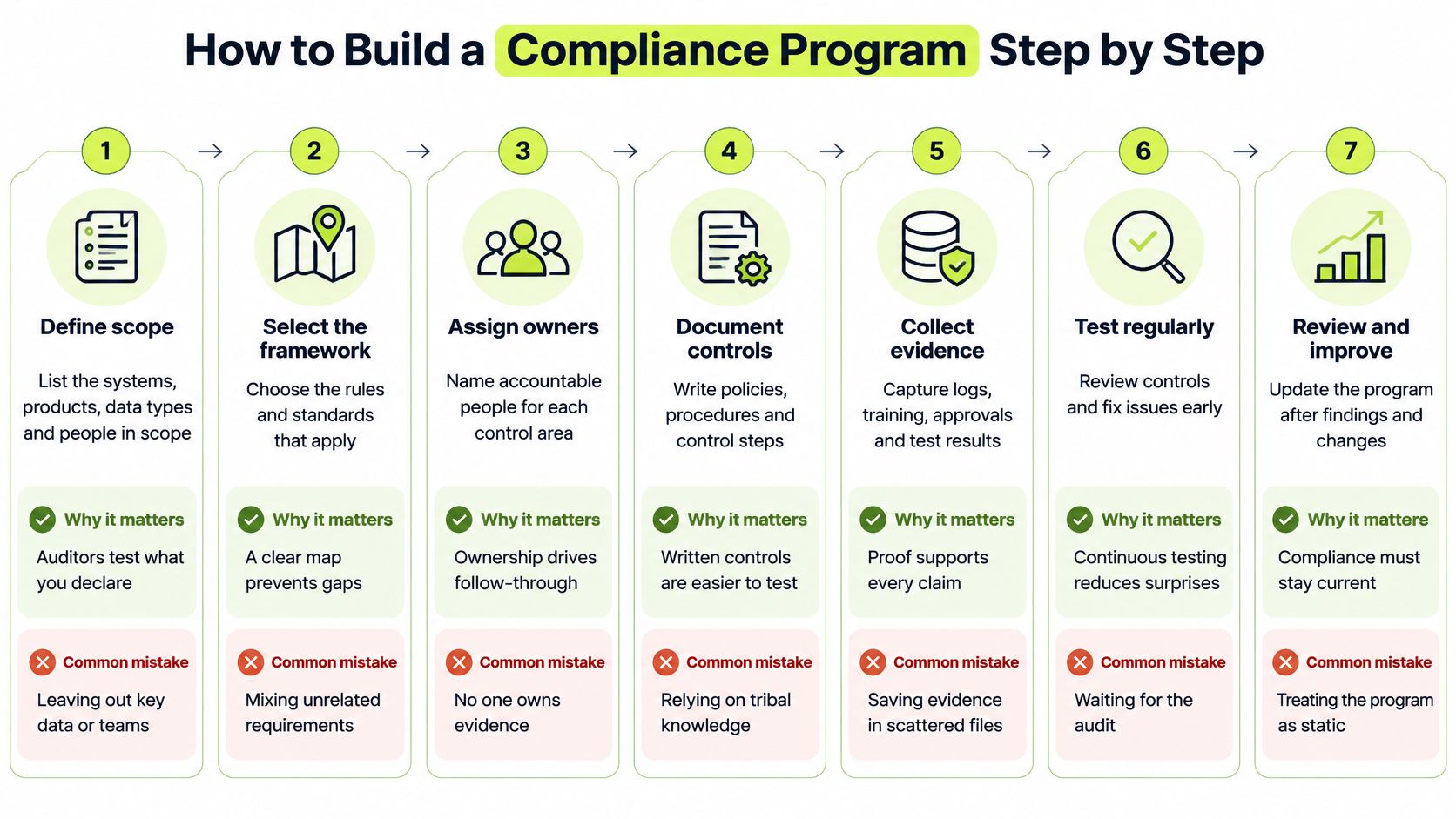
How to Build a Compliance Program Step by Step
Start with a control register, not a policy-writing sprint. A spreadsheet can work initially if it records ownership, execution, evidence location, review dates, and unresolved findings.
Use this process as the implementation checklist.
Establish scope and accountability
Define scope. List the products, cloud accounts, identity providers, repositories, data types, and people covered by the program, because auditors test the boundary you declare. A common mistake is documenting production infrastructure while omitting support tools that can retrieve customer data.
Select applicable frameworks. Record the legal, contractual, or commercial reason for each selection, then identify shared controls. Don't copy an entire template library into your register without checking whether each requirement applies.
Assign named owners. Give every control an accountable person, a written procedure, an evidence destination, and an escalation route. Assigning ownership to “IT” leaves uncertainty about who must investigate a failed check or produce the record.
Turn requirements into repeatable work
Build the learning matrix. Map employees, contractors, managers, developers, and administrators to training based on their responsibilities and access. Keep a common foundation, but don't use it as a substitute for instruction on privileged changes, secure development, or sensitive-data handling.
Set cadence and triggers. Schedule onboarding, recurring refreshers, and targeted instruction after relevant policy changes or incidents. An annual refresher may be part of your design, but don't present your chosen schedule as a universal requirement across frameworks.
Collect evidence during execution. Capture assignment, completion, comprehension, acknowledgements, and simulation outcomes with stable learner identifiers and timestamps. Waiting until audit preparation encourages reconstructed records that can't explain the original context.
Review and improve. I would schedule quarterly reviews of overdue assignments, weak assessment questions, repeated errors, and unresolved exceptions. Record the decision, owner, and due date for each change rather than treating a dashboard discussion as remediation.
A workable first cycle ends with an owner, a schedule, and a retrievable record for every implemented control. A discovered gap should have either a verified correction or an explicitly approved, time-bound exception.
An exception register is part of an honest program. An unexplained missing record is not an exception.
Keep the implementation proportionate. Automate repetitive collection once the procedure is stable; otherwise, you'll automate inconsistent assignments and spend the next review reconciling them.
Why Training Records Count as Compliance Evidence
Completion measures participation, not capability. The measurement gap appears in EIMF's discussion of compliance training effectiveness, which reports that 39% of organizations monitor completion and certifications, while 40% use knowledge assessments. Neither measure alone establishes that someone makes safer decisions at work.
An auditor needs a chain of evidence connecting the intended population, the instruction delivered, the assessment, and the response to weaknesses.
Training evidence and what it proves
| Evidence | What it shows an auditor | Typical source |
|---|---|---|
| Assignment and completion records | Who was required to train and when they finished | LMS or training platform logs |
| Comprehension scores | Evidence of understanding against a defined pass mark | Quiz results in the LMS |
| Phishing simulation results | Click and report behavior by difficulty level | Simulation platform with difficulty classification |
| Policy acknowledgements | Staff acknowledged the current policy version | Policy management or HR system |
| Role-based assignment records | Elevated-access users received additional training | Assignment rules and rosters |
| Overdue and reminder history | How gaps were detected and handled | Reminder logs and dashboards |
Read the records together
Assignment and completion records establish coverage only when you reconcile them against the workforce roster. A completion export that excludes contractors can look healthy while omitting people with production access.
Comprehension scores are stronger when questions test a decision, not recognition of a sentence copied from a slide. Preserve the question version and pass criteria, and distinguish an initial attempt from a successful retake.
Phishing outcomes need context about scenario difficulty and the population tested. Policy acknowledgements establish receipt or acceptance, but they don't establish that staff followed the policy. Role-based records explain why an administrator received different instruction, while reminder history shows whether managers addressed missing participation.
Measure a behavior repeatedly
A useful compliance training program connects a learning objective to an observable action. For suspicious messages, that might mean correct reporting through the approved channel, followed by appropriate handling of the message.
Shorter, frequent training can produce stronger evidence than an annual course if you preserve comparable observations over time. More lessons without a defined indicator create more activity records.
Don't claim that a better quiz score proves fewer breaches. State the narrower, defensible result: learners improved on a specified assessment, demonstrated a reporting behavior, or completed corrective instruction after an identified weakness.
Audit-Ready Practices for Continuous Evidence
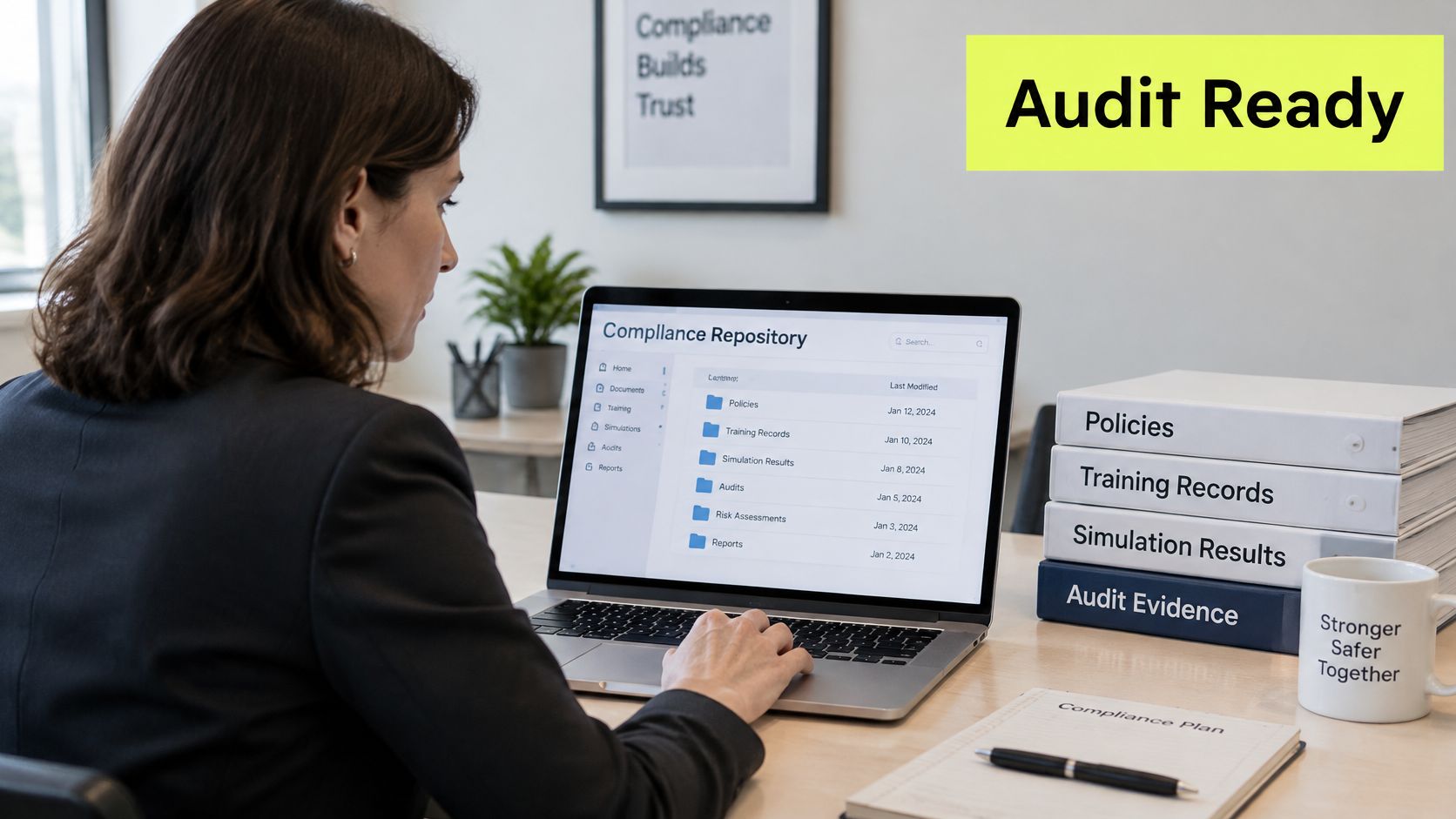
Make evidence understandable to someone who didn't administer the program. A folder full of exports isn't sufficient if reviewers can't identify the population, policy version, or control each file supports.
Organize the records around the decisions a reviewer must verify.
Make each record independently interpretable
- Use a logical system of record. Keep an authoritative evidence index even when original records remain in HR, identity, and training systems. Test whether a reviewer can reconcile an employee across those systems without relying on matching display names.
- Preserve timestamps and versions. Store assignment, delivery, completion, course version, and applicable policy version. Test whether an older completion still resolves to the material the learner received.
- Retain history deliberately. Set retention using applicable obligations, contracts, audit needs, and privacy constraints. Preserve the full review period and an appropriate buffer, but don't retain personal data indefinitely by default.
For phishing exercises, use the NIST Phish Scale user guide to classify human difficulty rather than treating every campaign as equivalent. Preserve the classification, target population, delivery timestamp, learner response, corrective action, and follow-up result so a reviewer can interpret the outcome.
Test retrieval before the audit
- Make records sample-ready. Assemble each person's assignment, assessment, acknowledgement, and exception history through a repeatable query or export. Test an account that changed departments, not just a straightforward new hire.
- Run a pre-audit walkthrough. As an internal exercise, select three employees each quarter and trace their evidence end to end. Include a contractor or privileged user when testing those workflows, and log every retrieval failure as a finding.
Use an archiving and compliance approach that preserves provenance, access restrictions, and disposal decisions. Exporting everything to a shared drive can undermine confidentiality and leave competing versions.
For a supplementary walkthrough, use the video below.
Retrieval test: Give someone who didn't run the program an hour to answer who was trained, on what, and what happened next.
That's an internal readiness target, not a regulatory deadline. If the reviewer needs the administrator to interpret every file, improve the record structure before adding more exports.
Connecting Training Data to Vanta and Drata
GRC platforms such as Vanta and Drata organize evidence against control requirements. The operational question is whether your training evidence reaches the control as a current, interpretable record or as an attachment someone must rebuild.
Consider a hypothetical company exporting completion CSVs every quarter. A GRC analyst compares the export with the workforce roster, maps courses to controls in a spreadsheet, and captures screenshots before the audit. A late completion then requires another export and another reconciliation.
Manual versus synced training evidence work
| Task | Manual approach | Synced approach |
|---|---|---|
| Export completion records | Download CSVs each quarter | Synced automatically to Vanta or Drata |
| Map training to controls | Hand-built spreadsheet mapping | Evidence linked to the control in the tool |
| Refresh evidence before audit | Rebuild screenshots and exports | Records stay current as learners finish |
| Track overdue learners | Manual reminder emails | Automated reminders and status tracking |
| Verify assignments | Compare rosters by hand | Assignment status flows through with the record |
Validate the integration boundary
Vigil Security is a training-layer option with Slack-native lessons, recurring microlearning, and phishing campaigns, alongside evidence synchronization with Vanta and Drata and automated assignments, reminders, and certificates. Confirm which fields your integration transfers rather than assuming every assessment attempt or coaching event appears in the destination.
Test a completed assignment, an overdue assignment, a reassigned learner, and a failed synchronization. Compare the destination record with the source and check whether corrections preserve history.
Synchronization reduces handling work; it doesn't determine applicability. Control owners must still approve mappings, verify population coverage, and investigate stale records. An integration can faithfully transmit the wrong assignment, so treat connector health and control effectiveness as separate checks.
Common Gaps Auditors Flag and How to Close Them
One annual course for everyone is easy to administer, but difficult to defend as role-based instruction. A 2025 effectiveness survey discussed by OCEG found that only 36% of organizations differentiate training by role, job function, or department, and only 26% consider risk level in training design.
A common foundation is useful. The gap appears when you can't explain how someone with deployment privileges learned responsibilities that don't apply to an employee without system access.
Common training compliance gaps and fixes
| Gap | Why auditors flag it | Fix |
|---|---|---|
| One annual course for everyone | Cannot show role-based coverage | Assign by role, team, and access level |
| Completion without comprehension | No evidence of understanding | Add knowledge checks with a defined pass mark |
| Contractors outside the records | Access granted with no training evidence | Include contractors in joiner-mover-leaver workflows |
| Policy changes not re-acknowledged | Stale policy versions found in review | Trigger acknowledgement for applicable updated policies |
| Phishing results without follow-up | Corrective action cannot be verified | Log coaching and retest an equivalent scenario |
| Access reviews not documented | No evidence access stayed appropriate | Run scheduled reviews with signed decisions |
Fix the missing decision, not just the file
For contractors, reconcile the identity-provider roster with procurement and training records. The consequence of an omission isn't merely an incomplete dashboard: the auditor can't verify that someone with access received applicable instruction.
For policy changes, identify the affected population and preserve the acknowledgement tied to the released version. For failed assessments, require targeted remediation rather than allowing repeated guesses to produce an unexplained passing result.
Phishing follow-up should address the missed behavior. Use a comparable scenario for retesting rather than relying only on the learner recognizing the original message.
Close storage and access-review gaps together
Personal drives create another failure mode: the owner leaves, and nobody can produce the evidence. Move authoritative records into controlled storage with an accountable custodian and documented access.
Access reviews need the same discipline. Preserve what the reviewer examined, what they approved or removed, and confirmation that removal occurred.
Don't promise that every gap is a quick fix. Moving a file may be straightforward; correcting role mappings or connecting joiner-mover-leaver workflows requires implementation and a subsequent test. Close a finding only when you can demonstrate the corrected process, not merely a revised policy.
Choose Your First Framework and Start This Month
Start with the obligation that determines your real deadline and scope. That may be a regulator's requirement, an existing contract, or an enterprise buyer's assurance request. Don't choose a framework solely because your preferred software makes its dashboard easy to configure.
For an enterprise-focused cloud business, SOC 2 may be the relevant assurance target when buyers explicitly request it. If GDPR applies to your processing, address those legal obligations alongside the assurance work rather than postponing them until after an audit.
A practical opening month
Week one, write the boundary. Starting Monday, list the systems, data types, legal entities, and people in scope. Have engineering, legal, and the business owner challenge omissions before approving it.
Week two, assign accountability. Name the owner and reviewer for each control, then identify its evidence source. Escalate controls that nobody has the authority or resources to perform.
Week three, configure the operating workflow. Map training to actual responsibilities and enable evidence collection in your GRC and training tools. Test the assignments against the workforce roster before releasing them broadly.
Week four, perform a walkthrough. Trace sample employees from onboarding through assignment, assessment, acknowledgement, and remediation. Create dated findings for anything you can't retrieve or explain, then verify the corrections.
This is a launch plan, not a promise of certification or an audit-ready operating history within a month. Some controls need time to accumulate evidence, and your auditor must agree on what supports the intended assurance outcome.
Choose tools after scope and ownership are settled. A training layer becomes useful when it executes a defined program and preserves evidence your control owners can evaluate.
Vigil Security offers Slack-native security awareness training, recurring microlearning, and phishing simulations, with training evidence synchronization for Vanta and Drata. Visit Vigil Security to evaluate how its assignments, assessments, and automated reminders could support your role-based training controls and audit evidence workflow.