Most companies don't fail a security review because they picked the wrong framework name. They fail because three buyers asked for three different proofs, and the evidence lives in three different places. You're not memorizing acronyms for a test. You're building one set of controls, with named owners and fresh records, that can answer SOC 2, ISO 27001, NIST, and, when it applies, HIPAA without rebuilding the work each time.
Why Security Compliance Standards Collide in Practice
Only 29% of programs consistently met internal and external standards in a 2025 survey of 500 US and UK IT and security decision-makers, even though 96% said keeping up with growing regulations was challenging in that same survey. That gap is central to the story behind security compliance standards. The control ideas overlap. Your teams, owners, and evidence workflows often don't.
A typical cloud-first company hears different requests at the same time. A SaaS customer asks for SOC 2. A European partner asks for ISO 27001. A public-sector prospect uses NIST language, and a healthcare conversation raises HIPAA before anyone has confirmed whether health data is in scope.
What the collision looks like day to day
- Scattered evidence: 92% used at least three tools to gather audit evidence, per the survey linked above, so a Slack admin, GRC lead, and engineer each hold part of the answer.
- Mostly manual collection: Only 39% of evidence collection was automated in that survey, which means screenshots and spreadsheet exports age quickly.
- Error-prone work: 62% said the process was at least occasionally error-prone, so a correct control can still look unproven to an auditor.
Buying more tooling doesn't fix this by itself. Another 2025 benchmark on compliance integration gaps reported that 53.7% of organizations lacked compliance integration in development pipelines, and only 44.1% reported complete synchronization between risk management and compliance. Your risk register can say one thing while engineering ships another.
Practical rule: If a control has no single owner and no fresh record, you don't have a reusable control yet, no matter how many frameworks list it.
People operations face the same ownership problem outside security, which is why a broader HR Management 365 workplace compliance guide can help HR partners see how policy, training, and recordkeeping need one accountable workflow. For security, your job is narrower and harder: decide which obligations apply, name one owner per control, and keep evidence fresh enough to reuse across audits.
How Major Frameworks Actually Work Together
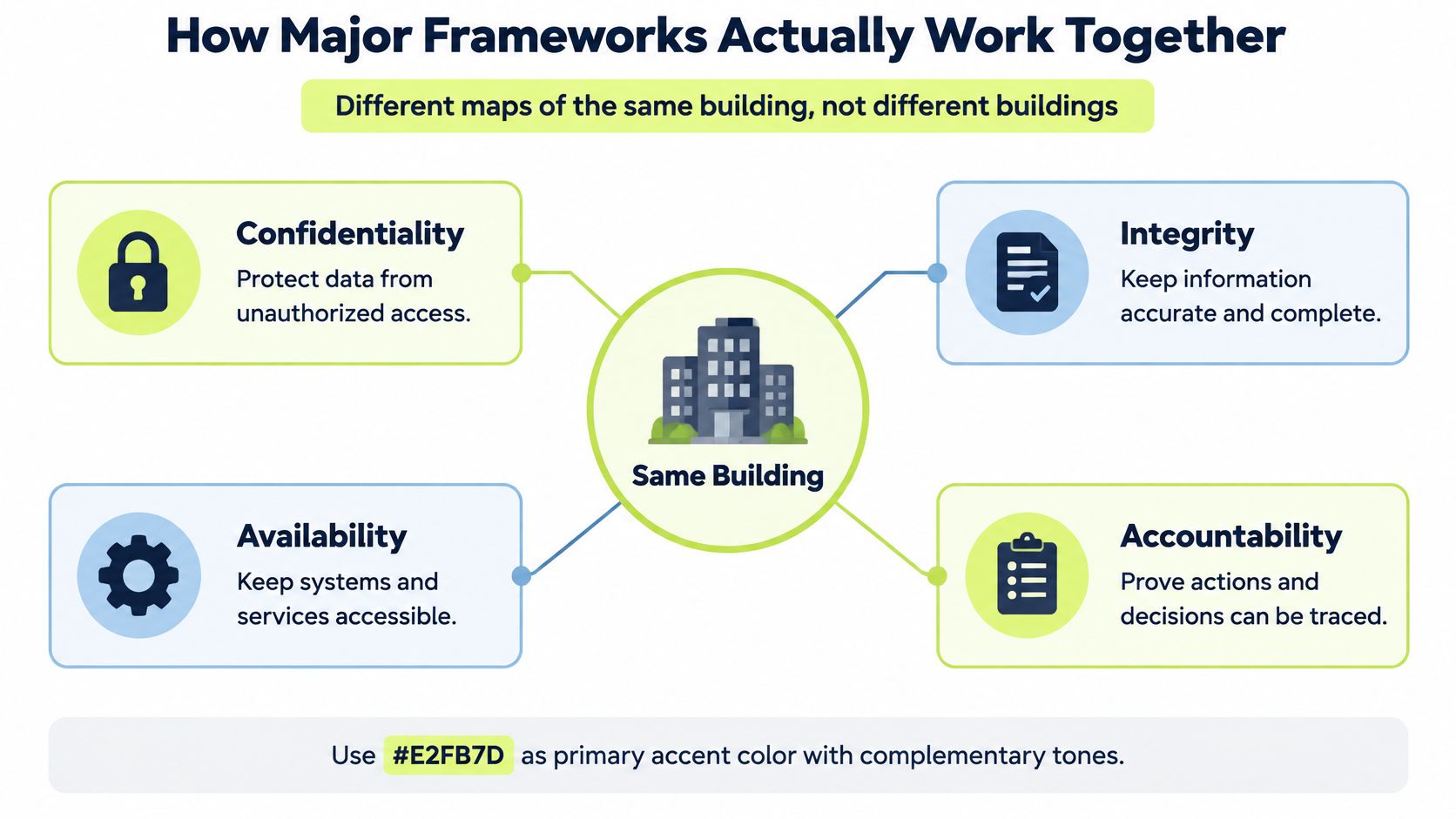
Think of the major security compliance standards as different maps of the same building, not different buildings. The rooms are confidentiality, integrity, and availability. You protect data from unauthorized access, keep it accurate and complete, and keep systems accessible when people need them. Risk assessment, governance, and continual improvement are how you decide which doors stay locked and who checks them.
Three jobs readers often mix up
ISO/IEC 27001 is a certifiable management system. It defines requirements for an information security management system, or ISMS, with documented controls, risk assessment, governance, and continual improvement. An independent audit can result in a certificate for a defined scope. The artifact proves certification, not that every employee behaved safely every day.
NIST CSF is a common risk vocabulary. The National Institute of Standards and Technology issued Framework Version 1.0 on February 12, 2014, after an effort focused initially on critical infrastructure, and organized activity around Identify, Protect, Detect, Respond, and Recover, according to NIST's fifth anniversary summary of the framework. NIST reported more than 500,000 downloads in the first five years in that summary. Private-sector use was voluntary, while a 2017 executive order made it mandatory for U.S. federal agencies. CSF 2.0 arrived in February 2024 and expanded scope beyond critical infrastructure with stronger governance emphasis.
HIPAA is a U.S. law, not a badge. It creates legal duties for organizations handling protected health information in defined roles. You don't collect HIPAA because a prospect works near healthcare.
A certificate proves a management system was audited. A NIST profile proves a risk conversation happened. A law proves a duty exists. Those aren't interchangeable.
That's why mapping matters more than memorization. A detailed walk-through of SOC 2 and ISO 27001 control equivalencies shows how one control can satisfy related criteria when the wording differs. Pair that mapping logic with your own risk and compliance planning so NIST becomes the crosswalk language, ISO provides auditable management-system certification, and SOC 2 answers a specific buyer report request. They complement each other when you keep the underlying control and evidence shared.
Matching Standards to Organization Type and Controls
Start with who you are and what data you touch, not with which logo looks strongest. A standard fits when a buyer, regulator, or law can demand it from you, and when your systems fall inside its scope. If you get that sorting wrong, you'll build controls for a market you don't serve while missing the report your real customer needs.
ISO's global weight explains why procurement teams ask for it so often. The ISO Survey 2024 results for ISO/IEC 27001 reported 96,709 valid certificates covering 179,877 certified sites, up 104.49% for certificates from 47,291 in 2023. China accounted for 33,359 certificates, followed by India with 6,758, Japan with 6,644, the United Kingdom with 4,455, and the United States with 4,260, per that survey. Don't misread that scale. Certificates and sites are not unique companies, because one organization may hold certificates covering multiple sites.
Which Security Compliance Standard Fits
| Standard | Typical fit | What you show | Awareness-related controls |
|---|---|---|---|
| SOC 2 | U.S. SaaS and service providers whose buyers request a report against Trust Services Criteria | An independent attestation report for a defined system and period | Role-based training, access awareness, incident reporting, vendor and privacy duties |
| ISO/IEC 27001 | Companies selling globally or needing a recognized ISMS certificate | A certificate for a stated scope, supported by risk assessment and documented controls | Competence and awareness, access and identity, remote-work safeguards, incident learning |
| NIST CSF | Teams needing executive reporting, maturity discussion, or public-sector alignment | A current and target profile mapped to outcomes, not a certificate | Asset and risk identification, training under Protect, detection and response roles |
| HIPAA | Covered entities and business associates that create, receive, maintain, or transmit protected health information | Risk analysis, safeguards, policies, and business associate agreements showing legal duties are met | Workforce training on health data handling, access discipline, incident procedures, physical safeguards |
A short worked example
Take a distributed SaaS firm with no health data. U.S. enterprise customers ask for SOC 2, so that report becomes a commercial requirement. A global partner expects ISO 27001, so the company builds an ISMS that can be certified. A public-sector prospect speaks in NIST functions, so the GRC lead maps the same controls into that vocabulary for executive reporting. HIPAA stays off the list until a product handles protected health information as a business associate.
Notice what didn't happen. The team didn't run four separate awareness programs. Access and identity, asset identification, awareness and training, incident response, vendor obligations, and remote-work safeguards each got one owner and one control definition, then got mapped outward.
Your takeaway should be a short applicable list, not a maximal one. Write down the standards you owe, the buyer or law behind each, and the control families that involve people. If you can't name the owner for a family, that's your first gap, before you debate framework wording with an auditor.
What Auditors Expect from Training Evidence
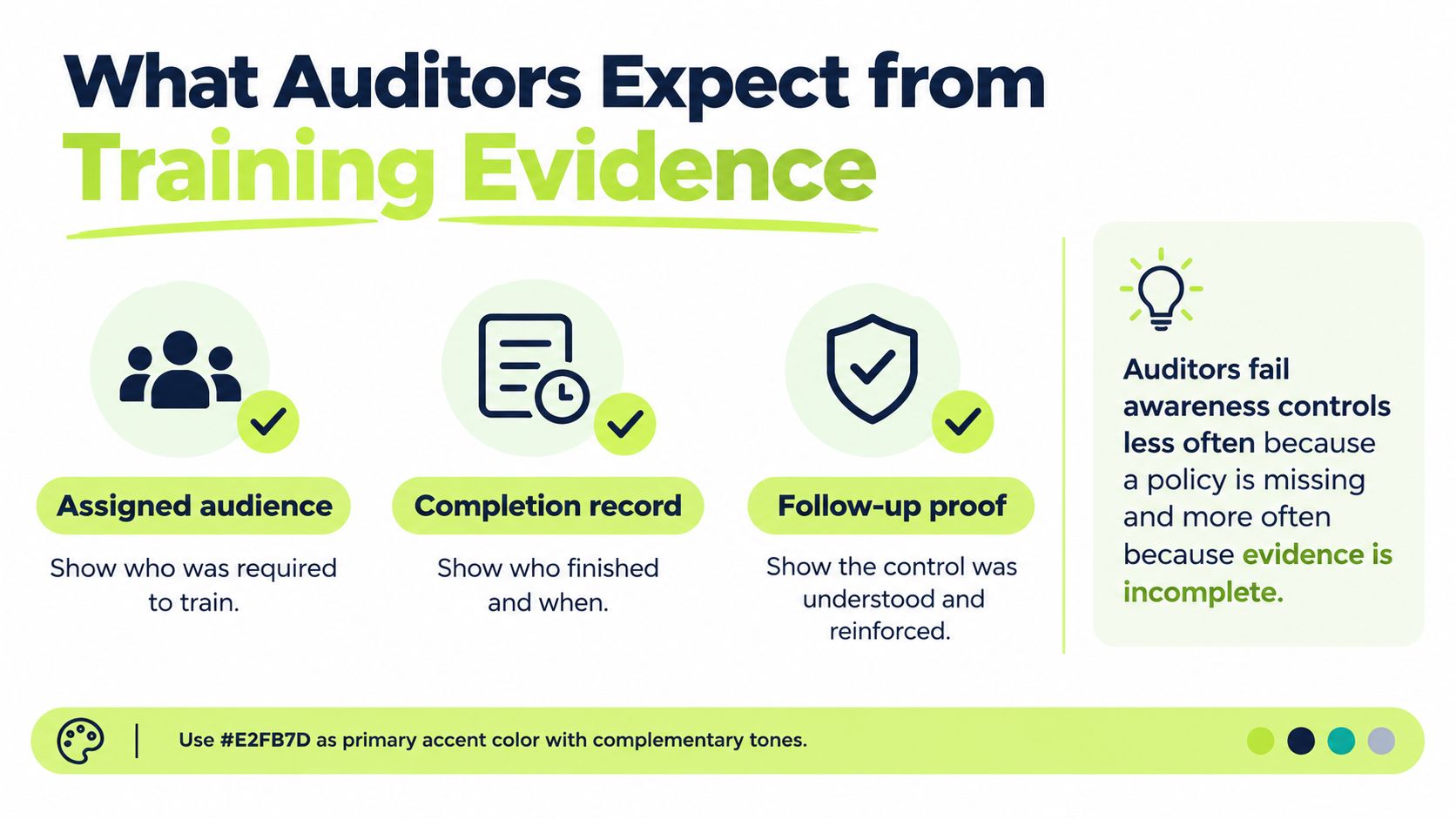
Awareness controls rarely fail because nobody wrote a policy. They fail because an auditor can't tie a person, a role, a lesson version, and a result together. A single annual export saying the company finished training doesn't answer the obvious follow-up: did the people with the riskiest access finish the training meant for them, and what happened when they didn't pass?
That's why you should measure specialized training by responsibility group. NIST SP 800-50 defines a metric as the number of qualified employees with documented completion divided by the total number of employees with significant security responsibilities, using training records and course-completion certificates as evidence, in NIST SP 800-50 on security awareness metrics. Privileged administrators, developers, incident responders, and system owners shouldn't disappear into a company-wide average.
The minimum record an auditor can reuse
- Person and role: Show who was in scope and why that role carried a specialized obligation.
- Course and version: Record which lesson or policy version the person received, so old content isn't mistaken for current instruction.
- Timestamp and result: Keep the denominator, completion time, and assessment outcome together.
- Follow-up: Show remediation, the exception owner, and a due date when someone is overdue or below threshold.
Regulated sectors outside software make the same point in a different setting. Reviewing FMCSA training requirements for drivers shows how role-specific duties need their own records rather than a generic attendance sheet. The stakes differ, but the evidence logic is familiar: define the population correctly, or your completion rate means little.
One artifact can support SOC 2, ISO 27001, and a NIST crosswalk when the control owner, scope, and freshness are documented on the record itself. That reuse is what makes specialized topics manageable, including when a team separately reviews PCI compliance security awareness training and needs its records to sit alongside the main program. Stale exports don't prove a control operated between audits, and exceptions without owners read as unmanaged risk.
Abundant evidence still doesn't automatically convince leadership. A benchmark cited in the opening section found 82% of teams believed they assessed control effectiveness well while 45% of board directors still sought external validation. It also reported 94.2% of CISOs believed continuous controls monitoring improves compliance, but only 72% of organizations had implemented it. Fresh, role-scoped records close part of that credibility gap because the board question changes from whether training happened to whether the right population is current right now.
Proving Behavior Change Between Annual Audits
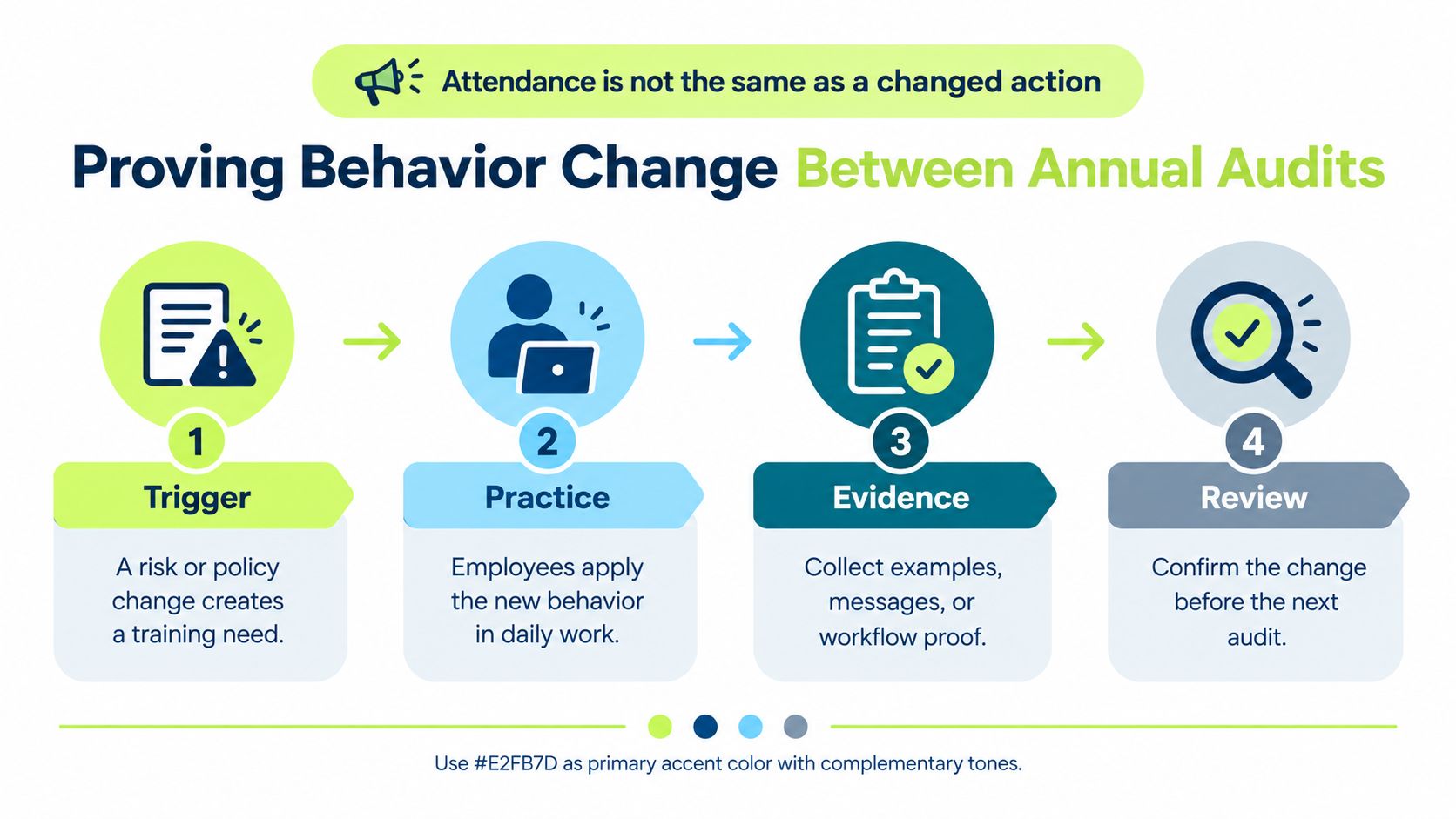
How do you prove training changed behavior rather than merely record attendance? A completion certificate can't answer that. It shows someone clicked Finish. It doesn't show whether that person would report a suspicious message on a busy Tuesday, which is the behavior your incident process depends on.
NIST SP 800-50r1 recommends measuring the share of phishing exercise participants who changed behavior appropriately, calculated as correct reports divided by recipients tested, and establishing baseline click or reporting rates by user group or work role, in NIST SP 800-50r1 on phishing behavior metrics. In plain language, you count who did the right thing, by group, then you test again later to see whether coaching worked.
A closed loop a distributed team can run
- Define the group: Segment by role or team before you send anything, so admins and sales staff aren't blended into one meaningless rate.
- Run one scenario: Record campaign date, scenario type, recipient population, click or link interaction, report status, and time to report.
- Coach immediately: Give corrective instruction at the moment of failure, and link any remedial lesson to that campaign record.
- Repeat and compare: Run a later exercise and compare reporting by the same group, alongside completion and assessment results.
A Slack-delivered version of that loop might use short lessons with an 80% passing threshold described in the product material, phishing campaigns with instant coaching, and recurring 30 to 60 second refreshers from that same description. The format matters less than the fields you preserve. If you keep only a pass or fail grade, you can't distinguish someone who reported quickly from someone who ignored the message entirely.
Measure whether a role reports faster and fails less over time. Don't turn individual employees into surveillance scores.
That boundary protects both trust and data quality. People who fear public ranking may hide mistakes instead of reporting real messages, which destroys the behavior you're trying to build. Report trends by group, use individual records for coaching and remediation, and retain only the fields an auditor needs to verify the control operated.
You should be able to tell an auditor which metric proves learning and which only proves attendance. Completion shows coverage. Assessment shows comprehension at a moment. Reporting rate and time to report show action in context. Together, they give human-focused controls a life between annual audits instead of a single dated certificate.
Choosing Slack-Native Training That Syncs Evidence
You have three practical ways to keep human controls alive, and they differ mainly in friction and evidence quality. Judge each on role-based assignment, reminder load, remediation after failure, and whether records reach your compliance system without a manual export. A pretty course library doesn't help if the GRC lead rebuilds the evidence pack by hand every quarter.
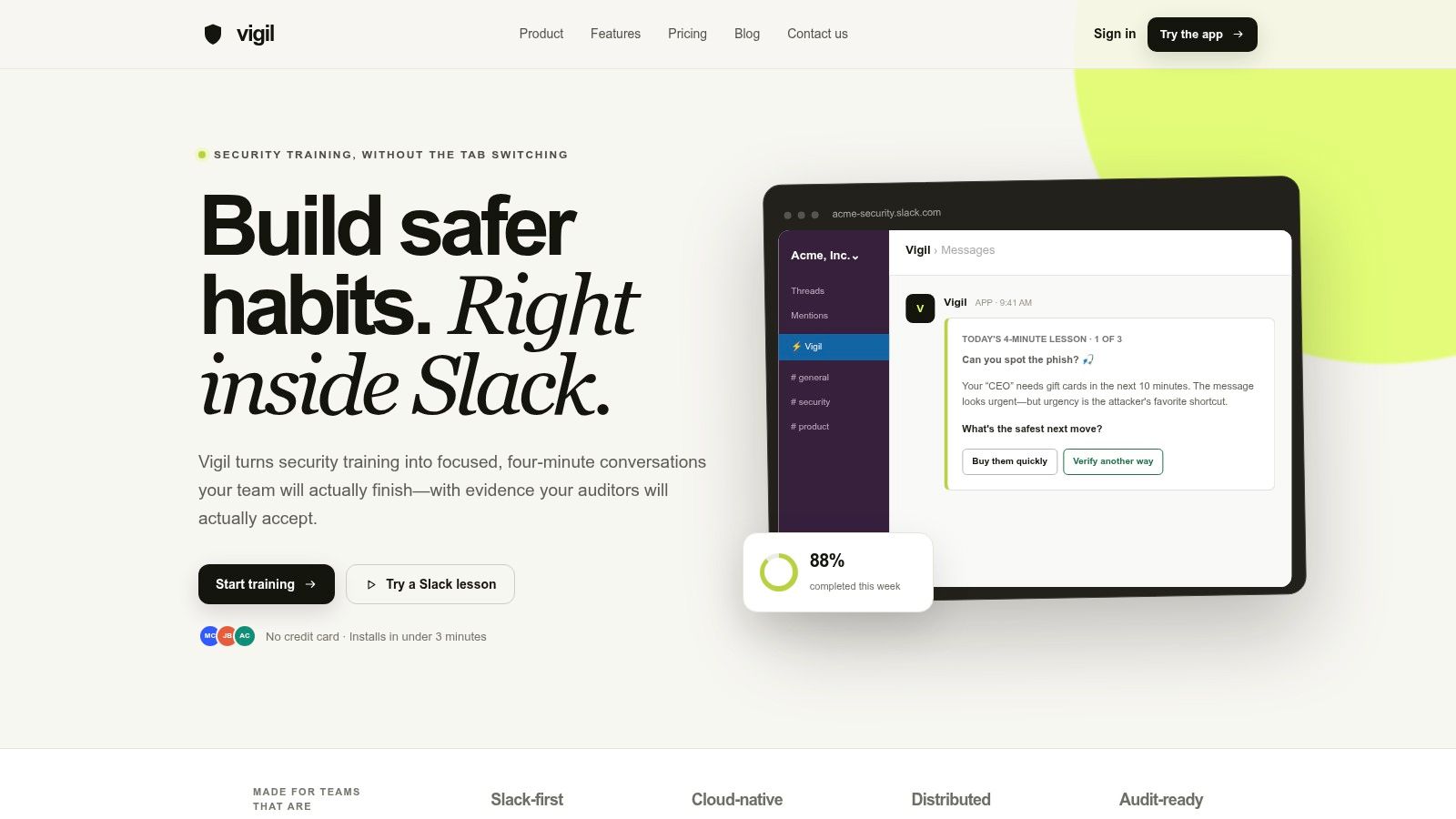
The screenshot below shows the Slack-native format discussed in this comparison.
Three options, judged on evidence
- External portal module: A long annual course is easy to buy but easy to postpone, and separate passwords add friction. Evidence usually arrives as a periodic export that someone must map to roles.
- Homegrown slides and spreadsheets: Content can be specific to your company, but reminders, grading, and overdue tracking become manual work. Version control is often the first thing to break.
- Training inside daily work tools: Lessons arrive where people already respond, assignments can follow team membership, and records can sync continuously if the integration preserves the right fields.
As the concrete Slack-native option, Vigil Security delivers interactive lessons, questions, and feedback entirely in Slack in about four minutes, with a library of 35 lessons across six learning paths in its product description. That description lists weekly Streams refreshers, Pulse quizzes and policy nudges, phishing drills with Slack coaching, assignment by workspace, channel, team, or person, and admin views of completion, comprehension, overdue status, and certificates with CSV export. It also describes evidence synchronization with Vanta and Drata, setup in under three minutes, authored question banks, and optional bring-your-own-key personalization using a customer's OpenAI or Anthropic key encrypted at rest. Pricing is described as a single plan at $2 per seat per month billed annually with a defined minimum, and learners use Slack App Home, direct messages, and commands such as /vigil learn and /vigil progress.
The short walkthrough below shows how that delivery model looks in practice before you compare it with a portal workflow.
Pick the option that preserves person, role, timestamp, result, and behavior fields in the system your auditor already trusts. If a tool can't show a failed assessment triggering remediation, or can't sync a fresh record without a spreadsheet, it's adding a training activity rather than strengthening a control.
A Practical Next Step for Continuous Readiness
Run this as a one-quarter sequence, not as a framework shopping exercise. Each step uses a decision you've already made above, so the work compounds instead of restarting with every customer questionnaire.
Your next quarter in five moves
- List what applies: Write the short list of standards you owe, the buyer or law behind each, and the control families that include people.
- Name high-impact roles: Separate privileged administrators, developers, incident responders, and system owners from the general population, with one control owner each.
- Choose one evidence home: Pick Vanta, Drata, or your existing system of record, and require every training record to carry person, role, course version, completion time, assessment result, and phishing outcome. Retention choices matter here, so align the plan with your approach to archiving and compliance before records pile up in chat.
- Replace the annual event: Schedule a small recurring set instead, with one short lesson, one policy nudge, and one phishing scenario with immediate coaching.
- Pilot in Slack: Assign one learning path to a pilot team, then confirm a completed record arrives in the compliance tool without anyone touching a spreadsheet.
Don't expand the pilot until that last check passes. If the record arrives late, lacks the role, or can't show what happened after a failed assessment, fix the workflow while the audience is still small. A clean pilot gives you a pattern you can roll to every team without redesigning assignments each time.
Done looks specific. You have one owner per human control, one fresh evidence trail, and one behavior metric you can show between audits. That's a stronger answer to a customer, a board member, or an auditor than another certificate date on a slide.
If your team already works in Slack, you can run that pilot with short native lessons, phishing coaching, and training evidence that syncs to Vanta or Drata instead of living in exports. Review the lesson paths and connect your workspace at Vigil Security to test whether a fresh, role-scoped record reaches your compliance tool without manual work.