A developer pastes a cloud console link into Slack. An administrator clicks it between meetings, approves an unexpected OAuth request, and continues working. Nothing crashes. The attacker now has a valid identity, access to a SaaS integration, and a path toward cloud resources that were never meant to be connected.
That scenario captures the actual shape of modern cloud computing security concerns. The exposure rarely begins with a dramatic failure at a provider's data center. It begins with a credential, a permission, a configuration change, a vendor connection, or an automation identity that nobody owns clearly. Teams looking for practical guidance on protecting client data in the cloud should start with that operational reality.
Why Cloud Computing Security Concerns Keep CISOs Awake
A Slack message can become a cloud breach path within minutes. A user opens a link, approves an OAuth request, and gives a SaaS integration access to company data. That integration reaches a storage resource with an overly broad policy, while a service account still holds administrative permissions. Logs remain split across consoles, so defenders miss the connected sequence. Attackers need one valid route that the organization has failed to join together.

Verizon's 2025 Data Breach Investigations Report analyzed 22,052 real-world security incidents globally, including 12,195 confirmed data breaches. Credential abuse accounted for 22% of breaches, vulnerability exploitation represented 20%, and third-party involvement reached 30%, after doubling from the previous reporting period. Those findings point to one conclusion: cloud security is an identity, application, supplier, and behavior problem as much as an infrastructure one.
Post-incident reviews repeatedly connect five concerns:
- Stolen credentials give attackers legitimate access.
- Misconfiguration makes private resources reachable.
- Data exposure lets valid users, compromised integrations, or public interfaces reach sensitive information.
- Supply chain compromise extends trust to vendors, contractors, SaaS applications, and APIs.
- Unclear shared responsibility leaves teams assuming another group owns the control.
These risks operate as one system. Collaboration tools move identities and data. Identity systems authorize access, while cloud configurations determine what that access can reach. A security program focused only on infrastructure misses the behavior and machine identities attackers exploit in Slack-first, cloud-native organizations. Teams seeking practical guidance on protecting client data in the cloud should start by mapping those connections.
Practical rule: Treat collaboration, identity, and data as one attack surface. Secure each layer separately, then test how an attacker can connect them.
The Shared Responsibility Model Explained Without the Jargon
Think of a cloud provider as the owner of an apartment building. The provider secures the building's physical structure, electricity, core systems, and shared facilities. You secure your apartment door, decide who receives keys, protect what you store inside, and control how residents use the space.
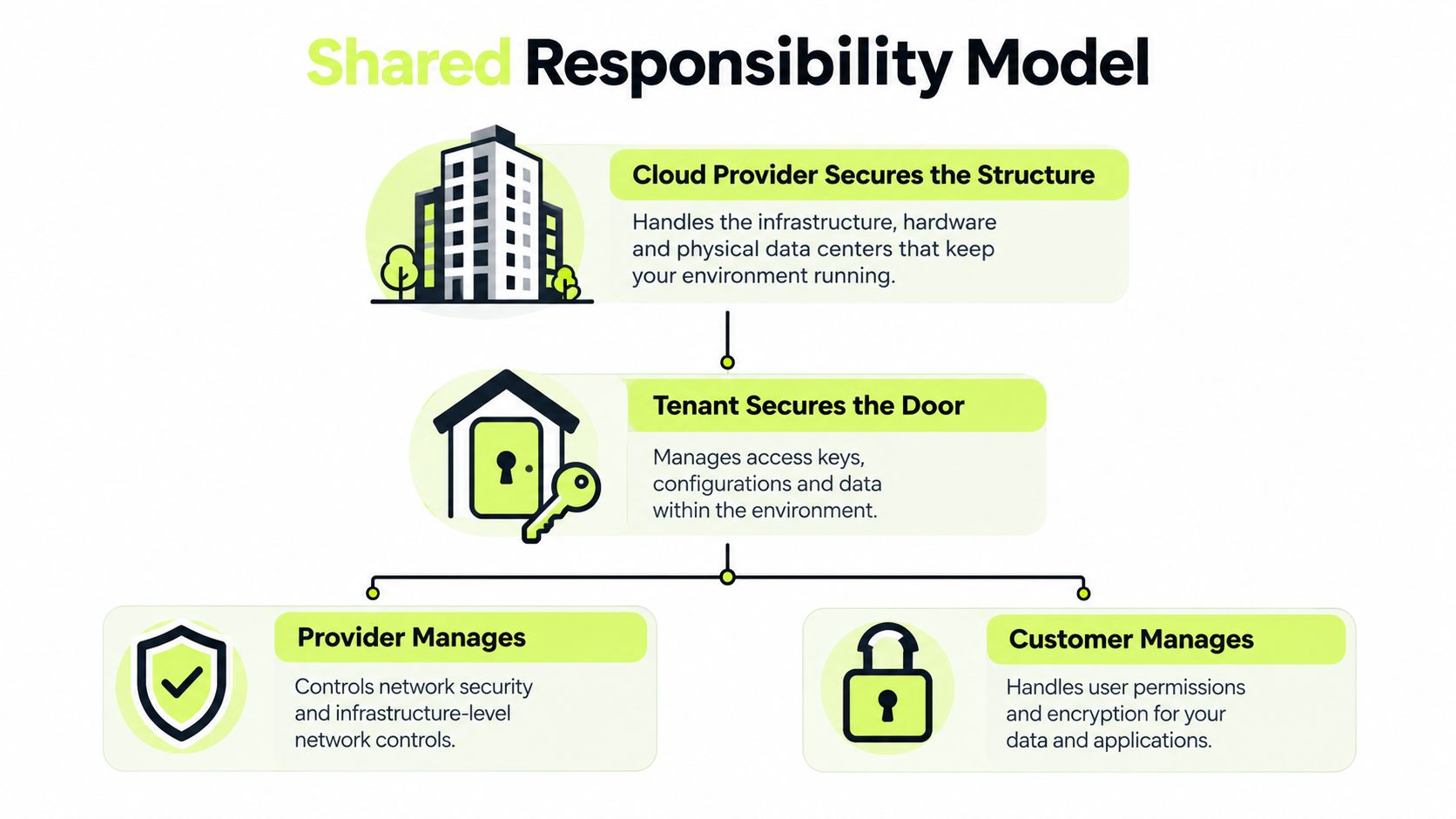
In cloud terms, the provider generally maintains physical data centers, hardware, the hypervisor, and core network infrastructure. Depending on the service, the provider may also manage parts of the host operating system, managed database platform, or application stack. That ownership doesn't transfer responsibility for what your organization places above those layers.
What the customer must secure
Your team owns the controls that determine who can enter, what they can do, and which data they can access. The exact boundary changes between infrastructure as a service, platform as a service, and software as a service, but the customer's core duties remain consistent:
- Identity and access management: Create named identities, enforce strong authentication, remove dormant accounts, and restrict privilege.
- Configuration: Set storage, network, logging, sharing, and security policies correctly.
- Data protection: Classify data, control access, encrypt appropriate information, and manage retention.
- Application logic: Secure code, APIs, dependencies, tokens, and business workflows.
- User behavior: Train people to reject suspicious requests, report exposed secrets, and validate external sharing.
SaaS creates the most common misunderstanding. The vendor secures the service infrastructure, but your administrators still configure users, groups, integrations, data sharing, retention, and application permissions. A secure SaaS platform can still become an unsafe tenant through a careless configuration.
Create an ownership chart for every critical service. Name the accountable team, the control, the evidence it produces, and the escalation path when the control fails. If a questionnaire asks who secures a system, an answer such as “the provider” is incomplete unless it specifies which layer.
The Top Cloud Computing Security Concerns Ranked by Real-World Impact
A stolen Slack session can become a cloud incident within minutes. The attacker may never breach a firewall. A valid employee identity, OAuth grant, API key, or connected workflow can provide access to files, applications, and administrative actions across the organization.
A defensible priority order starts with identity, then configuration, data exposure, and connected trust. Verizon's 2025 breach findings show why credentials, vulnerabilities, and third parties deserve immediate attention. IBM's 2025 Cost of a Data Breach research reports a global average breach cost of $4.44 million, an average of $5.05 million for breaches involving multiple environments, and an average breach lifecycle of 241 days.
1. Identity compromise
Credential abuse ranks first because cloud APIs treat valid identities as legitimate actors. A stolen administrator session, OAuth grant, API key, or workload credential can open several services without bypassing a traditional network perimeter. In Slack-first organizations, a compromised user account may also expose shared links, approval messages, and integration access that lead directly to cloud resources.
2. Misconfiguration and vulnerability exposure
A public storage policy, permissive security group, exposed database, or unpatched internet-facing system can provide a direct route to data. Verizon reported that vulnerability exploitation increased by 34% compared with the previous reporting period. IBM's 2025 research also identifies excessive privileges, public storage, exposed credentials, and inconsistent hybrid or multicloud controls as recurring weaknesses.
3. Data exposure
Data exposure follows from excessive reachability. Sensitive files may be accessible to a compromised employee, a broadly authorized service, a misconfigured SaaS connector, or an unauthenticated endpoint. Encryption protects data in specific conditions, but it does not correct authorization errors or uncontrolled sharing. Review who can retrieve, forward, export, and connect each sensitive dataset.
4. Supply chain compromise
Vendors and integrations expand the effective attack surface. A connected supplier can introduce malicious code, weak authentication, poor logging, or excessive data access. Third-party involvement reached 30% in Verizon's 2025 analysis, making supplier governance a security control rather than a procurement formality. Require named owners, limited scopes, reviewable logs, and a tested removal process for every integration.
5. Unclear ownership and insecure interfaces
APIs, automation workflows, and cloud control planes change quickly, while ownership often remains ambiguous. Teams may know that an interface exists without knowing who reviews its authorization, token scope, logs, and retirement status. This concern worsens every other category because an unattended interface can preserve access after a project, employee, or supplier relationship ends.
| Concern | Evidence or priority signal | Recommended measurement |
|---|---|---|
| Credential abuse | Reported share of breaches | Monitor account takeover, token misuse, and suspicious consent |
| Vulnerability exploitation | Increased from the previous reporting period | Track exposure age, remediation time, and internet-facing assets |
| Third-party involvement | Reported share of breaches | Track supplier access, scope, logging, and removal time |
| Misconfiguration | No separate figure established here | Measure public exposure and configuration drift |
| Data exposure and insecure interfaces | Impact varies by scope and environment | Track sensitive-data reachability and unused interfaces |
The table supports prioritization without assigning one cost or detection period to every concern. Measure your own time to detect, contain, and remove access. That evidence is more useful than repeating a general breach lifecycle across unrelated risks.
Identity and Access Failures That Open the Door to Attackers
Identity is the control plane attackers target first because cloud services trust identities to make decisions. Verizon found that credential abuse accounted for 22% of breaches in its 2025 report. The practical lesson is simple: a valid login can represent an account takeover, not a safe session.
Human identities need friction at the right moments
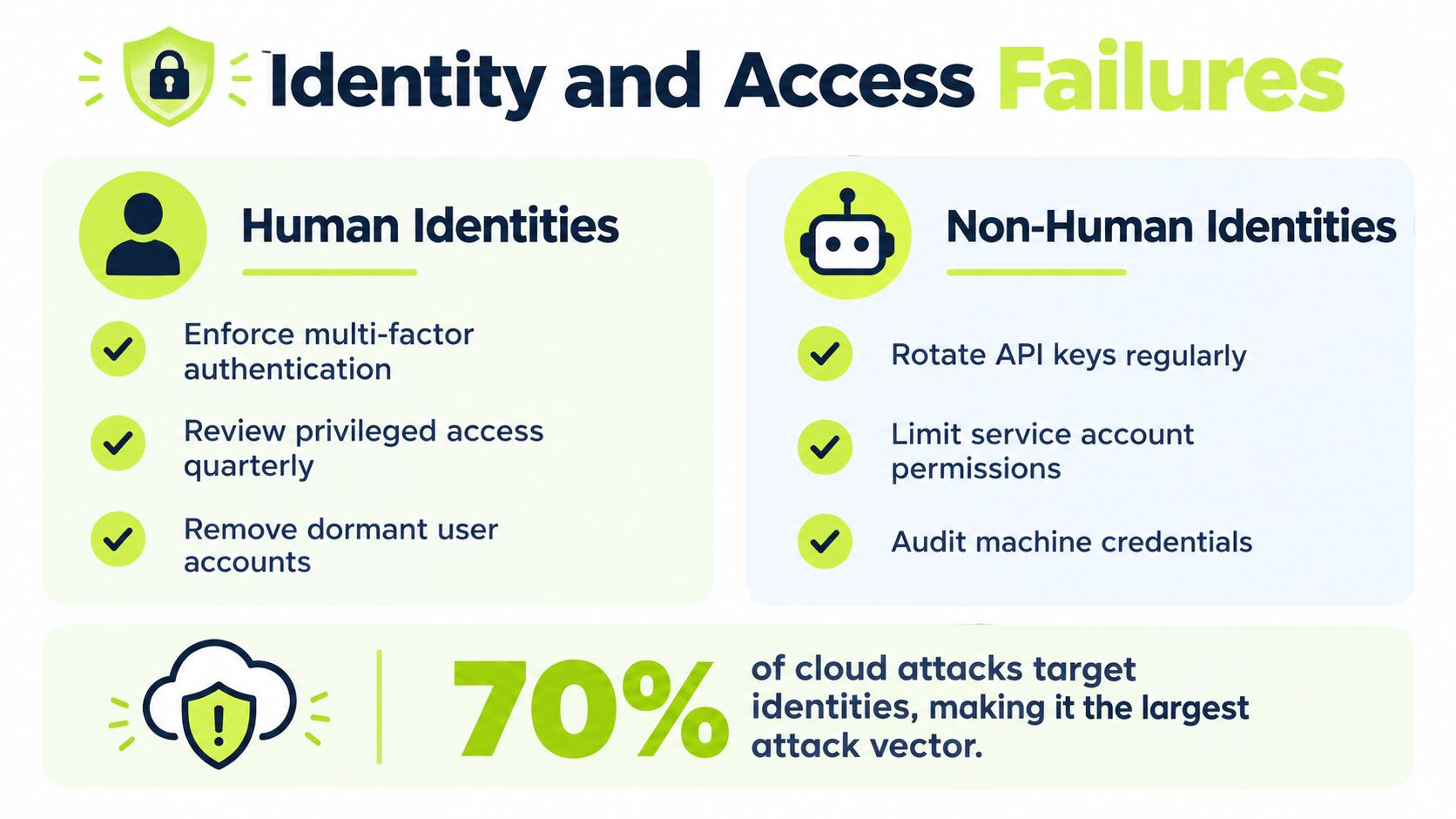
Users need phishing-resistant multifactor authentication, especially for administrators and people who approve integrations. Security teams should require named accounts, remove shared credentials, separate administrative and daily-use identities, and grant privileged access only for a defined task.
Use just-in-time elevation instead of standing administrator access. Review privileged permissions regularly, remove dormant accounts, and alert on unusual consent grants, token use, impossible access patterns, and privilege changes. Least privilege should be applied to each resource, not treated as a broad group membership exercise. Your team can use this least privilege access guidance to turn the principle into an operational control.
Non-human identities need accountable owners
Service accounts, API keys, bots, automation workflows, and AI agents create a different risk. A machine doesn't respond to awareness training, and it won't tell you that its permission is no longer needed. A 2025 cloud-security analysis found that non-human identities outnumber human identities by an average of 50 to 1. That ratio is documented in the 2025 State of Cloud Security Report.
Every machine identity needs an owner, purpose, resource scope, expiration or review date, and emergency revocation process. Use short-lived workload credentials, constrain token lifetime and audience, rotate secrets automatically, and keep runtime identities separate from administrative identities. Developers and administrators should record authorization decisions and centralize control-plane, data-access, and identity-change logs.
Security teams, developers, and end users have distinct obligations:
- Security teams: Set identity standards, monitor anomalous API activity, and verify access reviews.
- Developers: Eliminate embedded secrets, document service-account ownership, and request only necessary scopes.
- End users: Reject unexpected consent prompts, report credential requests, and validate sharing changes.
The difference between a mature program and a checklist is evidence. Show who approved access, which resources the identity can reach, when the permission was last reviewed, and how quickly the organization can revoke it.
Misconfiguration Errors That Quietly Expose Cloud Data
A cloud resource can look protected while remaining reachable. Encryption and detailed logging do not compensate for a public storage policy. An overly broad security group can expose an internal database beyond its intended boundary.
Google Cloud data in the 2025 Thales Cloud Security Study identified weak or absent credentials as 47.1% of observed initial-access incidents in the first half of 2025, with misconfigurations at 29.4%. The lesson is direct: identity and configuration controls must be tested together.
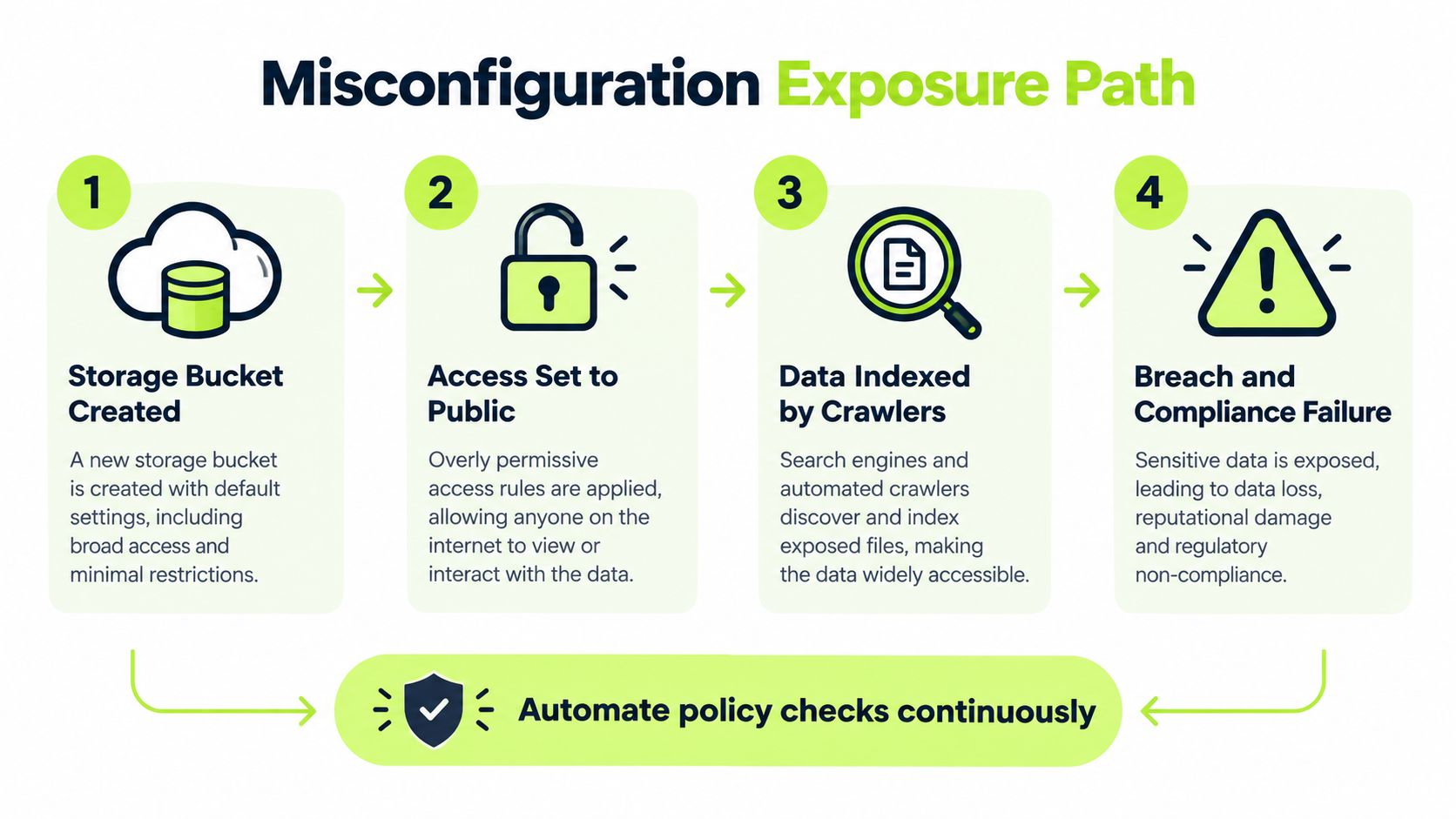
Separate accounts, rushed releases, copied templates, and provider defaults create drift across distributed teams. A setting that is safe in one environment can be permissive in another. Annual audits also miss temporary exposure, especially when a later deployment changes the resource before review.
Build detection and prevention into deployment and daily collaboration workflows:
- Policy scanning: Flag public storage, unrestricted network access, exposed databases, and excessive permissions.
- Infrastructure-as-code guardrails: Block unsafe changes before deployment and require documented review for exceptions.
- Drift monitoring: Compare live resources with approved configuration, then alert when a person or automation changes the state.
- Change evidence: Connect each material change to an owner, ticket, approval, and rollback plan.
Start network access with default-deny rules. Confirm that logs capture the control-plane change, the human or workload identity responsible, and any data access that follows. A scanner identifies the open door. Centralized evidence shows whether an attacker, integration, or employee used it, including through the collaboration tools where cloud work is coordinated.
Building Zero-Trust Controls That Actually Work in Cloud Environments
Attackers rarely need to defeat an entire cloud perimeter. A stolen Slack-linked session, service token, or overprivileged integration can provide the access they need. Zero trust is an authorization discipline that verifies the user, service, device, request context, and resource before granting access, rather than a product purchase or network diagram.
NIST's cloud-native zero-trust guidance recommends identity-tier and network-tier policies across hybrid and multicloud systems. A request does not become trustworthy because it originates inside a corporate network or cloud segment. The same rule applies to collaboration tools, where human approvals and machine integrations can alter cloud access.
Start by mapping every employee, workload, device, API, and SaaS integration to a governed identity. Apply least privilege at the resource level, evaluate context continuously, and deny access until policy conditions are satisfied. Use mutual TLS or an equivalent workload-authentication method for service-to-service communication where appropriate.
Short-lived tokens should be restricted by lifetime and audience. Separate administrative identities from runtime identities. Centralize authorization logs, including denied requests, so investigators can see why access was allowed, which policy evaluated it, and which identity supplied the credential.
Use this control sequence:
- Inventory identities and trust paths: Include employees, service accounts, APIs, integrations, devices, and automation.
- Remove standing privilege: Replace permanent administrative access with time-bound elevation.
- Protect workloads: Use short-lived credentials and workload authentication.
- Centralize decisions and evidence: Record policy evaluations, identity changes, and data access.
- Test denial: Confirm that an unknown device, unexpected workload, or wrong token audience is rejected.
Organizations using a perimeter model should close their largest identity and logging gaps first, then apply consistent policy across cloud accounts and SaaS services. Practical guidance on adopting zero trust security can help assign technical controls to business owners. For access decisions in cloud-connected work, zero-trust network access guidance provides an operational reference.
Why Human Error Is a Behavior Problem in the Tools Where Cloud Risk Lives
A rushed employee approves an OAuth request in Slack. A developer pastes a secret into a shared channel. An administrator accepts an integration without checking its scope. Each action can change cloud exposure, even when the person knows the policy.
Annual training arrives months before these decisions, often in a different system. Google Cloud findings summarized in Thales research rank human error among reported cloud-attack concerns and identify it as the leading reported cause of breaches. The gap is behavioral: people choose unsafe paths when secure choices are slow, unclear, or detached from daily work.
Short reinforcement, delivered when behavior changes cloud risk, outperforms another long module.
Put the intervention beside the action
Attach guidance to the workflow where the decision occurs. A suspicious Slack message should prompt advice about links, credentials, and consent requests. A developer sharing a secret needs immediate coaching and a clear reporting route. An administrator approving an integration should see reminders to inspect requested scopes, data access, and ownership.
Effective reinforcement has three properties:
- Short: A focused lesson or question fits the workflow.
- Role-aware: Developers, administrators, finance users, and executives receive scenarios tied to their decisions.
- Measurable: Teams assess comprehension, reporting behavior, and follow-up actions, rather than completion alone.
Vigil Security serves Slack-first organizations with short interactive lessons, recurring refreshers, phishing coaching, workflow-triggered assignments, and evidence synchronization with Vanta and Drata. Its value depends on connecting those interventions to real identity, permission, and data events. Controls should make the safe action clear before a human or machine identity grants access.
Supply Chain, Data Protection, and Your Next 90 Days of Action
Third-party access deserves the same scrutiny as employee access. Review every vendor, SaaS integration, OAuth grant, service provider, and contractor connection for ownership, scope, logging, retention, and revocation. Require software bills of materials where they fit the supplier relationship, maintain continuous vendor risk reviews, and contract for the logs needed to investigate an incident.
Data protection also needs an owner across its lifecycle. Identify sensitive data, restrict external sharing, protect access keys, verify retention rules, and confirm where the provider stores and processes information. Don't accept a compliance statement as proof that your tenant configuration is safe.
A practical 90-day sequence
Days 1 through 30
- Inventory human and non-human identities.
- Remove dormant accounts and unused credentials.
- Identify public storage, exposed databases, and permissive network rules.
- Assign owners to critical SaaS integrations and service accounts.
- Centralize identity, configuration, and data-access evidence.
Days 31 through 60
- Enforce phishing-resistant MFA for privileged users.
- Replace standing privilege with time-bound elevation.
- Add infrastructure-as-code policy checks and drift alerts.
- Review OAuth scopes, vendor access, and third-party logging commitments.
- Run role-specific microlearning and targeted phishing coaching in collaboration tools.
Days 61 through 90
- Test emergency credential revocation and vendor-access removal.
- Validate token lifetime, audience restrictions, and workload authentication.
- Test denial decisions for unknown devices and unauthorized services.
- Map controls to customer questionnaires and GRC evidence.
- Review archiving and compliance practices so retention and audit records remain usable during an investigation.
The executive message is straightforward. Reduce standing access, prevent unsafe configurations before deployment, monitor what changes, and make secure behavior part of daily work. Your auditors and customers need more than policy documents. They need evidence that controls are active, owned, tested, and improved.
Vigil Security helps cloud-first teams deliver security awareness and compliance training directly inside Slack through short lessons, recurring reinforcement, phishing coaching, and audit-ready evidence. Visit Vigil Security to see how it can connect everyday collaboration behavior with your cloud security and compliance program.