An auditor asks for training records, policy acknowledgments, and phishing results, and the fastest answer usually isn't “search the archive.” Archiving and compliance means keeping records retrievable, authentic, and governable so the organization can prove it met retention, e-discovery, and audit obligations.
The request lands during an ordinary compliance review. The security team knows the training happened. Human Resources has completion exports, the learning platform has assessment results, and Slack contains policy reminders and phishing responses. Yet the evidence is scattered across systems, some records lack timestamps or ownership, and nobody can confidently explain whether an export is complete, unchanged, or governed by an approved retention rule.
That distinction matters. An archive isn't a warehouse for old files. It's an evidence-management system that preserves content, context, access history, and lifecycle decisions. NARA's history makes the scale problem clear: it began handling early computer records in 1965, received its first electronic-records transfer from a federal agency in 1969, and recorded approximately 6,000 data files arriving between 1970 and 1988. Around 1989, improved systems more than doubled the managed volume to slightly over 14,000 data files, and by 1995 the volume exceeded 200,000 data files. NARA's electronic records history shows why obligations persist while formats, systems, and evidence volumes change.
When an Auditor Asks for Proof
The auditor doesn't ask whether your organization owns a training platform. They ask for the records supporting a control: who was assigned security training, who completed it, how comprehension was assessed, which policy version employees acknowledged, and what happened after a simulated phishing message.
A security lead may find the completion record in one system, the policy acknowledgment in another, and the phishing result in a spreadsheet assembled after the fact. The files exist, but the surrounding facts are missing. A reviewer can't tell whether the list covers the relevant population, whether a completion timestamp reflects the original event, or whether someone altered the export before delivery.

Storage isn't evidence
A backup may help restore a system. It doesn't automatically prove what happened inside that system. Compliance archiving must preserve the record's identity, origin, timestamp, context, and handling history, then make that evidence available to authorized reviewers without depending on someone's memory or a retired application.
The same principle applies to audit logs. A useful log connects an actor to an event and an outcome, rather than recording an unexplained technical message. Teams that need a practical starting point can review building audit logs with Vision for guidance on designing event records that support investigation and accountability.
Practical rule: If a reviewer needs a meeting with three system owners to interpret one export, the archive isn't audit-ready.
The operational target is simple to state and difficult to fake: retrieve the right records, in context, with a defensible explanation of how they were created, protected, accessed, retained, and disposed of. That is the difference between accumulating evidence and managing it.
The Three Pillars of Compliance Archiving
Compliance archiving rests on retention, e-discovery, and audit evidence. They overlap, but each answers a different question.
Retention answers how long
A retention schedule assigns a record class to an approved lifecycle. Training assignments, completion results, policy acknowledgments, assessment attempts, and administrator changes may have different business purposes and therefore different retention treatment. A schedule also needs an owner, an effective date, a review process, and a disposition action.
Retention isn't a license to keep everything forever. It tells the organization why a record exists, how long that reason remains valid, and what must happen when the period ends.
E-discovery answers where and how
During an investigation or legal request, teams must locate relevant records across email, messaging, files, SaaS logs, and other systems. Searchability alone isn't enough. The organization needs a way to preserve relevant data, apply a hold, narrow the collection, and produce a comprehensible set without altering the underlying evidence.
Distributed work makes this harder because a single event may span a Slack thread, a direct message, a policy document, and an identity record. If those items can't be connected through identifiers, timestamps, or source information, reviewers receive fragments rather than a reliable account.
Audit evidence answers what happened
Audit evidence must show who did what, when, under which control, and with what result. A completion file without the assigned obligation doesn't prove that the right person received the requirement. A policy acknowledgment without the policy version doesn't establish what the employee accepted. A phishing result without the campaign identity or response outcome leaves the control difficult to evaluate.
ISO 15489 describes records-management responsibilities across records, metadata, policies, ownership, monitoring, training, controls, and lifecycle processes. Its scope covers records regardless of structure or form, and the ISO 15489-1:2016 overview makes clear that the framework provides concepts and principles rather than a simple certification checklist. Organizations still need operating controls that turn those principles into repeatable evidence.
These pillars fail together when ownership is unclear. A retention rule without retrieval creates inaccessible data. Retrieval without integrity creates questionable evidence. Evidence without disposition creates uncontrolled accumulation. A practical risk-and-control view is also useful in risk and compliance management, where teams can connect obligations to accountable processes instead of maintaining isolated checklists.
What Makes an Archive Defensible
A defensible archive preserves more than the visible content of a record. It preserves the facts that allow another person to understand what the record is, where it came from, and whether it remained reliable.
ISO 15489 treats digital records as inseparable from their metadata. That metadata carries the record's content, structure, business context, relationships, identifiers, and lifecycle events. It must also be protected against loss or unauthorized deletion and handled under the same approved disposition rules as the associated record. The ISO 15489-1:2016 text supports a practical test: if the content survives but its context doesn't, the organization may still be unable to prove reliability.
Start with provenance
For a training completion, useful evidence can include a record identifier, learner identity, creator or source system, assignment timestamp, completion timestamp, assessment outcome, version, access history, retention category, and disposition status. The exact fields depend on the record class, but the logic is consistent. A reviewer needs enough information to reconstruct the event and distinguish an original record from a later report.
A CSV export can be accurate and still be weak evidence if it doesn't preserve source identifiers, version history, or the relationship between assignment and completion. Screenshots are even more limited. They show a view, not necessarily the underlying event, its scope, or its change history.
An intact file without trustworthy context is a document. A record with protected provenance can serve as evidence.
Protect the lifecycle
Immutability matters because evidence must resist silent alteration. That doesn't mean every archive must use one particular storage technology. It means the organization should be able to demonstrate how records are protected, who can access them, how access is logged, and how changes or attempted deletions are handled.
Retention schedules should map to record classes, not broad repositories. Before routine deletion, the owner must check for legal holds, regulatory obligations, investigations, and other exceptions. A legal hold overrides ordinary disposal, but it shouldn't become a permanent excuse to preserve unrelated personal data.
Test the chain of custody
A chain of custody is a documented account of collection, transfer, access, export, and disposition. It helps answer questions that auditors and investigators often ask indirectly: Did the evidence come from the system claimed? Was it complete? Who handled it? Can the organization explain any transformation between the source and the produced package?
The archive should preserve this context as part of the record-management process. Metadata isn't administrative decoration. It is the mechanism that connects operational events to defensible conclusions.
Building an Audit-Ready Archiving Workflow
A reliable workflow moves records through deliberate states. It doesn't begin with a storage purchase and end with an export button.
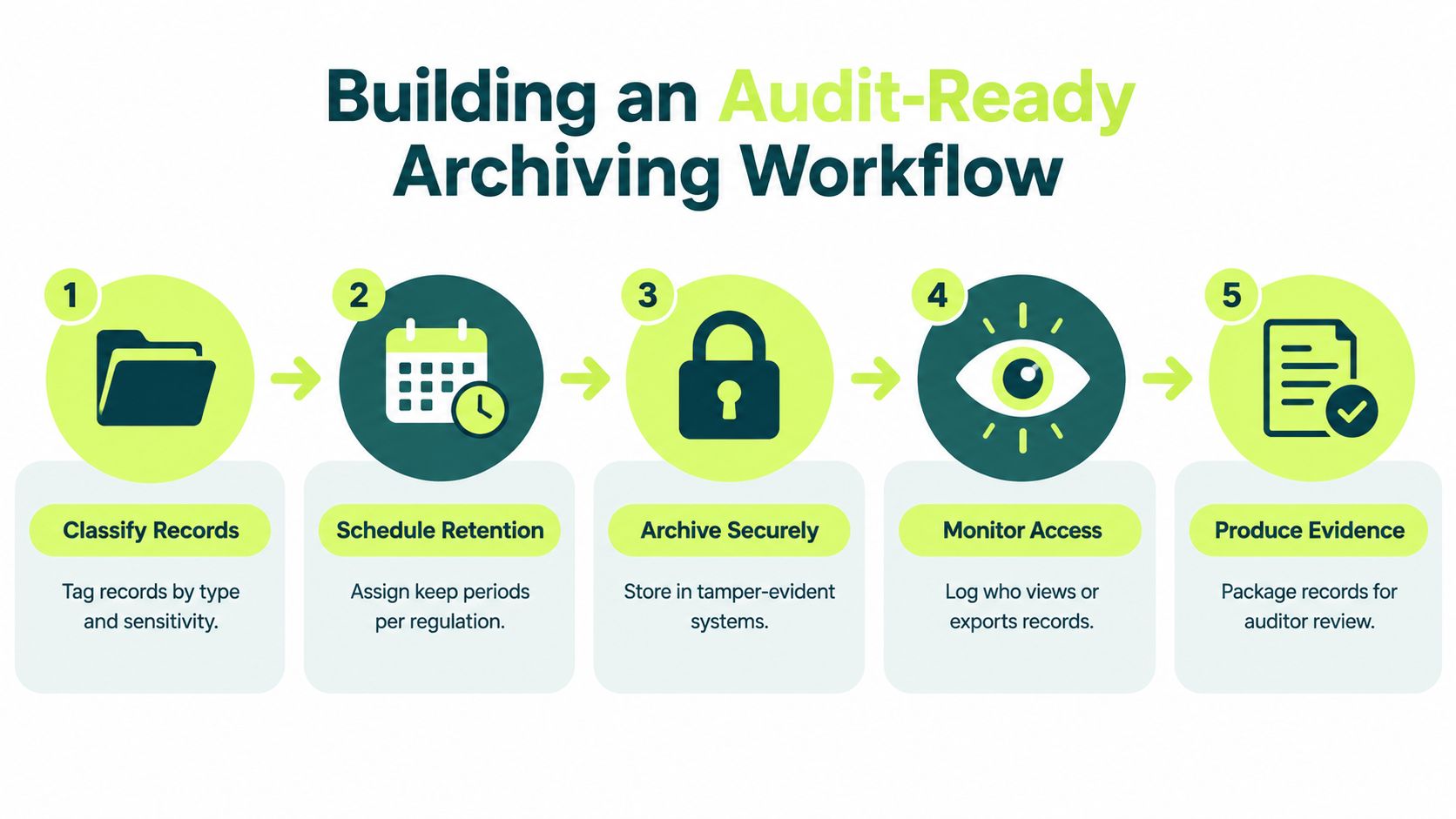
1. Classify the record
Start with the business activity, not the file extension. Create record classes for training assignments, completions, assessment results, policy acknowledgments, phishing responses, administrator changes, and evidence synchronization. Mark sensitivity and identify the system of record.
Classification prevents two common mistakes. Teams often retain irrelevant data because they can't distinguish evidence from operational noise, or they delete meaningful context because a useful record looks like an ordinary message.
2. Schedule retention
Assign each class an approved retention rule, owner, jurisdiction, and disposition action. Document exceptions for legal holds and investigations. The schedule should state what happens at the end of the period, including review, transfer, or controlled deletion.
3. Archive securely
Keep frequently queried evidence in the primary system when that system provides suitable controls. Move older records to protected archival storage when operational systems are not designed for long-term access. In both tiers, preserve integrity metadata, restrict access, and separate administrative permissions from ordinary viewing rights.
4. Monitor access and retrieval
NIST places audit-trail retention within documented system-management decisions. Administrators and security personnel should determine how long audit data remains in active systems or archive files. NIST guidance on audit trails supports an operational model with defined ownership, access restrictions, export procedures, controlled disposal, and periodic retrieval tests.
Don't wait for an audit to discover that an old record can't be opened. Test searches using realistic requests, confirm that authorized reviewers can access the result, and verify that exported packages preserve the required metadata.
5. Produce evidence
Build an evidence package that explains scope, source, time period, control, record count or population definition, exceptions, and access history. The package should allow a reviewer to understand the evidence without reconstructing the organization's systems.
Manual screenshots and one-off spreadsheets can help during an emergency, but they shouldn't be the normal control. A repeatable workflow produces consistent records and makes gaps visible before an examination.
Choosing Archiving Tools for Distributed Teams
Distributed teams rarely work in one evidence system. Slack conversations, email, SaaS platforms, shared documents, identity services, and employee-owned devices each hold part of the operational story. The right architecture depends on whether the organization prioritizes rapid deployment, rich context, independent preservation, or low administrative overhead.
| Approach | Implementation Speed | Metadata Richness | Audit Export Readiness | Administrative Overhead |
|---|---|---|---|---|
| Platform-native archiving | Fast when the platform is already deployed | Strong inside that platform, limited across systems | Usually good for native records, with platform dependencies | Lower initially, higher when teams and systems change |
| Integration-based archiving | Moderate, depending on connectors and mappings | Can combine sources, but quality depends on synchronization | Strong when exports preserve source and control context | Moderate, with ongoing connector and mapping maintenance |
| Dedicated records system | Slower because classification and migration require planning | Broad and structured across record classes | Strong when search, holds, metadata, and chain of custody are built in | Higher governance and administration |
| Manual exports and spreadsheets | Fast for isolated requests | Usually weak and inconsistent | Fragile, especially when scope and provenance aren't documented | High over time because every request becomes a project |
Match the tool to the risk
Platform-native controls can be sensible when evidence stays within one service and the retention model is straightforward. They become less comfortable when a business needs to correlate a Slack message with a policy version, identity event, or training outcome.
Integrations reduce that fragmentation, but synchronization itself becomes a control. The archive should record when evidence arrived, whether the transfer succeeded, what source produced it, and how failures are handled. A dedicated records system offers stronger separation from operational platforms, though it demands better classification and ownership.
Password fatigue and context switching also affect compliance behavior. If employees must leave Slack, create another account, and remember another workflow for every assignment, completion evidence may become less reliable. For teams evaluating broader operational options, compliance management solutions can help frame the choice around control mapping, evidence production, and administrative workload rather than feature count alone.
Choose the smallest architecture that preserves the required context and remains defensible when a source system changes. Cheap storage isn't cheap if retrieval requires a reconstruction project.
Retention versus Deletion Decisions
“Keep everything” sounds cautious until a privacy request, breach, or legal review exposes the consequences. Over-retention can expand the amount of personal data at risk, increase discovery scope, and conflict with data-minimization or deletion duties.

The difficult cases involve competing obligations. A legal hold may require preservation while a privacy process calls for deletion. A regulatory schedule may require a record to remain available, while redundant copies in chat history or an employee-owned device no longer serve a legitimate purpose.
Use an exception-based decision
For each data set, ask five questions:
- What is the record class and business purpose?
- Which jurisdictional, contractual, regulatory, or legal requirement applies?
- Is a hold or investigation active, and who approved it?
- What is the minimum evidence needed to prove the relevant event?
- When will the decision be reviewed, and how will deletion be verified?
This approach separates immutable evidence from redundant personal data. Preserve the completion event, assessment result, and policy version when they support an obligation. Don't automatically preserve every duplicate notification, unrelated conversation, or local download.
Organizations also need a deletion record. It should identify what was deleted, why, when, under which rule, and who authorized the action. That record proves the organization followed a governed process rather than losing data accidentally.
A practical checklist for AgentStack compliance steps can help teams document retention decisions, but no checklist resolves conflicts by itself. Legal, privacy, compliance, and security owners must agree on the exception and its review point.
The following explainer is useful for teams translating policy into operational handling:
A defensible program can say both “we preserved this record because a hold applied” and “we deleted these redundant copies when the reason for retention ended.” That is stronger than indefinite accumulation.
Keeping Retention Rules Synchronized with Regulatory Change
A retention schedule becomes a liability when nobody knows which rule it reflects. Archiving and compliance should operate as a continuously changing control, with a visible path from regulatory change to approved policy, system configuration, employee behavior, and test evidence.
The change-management model needs several connected inventories:
- Record classes: Identify the evidence created by each business process.
- Jurisdiction mappings: Connect record classes to the countries, regulators, business lines, and systems involved.
- Policy versions: Record which rule was approved, when it took effect, and what changed.
- Exception workflows: Route holds, overrides, and deletion pauses to accountable owners.
- Repository coverage: Confirm that updated rules reached each relevant archive and source system.
The OFAC example shows why broad rules create operational mistakes. The U.S. Treasury's Office of Foreign Assets Control extended certain sanctions-record retention requirements from five to ten years, effective March 21, 2025. The change applies to specified sanctions records, including transactions, licenses, blocked-property reports, communications with OFAC, and related compliance documentation, not to every regulatory record. The compliance notice on the OFAC change illustrates why teams must map rules to record classes instead of applying one universal period.
Measure policy-to-evidence freshness
A useful freshness lens asks:
- Has the changed rule been identified and interpreted?
- Has an owner approved the new policy version?
- Has the archive or repository implemented it?
- Have affected employees and administrators received the change?
- Has a retrieval or control test produced evidence that the rule works?
Privacy obligations also require careful mapping of where personal data resides, how it moves, and when it should be archived or erased. Teams can use the LiveDocument GDPR overview as one input to that mapping, then validate the resulting controls against their own jurisdictions and legal advice.
The objective isn't merely a current document. It's evidence that the organization converted a rule change into working behavior.
Producing Evidence That Survives Scrutiny
A mature archive proves more than retention volume. It demonstrates that records remain searchable, tamper-resistant, access-controlled, contextual, and exportable when an auditor, investigator, or privacy reviewer asks for them.
Test that claim with realistic requests. Select a control, identify the expected population, retrieve the associated records, verify metadata and versions, review access history, and export the package through the normal process. Record failures and remediate them before external scrutiny.
Training evidence deserves the same discipline as technical logs. Assignments should connect to people and roles, completions should connect to assessment outcomes, and policy acknowledgments should identify the accepted version. For organizations aligning awareness programs to a control framework, PCI compliance security awareness training provides a useful example of how training records fit into broader compliance evidence.
The strongest programs don't celebrate the amount of data retained. They measure whether the organization can explain its decisions, retrieve evidence without reconstruction, protect metadata, honor holds, and delete information when its approved purpose ends. That is how archiving reduces risk across audits, investigations, and privacy reviews.
Vigil Security delivers short, interactive security awareness and compliance lessons inside Slack, with assignments, reminders, assessments, phishing exercises, progress reporting, and evidence synchronization with Vanta and Drata. Visit Vigil Security to see how Slack-native training can produce structured, audit-ready records without adding another employee portal.