Approximately 60% of confirmed breaches involved the human element, according to Verizon's 2025 Data Breach Investigations Report executive summary. The same summary reports that third-party involvement doubled from 15% to 30%, while credential abuse accounted for 22% of breaches, vulnerability exploitation for 20%, and phishing for 14%. Those findings call for more than another reminder to be careful.
A useful security training program prepares employees for the decisions within their control. For distributed teams, that means connecting lessons to permissions, business processes, and the requests people receive in Slack, rather than assigning different slides to different departments.
Why Role Based Security Awareness Training Matters
Finance, engineering, and an administrator finish the same annual module. The next morning, finance receives a vendor payment-change request, an engineer considers adding a dependency, and the administrator gets an urgent account-access request. They've completed identical training, but they need different judgment.
The human-element finding above doesn't mean employees caused every breach in that category. Nor does it mean training could have prevented them all. It does mean security leaders should examine the decisions people make alongside the systems, permissions, and processes surrounding those decisions.
Different access creates different responsibilities
A finance employee needs to recognize business email compromise and know how to verify changed payment instructions. An engineer needs to understand secret handling and dependency risk. An administrator needs to protect privileged access and recognize when an identity or access request requires escalation.
Consider what each person must do:
- Finance: Pause a suspicious payment change and use the approved verification process.
- Engineering: Check whether a proposed dependency or repository action introduces unacceptable exposure.
- Administration: Verify identity before changing access, even when the requester sounds authoritative.
These aren't interchangeable demonstrations of competence. Recognizing a suspicious email doesn't establish that someone can safely review a privileged-access request.
Practical rule: Train people for the consequential decision they can make, not merely the threat name they can recognize.
Awareness belongs beside technical controls
Training shouldn't substitute for access restrictions, secure configuration, or authentication controls. It should explain how employees use those controls, when they must stop a workflow, and where they should report uncertainty.
For example, payment verification is incomplete if the employee knows the warning signs but can't find the approved contact. Privileged-access training is incomplete if administrators understand least privilege but routinely face undocumented exceptions.
Treat role based security awareness training as a continuous control, with practice and feedback attached to relevant work. Keep annual completion records where they're needed, but don't confuse that administrative milestone with evidence that employees can make the next high-impact decision safely.
What Role Based Training Actually Changes
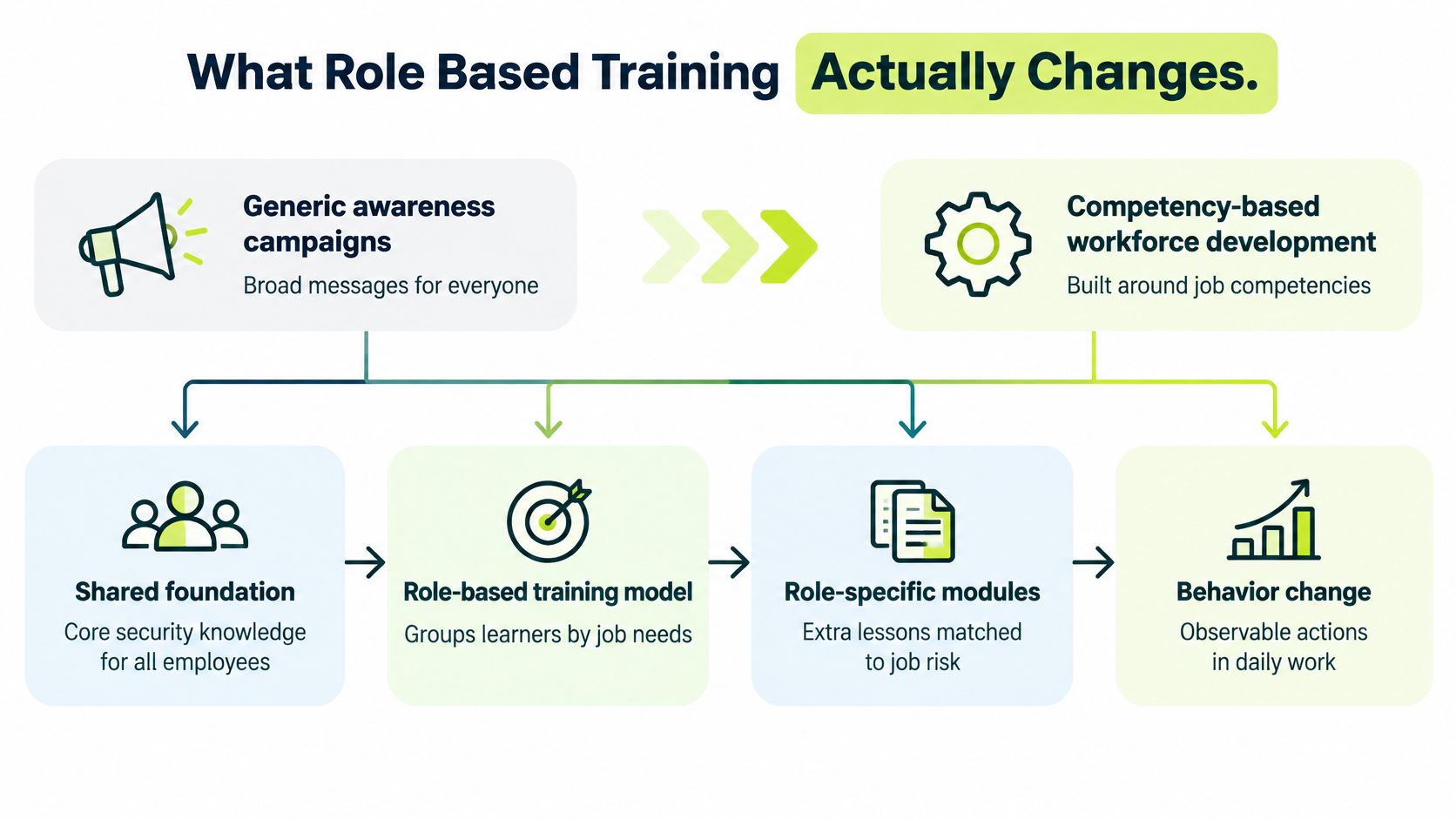
Role-based training maps assignments and evidence to responsibilities. Employees should learn the security knowledge and skills their work requires, then demonstrate those skills through relevant actions.
CISA formalized this approach in its Cybersecurity Workforce Training Guide, released in August 2021. Designed for federal, state, local, tribal, and territorial personnel, the guide provides more than 100 training resources and certification-preparation courses and directs learners to prioritize work roles, tasks, knowledge, skills, and abilities according to career stage and development path.
The practical shift is from broadcasting awareness messages to developing job-relevant competence.
Different keys require different demonstrations
Think of employees working in the same building with different keys. Everyone should understand basic safety and how to report a problem, but someone holding the server-room key needs additional instruction. Testing every person on every door would add work without establishing the right competence.
The same principle applies to digital access. Administrators, developers, finance staff, executives, and general employees shouldn't be scored against identical scenarios just because they share an employer.
A defensible model connects:
- Responsibility: What must this employee protect, approve, configure, or escalate?
- Competence: What must they understand and be able to do?
- Evidence: What action would demonstrate that ability?
Keep a common standard without identical assignments
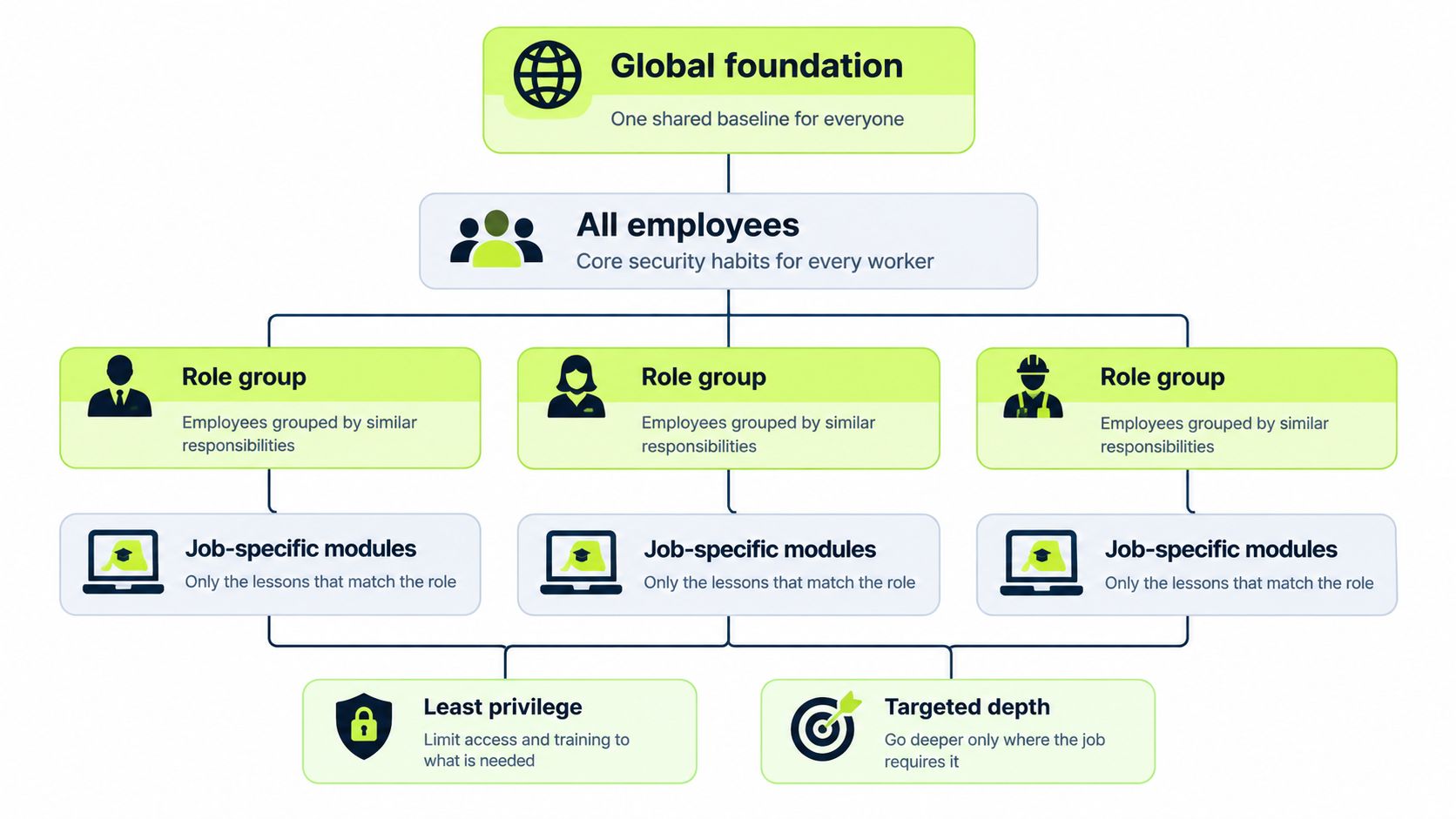
A shared foundation still matters. Employees need a common understanding of reporting, account protection, and safe handling of organizational information.
The difference is what happens beyond that baseline. A developer might demonstrate safe handling of a repository secret, while a finance employee demonstrates independent verification of changed payment instructions. Both follow the organization's security expectations, but their evidence reflects their responsibilities.
For distributed organizations, this structure also makes documentation clearer. Security and GRC teams can explain why someone received an assignment, which responsibility it addressed, and how the employee demonstrated understanding. Leadership gets a stronger answer than a list of names marked complete.
How to Segment Learners by Real Risk
Department labels are useful starting points, not finished training segments. A Finance path isn't meaningfully role-based if its scenarios don't resemble the payment decisions finance employees make.
Research summarized by San Diego State University identified employees' perception that cybersecurity materials were disconnected from their job functions as a core program failure. The practical implication is straightforward: relevance depends on the work, not the label.
Group by exposure before building more content
Start with a shared foundation, distinguish employees by privilege and data sensitivity, then identify their actual decision points. Ask team leads to walk through approving a vendor change, exporting customer information, resetting an account, or responding to an executive request.
For each workflow, capture the application, permission, incoming request, verification step, and escalation route. In a distributed cloud company, employees with the same title may use different tools and follow different Slack approval processes.
Role Segments by Decision and Evidence
| Role | Exposure | Training focus | Observable behavior |
|---|---|---|---|
| Finance staff | Payment changes and business email compromise | Verify changed payment instructions | Records verification through the approved route |
| Developers | Secrets, repositories, and dependencies | Handle secrets securely and evaluate dependency risk | Demonstrates the approved handling or review action |
| Help-desk personnel | Account-reset requests and social engineering | Verify identity before changing access | Follows verification and escalates exceptions |
| Privileged administrators | Powerful permissions and identity threats | Least privilege and access decisions | Documents access-review decisions |
| Employees handling customer exports | Sensitive information leaving an application | Verify authorization and destination | Uses the approved export and sharing process |
Treat these as starting examples to validate with workflow owners, not assumptions about every employee in a department.
Avoid a curriculum for every job title
Group employees together when they face the same consequential choice and use the same control. Separate them when permissions, data sensitivity, or the approved response materially differ.
A scenario is relevant when the employee can recognize the request, the tool, and the safe next action.
During onboarding, use Loresson's resource to help design phased learning for new hires, then align security assignments with employees' responsibilities. Someone shouldn't inherit every departmental lesson before they've gained the access that makes it necessary.
Validate the first segments with employees themselves. Ask whether the scenario could occur in their work and whether the proposed response is possible using their current tools.
Mapping a Curriculum to Each Role
Build a curriculum around decision, control, failure mode, and feedback. A lesson should ask the employee to choose an action, explain the control behind the safe choice, show what could go wrong, and provide corrective feedback.
This structure gives content owners something more useful than a topic list. Instead of assigning a module called data security, they can teach an employee how to handle a specific export request.
Keep the curriculum broad at the foundation and narrow where responsibilities require additional depth.
Write lessons around choices
Use the following mappings as curriculum design examples:
- Developers: Present a secret-handling or dependency decision. Explain the approved control and give feedback on why the proposed action would expose credentials or introduce dependency risk.
- Help-desk staff: Present an urgent account-reset request. Require the approved identity-verification procedure rather than accepting familiarity or urgency as evidence.
- Finance staff: Present changed payment instructions. Ask which verification route is acceptable before the change can proceed.
- Privileged administrators: Practice phishing-resistant authentication, least-privilege decisions, and escalation when a request falls outside normal authorization.
For employees handling personal information, connect personally identifiable information training to the actual collection, export, and sharing choices they're authorized to make. Avoid teaching abstract definitions without showing what the employee should do differently.
Split the scenario, not the whole catalog
How granular should role-based training be? Go deeper when the safe decision changes.
If employees with the same title use different applications but follow an equivalent approval control, a variation within the same lesson may be enough. If one group can export sensitive information and another cannot, their scenarios should reflect that distinction.
Have the workflow owner review the lesson before publishing. They should confirm that the request looks plausible, the approved response is accurate, and the employee can carry it out without inventing a workaround.
Give every specialized module an owner and a reason to exist. When the permission disappears or the workflow is retired, remove the assignment from affected employees. When the process changes, update the scenario and answer logic rather than adding another overlapping course.
Measuring Behavior Instead of Completion
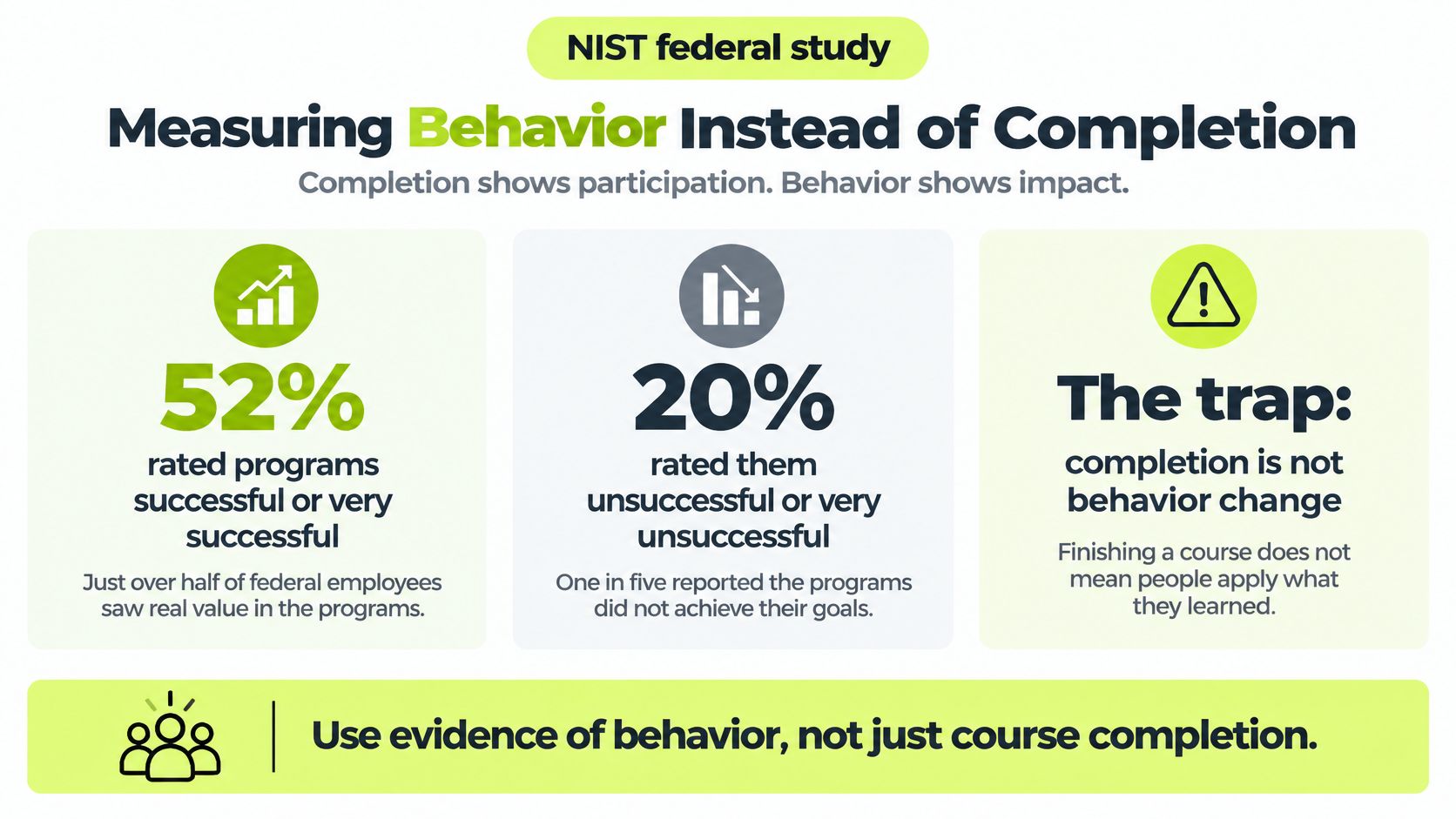
Completion measures exposure to training, not behavior change. NIST's federal role-based training study illustrates the gap: 52% of respondents rated their programs successful or very successful, while 20% rated them unsuccessful or very unsuccessful; 65% used completion rates, 47% assessed whether employees applied learning, and 34% used surveys, while roughly 40% found completion moderately or very challenging.
Keep completion on the dashboard because it identifies missing assignments. Put it beside evidence of application, not in place of it.
The distinction between finishing content and applying it should be visible in program reporting.
Build a dashboard around the target decision
For a broader evaluation framework, LearnStream's guide to measuring training effectiveness can help organize the review. For security, choose indicators tied to the behavior each lesson was designed to change:
- Understanding: Compare knowledge before and after instruction, using questions that test the decision rather than memorized wording.
- Application: Review scenario performance, secure configuration reviews, validated finance reports, and documented access-review decisions.
- Response: Track phishing reporting, time to report, and whether escalations contain enough context for investigation.
- Correction: Monitor remediation time and recurrence of the targeted error.
Use phishing simulation training to assess recognition, reporting, and recovery, not just whether someone clicked.
Connect learning evidence to operational evidence
IBM's 2025 breach analysis attributed 26% of breaches to human error, 23% to IT failure, and 51% to malicious or criminal attacks. Those categories support examining employee decisions alongside technical and process failures rather than treating training as an isolated activity.
Correlate learning results with reported phishing, blocked malicious actions, privileged-access exceptions, misdirected data events, and mean time to report. Segment the review by role and business unit so changes in exposure don't disappear inside an organization-wide average.
Measurement caution: Better reporting can produce more recorded events. Investigate what changed before interpreting a larger count as worse security.
Don't claim that improved quiz scores prove fewer breaches. Look for consistent evidence across realistic practice and operational behavior, and document changes to permissions or processes that may also explain the result.
Running Role Based Lessons Inside Slack
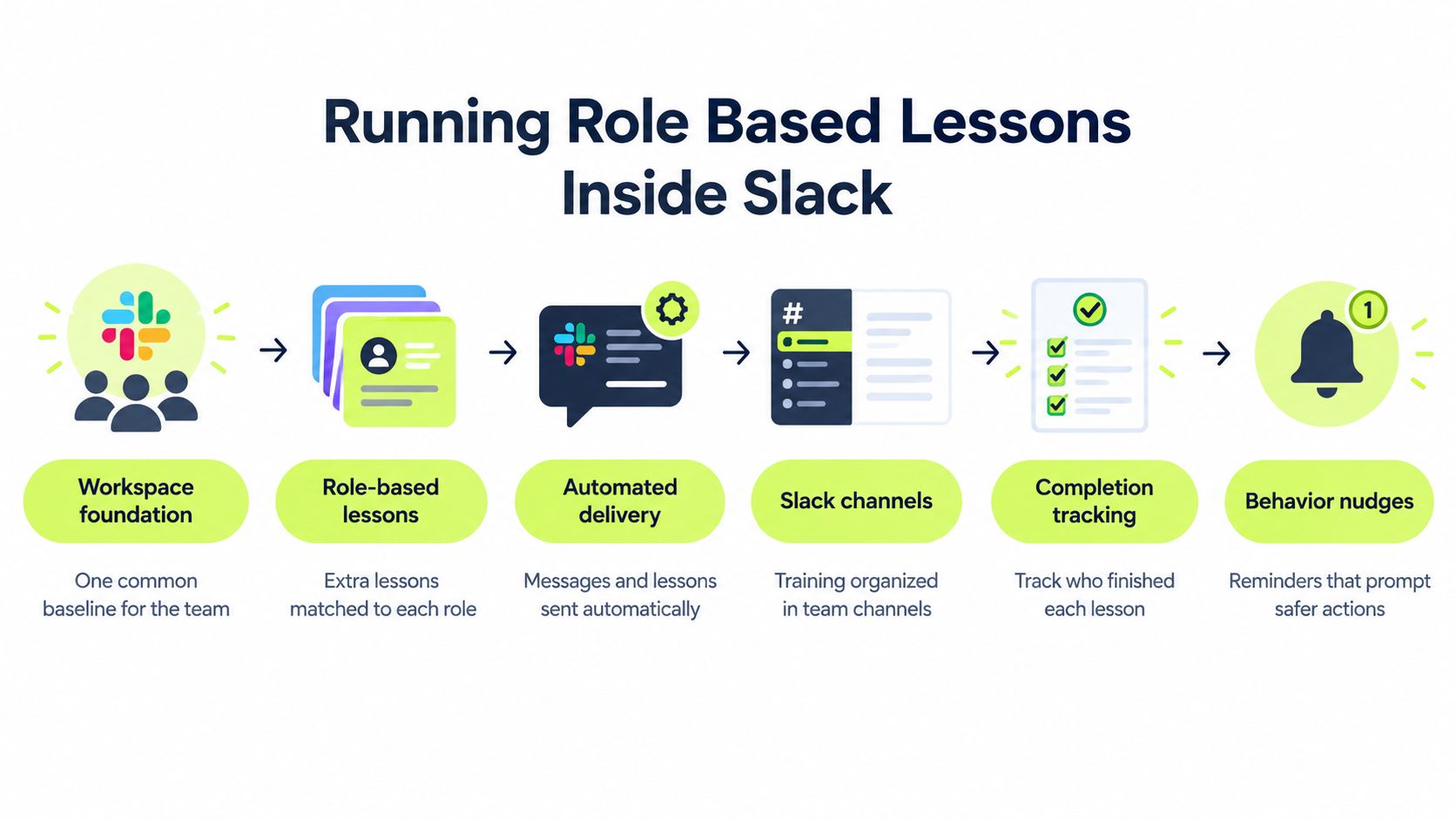
Consider a hypothetical distributed team delivering its program through Slack. The administrator assigns the foundation at workspace level, then sends targeted lessons to the relevant channel, team, or individual. Employees receive interactive questions and reminders in their normal workspace rather than navigating to a separate portal.
Delivery should follow a visible assignment and feedback loop.
Follow a miss through diagnosis and recovery
A finance employee encounters a simulated payment-change message and follows the unsafe path. Immediate Slack coaching explains which verification step was missed and points to the approved process.
The program owner doesn't automatically assign the entire foundation again. Instead, they review what happened and choose a proportionate response:
- Knowledge gap: Provide short coaching on the missed decision, followed by a realistic retest.
- Process gap: Ask whether the approved verification route was available and clear.
- Workload problem: Review whether normal expectations made the safe action impractical.
- Persistent pattern: Involve the manager or control owner when the same unsafe behavior continues after support.
A deceptive simulation can expose a poorly designed process as readily as a missing skill. Record the diagnosis so the next intervention addresses the cause, not just the score.
Automate delivery without automating blame
Use recurring refreshers, pulse checks, and policy nudges to reinforce the selected behavior. Workflow automation can trigger relevant training from real activity, but program owners should review the trigger and scope before enabling it.
For example, define the qualifying event, the matching lesson, the reminder behavior, and the evidence required to close the follow-up. Don't promise that every business application or Slack action can trigger training without validating the available integration.
This video provides additional context for Slack-based delivery.
Give administrators progress views covering completion, comprehension, overdue work, and certificates, with CSV export for review. Keep the assigned lesson, assessment result, coaching, and follow-up evidence connected so GRC owners can reconstruct what happened.
Protect employee-level results from unnecessary exposure in public channels. The useful output is an audit-friendly record of support and demonstrated improvement, not a public ranking of mistakes.
Choosing a Program and Starting This Quarter
A vendor demo tells you what the platform can do. A hands-on test tells you what your administrators will live with. Before comparing feature lists, ask a learner to finish one assignment and an administrator to retrieve the evidence for it. That exercise exposes completion friction, grading gaps, and audit-readiness faster than any sales deck.
Test the operating details
Evaluate each delivery model against the work it creates. An external annual portal fits a scheduled course. A spreadsheet-and-LMS process gives administrators direct control over assignments but adds manual tracking. Slack-native microlearning fits when employees already make the risky decisions inside Slack, since the lesson arrives where the behavior happens.
For a Slack-native option, check role-aware assignment by workspace, channel, team, or individual, plus recurring refreshers, pulse quizzes, and phishing campaigns with immediate coaching. Confirm scheduling, grading, reminders, certificates, and evidence synchronization with Vanta or Drata in your own environment, not the demo tenant. Review data handling and key ownership with your security team before treating personalization as a requirement.
Pricing pages reveal what a demo hides. Reading a vendor's published tiers, the same way you would compare LunaBloom AI subscriptions for a different software category, shows seat minimums, billing cadence, and included functionality before you commit to a sales call. When reviewing phishing simulation tools, weigh the coaching and reporting workflow more heavily than campaign creation alone.
Start with a bounded pilot
Keepnet's security awareness statistics summary reports that only 7.5% of organizations used adaptive training based on recurring awareness-test results, so a simple, well-scoped pilot already puts you ahead of most programs. Choose a small cohort tied to one high-impact workflow and an accountable business owner. Set the baseline behavior, agree on the follow-up evidence you expect to see, and watch whether delivery adds work for employees or administrators.
This quarter, list your highest-impact workflows, pick one pilot, and assign a foundation lesson plus a role-specific path in Slack. Review reporting quality and repeat-error evidence with the GRC owner before expanding. Vigil Security delivers Slack-native interactive lessons, role-aware assignments, recurring refreshers, and phishing campaigns with immediate coaching, so start a pilot there and judge it by the assignment records and behavioral evidence it produces.