You're three weeks from a PCI assessment. The learning management system says everyone completed security training, but the assessor asks a simple follow-up: which roles received which content, who failed the knowledge check, what remediation followed, and when did each person acknowledge the policy? Your completion dashboard can't answer. The audit problem isn't training volume. It's evidence quality.
PCI compliance security awareness training should operate like every other security control. It needs an owner, a defined scope, a repeatable cadence, measurable outcomes, and records that remain trustworthy months after the training event. PCI DSS Requirement 12.6 establishes annual security awareness training as a baseline, but a defensible program proves much more than attendance. It shows that personnel understood the risks relevant to their work and that the organization responded when behavior or threats changed.
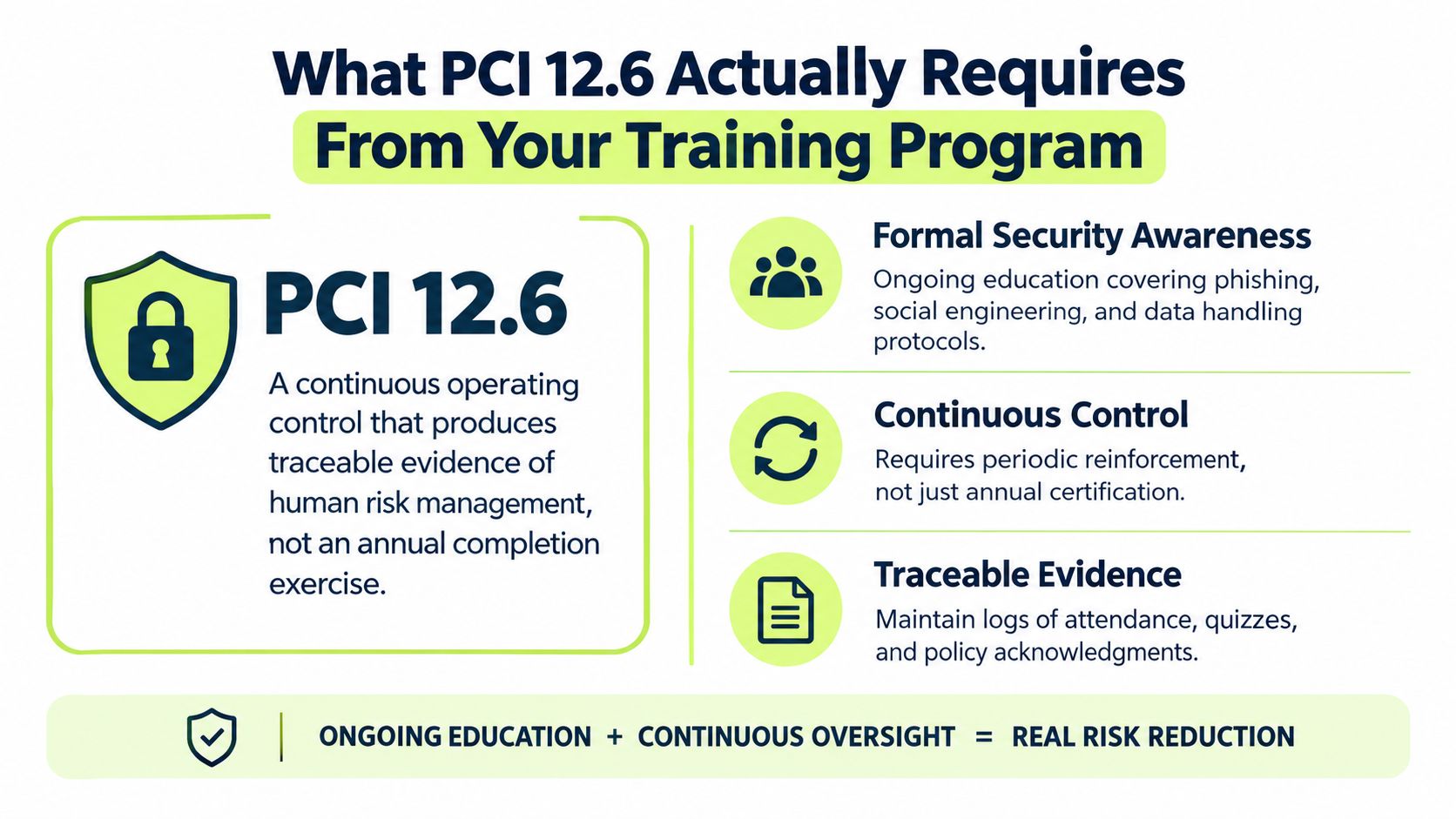
What PCI 12.6 Actually Requires From Your Training Program
PCI DSS Requirement 12.6 applies to organizations that store, process, or transmit payment card data. It requires a formal security awareness program, training when personnel are hired and at least once every 12 months, coverage of phishing, social engineering, and acceptable use, and an annual acknowledgment that personnel have read and understood the security policy. The program must also be reviewed at least every 12 months and updated when new threats or vulnerabilities affect the environment, as summarized in this PCI security awareness training requirements guide.
That makes 12.6 an operating control, not an annual video assignment. Requirement 12.6.1 concerns formal security policy, while 12.6.2 concerns user awareness of cardholder data and sensitive authentication data. Treat those as separate evidence questions. An assessor can ask whether the policy exists and is communicated, then separately ask whether employees understand what data they may encounter and how they must protect it. Your answer shouldn't depend on one generic course certificate.
Build evidence into the control
A defensible twelve-month cycle should produce these artifacts:
- Role-scoped curriculum maps: Show which modules apply to retail staff, support agents, developers, administrators, contractors, and executives.
- Completion records: Preserve user identity, assigned content, completion status, timestamps, and overdue history.
- Comprehension results: Retain question-level answers, scores, attempts, and the applicable passing rule.
- Phishing results: Record clicks, reports, submitted credentials if safely simulated, department, role, lure type, and follow-up coaching.
- Remediation records: Link failed assessments or simulations to assigned corrective training and retesting.
- Attendance attestations: Keep evidence for live sessions, including the session date, attendees, facilitator, and covered topics.
- Policy acknowledgment registers: Capture each person's acknowledgment in a system that records identity and date.
An empty LMS percentage is weak evidence. Assessors want to know whether the assigned content matched the employee's exposure, whether low performers received remediation, and whether policy changes triggered a new communication or refresher. A useful security awareness training framework should therefore connect assignment, learning, testing, remediation, and acknowledgment in one traceable record.
The practical sequence is straightforward. Define the cardholder data environment and sensitive authentication data, map risks to roles, assign training, test understanding, remediate weak results, and review the program on schedule. If your system can't answer those questions through a user, role, date, or topic query, it won't become more defensible just because you export more spreadsheets.
Required Topics and Role-Aware Content Coverage
Generic awareness content fails because it describes security in the abstract. PCI training must explain what people should do in the workflows where they can expose cardholder data, weaken access controls, or delay incident response.
Start with the core subjects: phishing, social engineering, password hygiene, multifactor authentication usage, cardholder data handling, point-of-sale security, remote work, removable media, tailgating, and incident reporting. Add acceptable-use rules and the local procedures employees follow when they suspect tampering, a fraudulent request, or an unintended disclosure.
Three areas receive the hardest scrutiny because they connect directly to human actions during an incident:
- Phishing recognition: Demonstrate that personnel can identify suspicious links, attachments, sender impersonation, urgency, and requests for credentials. Keep simulation results and coaching records.
- Cardholder data handling: Show the approved process for viewing, transmitting, storing, masking, and disposing of payment data. Screenshots of the workflow or sanitized examples are more useful than a slide saying “protect sensitive information.”
- Incident reporting: Give employees a clear reporting channel and test whether they use it. Preserve call scripts, reporting instructions, ticket timestamps, escalation records, and closure notes.
Role mapping turns those subjects into meaningful evidence. Frontline retail staff need card-present scenarios, terminal inspection, tampered-device reporting, and safe handling of receipts. Contact center agents need card-not-present controls, voice phishing practice, privacy around recorded calls, and a clear rule against entering payment data into unapproved systems. Engineers and database administrators need secure coding, secrets management, privileged access, logging, and change-handling content. Executives need business email compromise, vendor impersonation, urgent payment requests, and independent verification.
A role-based training approach should assign content from actual exposure, not job-title stereotypes. Review the assignment whenever a person changes team, gains privileged access, moves into a payment workflow, or becomes a contractor with access to the environment.
| Required Topic | Primary Role(s) | Assessor Probe |
|---|---|---|
| Phishing and social engineering | All personnel, with deeper scenarios for finance, support, and executives | Can you show simulations, report behavior, and corrective coaching? |
| Cardholder data handling | Retail, contact center, finance, operations, administrators | Does the curriculum reflect how each role sees, enters, transmits, or disposes of data? |
| Point-of-sale security | Store, warehouse, field, and support teams | Are terminal inspection and tampering procedures documented and tested? |
| Password hygiene and MFA usage | All personnel, especially privileged users | Do questions and simulations test the approved authentication workflow? |
| Acceptable use and remote work | Remote, hybrid, contractor, and distributed teams | Can you show policy communication and acknowledgment? |
| Incident reporting | All personnel, with escalation owners in IT, security, and operations | Do tickets prove timely reporting, routing, and follow-up? |
| Removable media and physical security | Store, warehouse, facilities, and technical teams | Does training address unauthorized devices, tailgating, and lost equipment? |
| Secure development and access logging | Developers, database administrators, and infrastructure teams | Does role-specific content cover secrets, access, code paths, and logging? |
Scheduling Training That Auditors Believe
A schedule becomes credible when it is automated, documented, and visible in the evidence trail. “We send reminders when training is due” is an intention. A controlled program records who was enrolled, when the assignment opened, which reminders were sent, what happened after noncompletion, and whether the employee eventually satisfied the requirement.
Use this operating cadence:
- Within the first seven days of access: Assign foundational security awareness, policy review, role-specific data handling, reporting procedures, and policy acknowledgment before the person settles into payment-related work.
- Every month: Deliver one short reinforcement topic. Rotate phishing, social engineering, payment data handling, remote work, physical security, acceptable use, and reporting.
- Each quarter: Run a phishing simulation with a different lure theme or channel, then review results by role and department. Use additional testing for high-exposure populations when the risk warrants it.
- At least once every 12 months: Complete the formal refresher for all in-scope personnel, review the program, update content, and collect the policy acknowledgment required by Requirement 12.6.
- After a material change: Release targeted learning when a policy changes, a vendor incident affects workflows, or a new scam pattern reaches the organization.
The minimum calendar I recommend is two phishing simulations, four microlearning nudges, one annual refresher, and one policy acknowledgment cycle. That is a floor for a small, stable environment, not a universal ceiling. High-risk teams may need more frequent practice, especially when they approve payments, administer systems, handle card-not-present transactions, or respond to customer requests.
The case for recurring practice is stronger than the case for annual-only delivery. Fortinet's 2025 global survey found that 67% of organizations reported moderate or significant reductions in intrusions, incidents, and breaches after implementing security awareness and training, while 53% used reduced security incidents as an effectiveness metric. The same report lists employee feedback at 52% and security audits at 50% as common measures of effectiveness. These findings support a program that measures behavior and reinforces it, rather than one that stops at completion.
A separate large-scale analysis covering more than 60,000 customer organizations and 32,604,108 users found that groups running weekly phishing tests were 2.74 times more effective at reducing risk than groups testing less than quarterly, as reported in this analysis of continuous PCI awareness practice. You don't need to copy that exact testing frequency. You do need a documented reason for your cadence and evidence that the cadence produces action.
Evidence Collection Assessors Accept
The audit deliverable is not a certificate folder. It's an evidence chain that proves the right people received relevant training, understood it, practiced the required behavior, and received remediation when they fell short.
Build a queryable evidence stack
Capture records automatically from the LMS, identity system, HR workflow, and phishing simulation platform. At minimum, retain:
- Identity-linked training records: User ID, department, role, assignment, module, completion status, completion timestamp, due date, and overdue status.
- Question-level results: Quiz attempt, answers, score, passing rule, retest status, and remediation assignment.
- Role assignment logic: The rule or mapping that explains why a person received particular content.
- Simulation outcomes: Clicks, reports, lure type, department, role, date, coaching delivered, and any repeat-failure workflow.
- Policy attestations: The exact policy version acknowledged, employee identity, acknowledgment date, and current status.
- Change evidence: Updated content, review date, approver, threat rationale, and the population that received the refresher.
- Exception records: Contractors, leave cases, inaccessible content, language accommodations, and approved extensions.
Store the data so an assessor can filter by employee, role, date, and topic. A spot-check request should return a coherent record, not start a manual search through email attachments and shared drives.
The evidence weakness I see most often is retrospective assembly. Teams export a spreadsheet just before the assessment, take a dashboard screenshot, and ask managers to sign a document in a batch. That approach may show activity, but it doesn't prove that the record was created during normal operations or that the training content was relevant.
| Artifact Type | Strong Evidence | Weak Evidence |
|---|---|---|
| Training completion | System record tied to a user ID, module, timestamp, and assignment | A percentage exported without user-level detail |
| Knowledge assessment | Question-level answers, score, attempt history, and remediation link | A certificate with no score or question record |
| Phishing exercise | Results segmented by role and department, with coaching and follow-up | A campaign screenshot showing only a headline rate |
| Policy acknowledgment | In-system acknowledgment tied to a policy version and date | Email replies or a signature page created during audit preparation |
| Role mapping | Approved curriculum matrix connected to HR or identity attributes | A generic course assigned to every employee |
| Remediation | Ticket or workflow showing assignment, completion, and retest | Manager notes saying the issue was discussed |
| Program review | Dated review, approved changes, rationale, and distribution log | An undated statement that content is reviewed annually |
Use a compliance management solution only if it preserves source records and relationships. A polished dashboard is useful for reporting, but the underlying event history is what survives scrutiny. The assessor needs to trace an outcome back to a person, an assignment, a piece of content, and an action taken afterward.
Assessments, Scoring, and Comprehension Checks
Attendance proves exposure. It doesn't prove understanding. Every module that matters to PCI risk should include comprehension checks covering cardholder data handling, phishing recognition, password hygiene, and incident reporting.
Set a written passing rule before deployment. I recommend an 80% threshold for role-relevant assessments, not because a universal score is mandated, but because a defined threshold gives the program a consistent decision rule. Anyone below it should enter automatic remediation and receive a retest within 14 days. Those are operating recommendations, so document them in policy and apply them consistently across comparable roles.
The record should show the full path:
- Attempt: The person opened the assessment and submitted answers.
- Result: The system calculated the score against the approved rule.
- Remediation: The person received targeted content tied to the missed topic.
- Retest: The person completed a new attempt within the defined period.
- Escalation: An overdue or repeated failure moved to the designated owner.
Don't hide behind average scores. An overall department result can mask a critical misunderstanding among people who handle payment data every day. Review missed questions by topic and role, then change the content when the same misunderstanding repeats.
Phishing simulations add a behavioral layer. Track both click behavior and reporting behavior, because an employee who reports a suspicious message demonstrates a more useful response than one who merely passes a quiz. Keep the grading rubric in the policy, define how remediation works, and separate coaching from punitive performance management. Employees must be able to report mistakes without learning that silence is safer.
Adapting Training for Distributed and Role-Specific Teams
A single onboarding deck is an audit shortcut, not a PCI program. It gives every employee the same language while leaving the actual cardholder-data workflows untouched. A contact center agent, a database administrator, a store associate, and a remote product manager can all be “trained” and still need entirely different decisions reinforced.
Build assignments around exposure:
- Contact center agents: Cover payment data in calls, recorded-call risks, shoulder surfing, verification questions, voice phishing, and the approved escalation path.
- Developers and database administrators: Cover threat modeling, secrets management, privileged access, secure code paths, logging, and change control connected to the cardholder data environment.
- Store and warehouse staff: Cover terminal inspection, point-to-point handling, removable media, physical access, tampering indicators, and immediate reporting.
- Remote workers: Cover secure screen use, home network hygiene, workspace privacy, approved communication tools, device handling, and verification of urgent requests.
- Support and operations teams: Cover access exceptions, customer identity checks, vendor requests, logging, and the boundary between troubleshooting and viewing payment information.
Role-specific training isn't just a better learning experience. It creates stronger evidence because the curriculum explains why a person received a module and what behavior the organization expects from that role. A generic course can show that someone watched a video. A mapped course can show that the person was trained on the workflow they perform.
Distributed teams need localized delivery, mobile-friendly formats, accessible content, and documented accommodations. Translate or adapt examples where language, regional processes, or local work practices affect interpretation. Keep the same control objective and evidence requirements across locations, but don't pretend that a scenario written for a headquarters office automatically fits a remote employee or a warehouse team.
Assessors often identify generic coverage when payment data touches multiple functions. Review the curriculum matrix against the cardholder data flow, not against the organizational chart alone. If a role can influence access, payment capture, support, logging, or incident reporting, it needs a clear place in the program.
A Practical PCI Awareness Program Checklist
Turn Requirement 12.6 into assigned work with an owner, deadline, and artifact. If a checklist item produces no record, it probably isn't operational enough.
Onboarding triggers
- New hire orientation: Assign foundational awareness before or immediately after access begins. Produce an assignment and completion record.
- Role-specific data handling: Map the person's role to cardholder data, sensitive authentication data, payment systems, and reporting duties. Produce a curriculum assignment record.
- Policy acknowledgment: Capture acknowledgment of the current security policy in the system. Produce a dated attestation tied to the policy version.
- Access change review: Reassign or add content when a person moves into a payment, support, engineering, administrative, or vendor workflow. Produce an updated assignment history.
- Contractor inclusion: Apply the same scope decision to contractors and temporary staff. Produce an inclusion decision and completion record.
Recurring activities
- Microlearning reinforcement: Publish short lessons on one behavior at a time, such as phishing reporting or terminal tampering. Produce delivery and completion logs.
- Phishing simulations: Vary lure themes and review clicks, reports, and remediation. Produce campaign results and outcome sheets.
- Annual refresher: Deliver the formal security awareness course within the required twelve-month cycle. Produce completion, assessment, and overdue reports.
- Policy acknowledgment cycle: Collect acknowledgment after the annual review and after material policy changes. Produce an attestation register.
- Threat-driven updates: Release targeted content when a new vulnerability, scam pattern, or workflow change affects personnel. Produce a change rationale and distribution log.
Quarterly audits
- Completion review: Find assigned-but-never-opened training, overdue users, departed employees, and missing contractors. Produce an exception report.
- Effectiveness review: Analyze quiz misses, simulation outcomes, report behavior, and remediation closure by role. Produce an effectiveness summary.
- Evidence test: Query a sample by employee, role, date, and topic. Produce a spot-check packet without manual reconstruction.
- Content review: Confirm that training reflects current policies, cardholder data flows, phishing methods, acceptable use, and incident procedures. Produce approval and version records.
- Control-owner review: Confirm that HR, IT, security, GRC, and business owners have completed their assigned actions. Produce meeting decisions and tracked tickets.
The common failures are predictable: training is assigned but never opened, simulations launch without a scoring rubric, contractors disappear from refresher cycles, and the same small group receives every checkpoint until the evidence becomes unrepresentative. Fix those failures by automating enrollment, reminders, scoring, remediation, and reporting. The PCI DSS guidance on implementing a security awareness program supports the broader principle that awareness must be documented, reviewed, and updated rather than treated as a one-time event.
If your team needs to move this workflow into the daily tools employees already use, Vigil Security provides Slack-native lessons, recurring microlearning, phishing simulations, role-aware assignments, comprehension tracking, and evidence synchronization with Vanta and Drata. Review how Vigil Security can help you build a PCI awareness program that produces queryable records before the assessor asks for them.