Monday morning always seems to pick the same moment to test a security team. The audit email is open, a vendor security review is waiting in the queue, and someone in finance just clicked a phishing link and wants to know if it matters. That's the face of risk en compliance inside a modern company, not a policy binder on a shelf, but a live set of decisions about what gets attention, what gets funded, and what gets documented before the next request lands.
What Risk and Compliance Actually Mean Inside Modern Teams
At 9:14 a.m., a security lead isn't thinking in abstract definitions. She's deciding whether the phishing report needs incident response, whether the vendor review can wait until next week, and whether the auditor's evidence request can be answered from existing controls or needs a fresh pull from IT. Risk is the discipline of deciding which threats deserve action, money, and escalation. Compliance is the discipline of proving that those decisions were made, carried out, and recorded in a way an outside party can trust.
Two jobs, one accountability chain
The two functions often get blurred because they both touch controls, but they're not the same job. Risk asks, “What could hurt us, and what do we do about it?” Compliance asks, “Can you show your work?” That difference matters when a manager is choosing between fixing a weak control, documenting a mitigating control, or pulling evidence for an audit.
Practical rule: if the question ends with “should we act,” you're in risk. If it ends with “can you prove it,” you're in compliance.
That split is why mature programs treat risk and compliance as one accountability contract between the business, its customers, regulators, and attackers. The historical shift is visible in the GDPR's evolution, from the 1995 EU Data Protection Directive to GDPR adoption in 2016 and enforcement in 2018, with penalties of up to €20 million or 4% of global annual turnover under the enforcement mechanism (GDPR history and enforcement background). That's not just a legal milestone. It's a signal that privacy and compliance became board-level issues, because the cost of being wrong is no longer local or theoretical.
In plain terms, risk is the map, compliance is the receipt. A manager needs both if the team is going to make good decisions and defend them later.
How Risk and Compliance Fit Into a GRC Program
GRC works best when it behaves like one operating system, not three separate apps. Governance sets the rules of the road, risk shows where the road is dangerous, and compliance records that the drive happened the right way. When those layers are disconnected, policies drift away from actual practice, and evidence gets rebuilt from scratch every time someone asks for it.
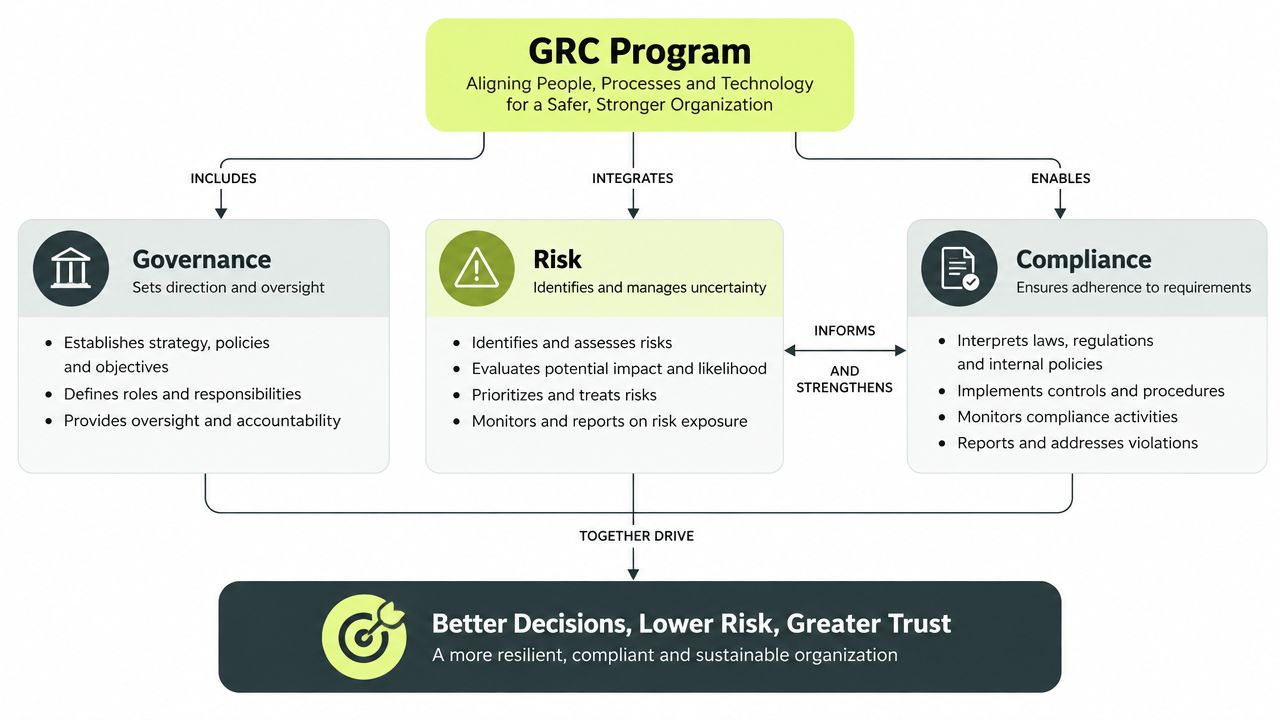
A control change should flow through all three layers
A useful GRC program does not stop at publishing a policy. It pushes decisions downstream and then pulls proof back upstream. If governance says only approved vendors can touch sensitive data, risk has to measure whether a new vendor introduces exposure, and compliance has to verify that the control existed, ran, and left evidence.
A simple example makes the chain obvious. A business team wants to use a new AI vendor. Governance says the vendor must meet acceptable-use standards. Risk triggers a review of data access, residency, and contract terms. Compliance checks whether a SOC 2 control review or equivalent evidence is needed, then the acceptable-use policy gets updated if the new workflow changes the operating model.
That's why GRC isn't just paperwork. It's the connective tissue that keeps awareness training, vendor reviews, and audit cycles from living in different inboxes. In practice, a strong GRC program turns policy into measurable behavior, and measurable behavior into audit-ready records.
The same logic applies to compliance operations more broadly. A current risk and compliance survey found that only 67% of organizations report having a centralized program for day-to-day compliance investigations, while 23% say they use a decentralized approach (current global risk and compliance program data). That gap is one reason GRC leaders keep getting pulled toward recurring training, automated workflows, and better evidence collection. The operating system only works when the parts talk to each other.
Core Responsibilities of a Risk and Compliance Function
A mature risk and compliance function usually breaks into six workstreams, even if the org chart doesn't say so out loud. Each one produces a different artifact, and each artifact feeds another team's next step. If one of these pieces is missing, the whole loop gets slower and harder to defend.
The six workstreams that keep the loop moving
| Workstream | Primary Output | Ownership Signal |
|---|---|---|
| Risk identification and assessment | Heat map | Named risk owner and review date |
| Control design and ownership | Control library entry | Control owner and test cadence |
| Policy lifecycle management | Published policy version | Approved owner and revision history |
| Regulatory mapping | Crosswalk spreadsheet | Framework mapping owner |
| Third-party risk management | Vendor scorecard | Assigned reviewer and renewal trigger |
| Audit and assurance | Evidence repository | Evidence steward and request SLA |
The important detail is not the document itself, it's whether someone owns it, whether it gets refreshed, and whether another function can consume it without guessing. A heat map that nobody updates is decoration. A control library entry without a named owner becomes a debate every audit cycle. A policy version without revision history doesn't help legal, security, or HR make decisions when the process changes.
Centralized teams often do better here because they can keep the control language consistent and the evidence location predictable. But centralized control only works if the function also sees what happens in the business. That's why a vendor scorecard should feed risk review, and a policy change should feed training and evidence collection.
One area that often gets overlooked is human behavior. Insider-risk awareness only becomes useful when the function can tie behavior, process, and controls together, not just publish another training slide deck. For a practical adjacent example, see insider threat awareness.
The mature pattern is simple. Every control has a human owner, a measurable signal, and a defined refresh cadence. Without those three, the function has paperwork, not governance.
Major Compliance Frameworks and How They Overlap
Frameworks often get treated like rival teams, but they're more like overlapping city maps. The street names differ, yet the intersections are often the same. If you already run access reviews, vendor due diligence, incident response, and governance oversight, you're covering core ground across SOC 2, ISO 27001, NIST CSF, and GDPR.
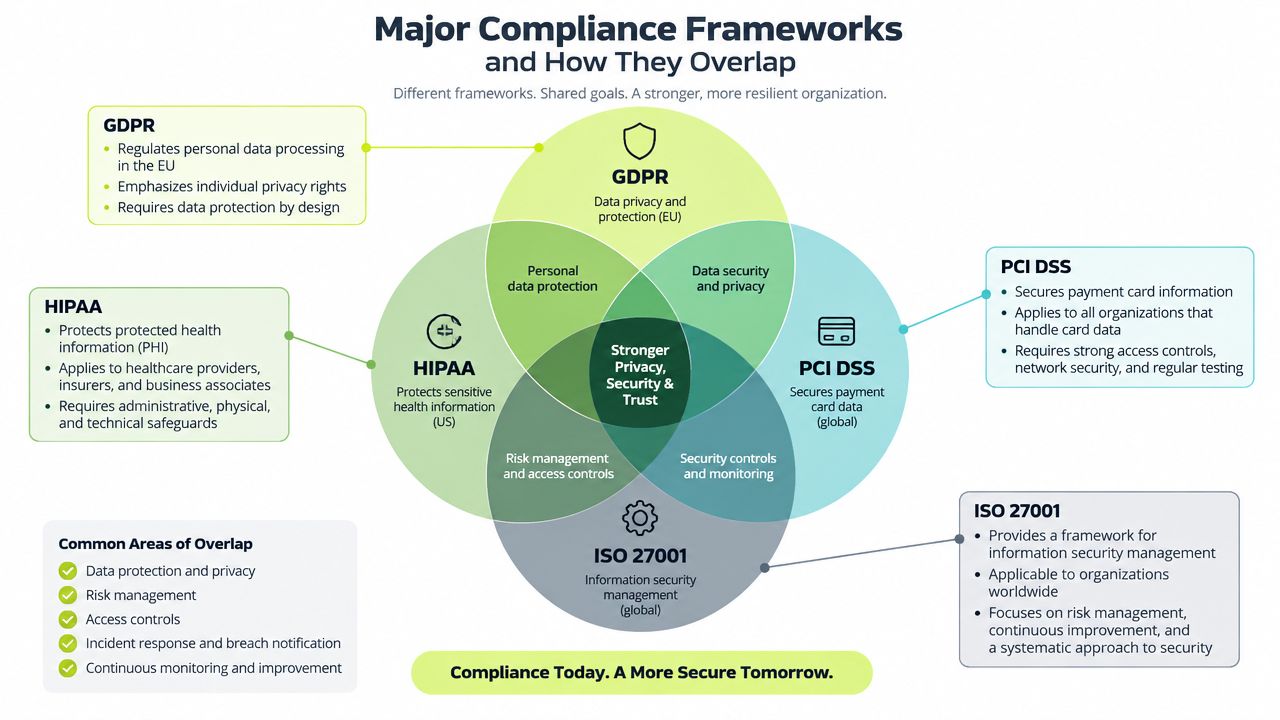
Same controls, different vocabulary
SOC 2 and ISO 27001 often land in the same control domain, especially around access management, asset protection, and vendor oversight. NIST CSF adds a maturity lens by organizing security activity into functions and categories, which helps teams talk about how well the program works, not just whether a control exists. GDPR sits partly beside those frameworks, because it brings privacy obligations like lawful basis and data-subject rights into the picture, which typical security standards don't fully cover.
That overlap matters because auditors and assessors can accept crosswalk mappings when the linkage is explicit. A single well-documented control can support more than one framework if the evidence shows how it maps. That saves work, but only when the organization keeps the source-of-truth clear.
Two places still diverge sharply. GDPR's privacy-by-design expectations reach beyond ordinary security controls, and ISO 27001's Statement of Applicability creates a formal record of which controls apply and why. Those are not cosmetic differences. They shape how teams write policies, document exceptions, and explain scope.
For security managers, the takeaway is practical. Don't build four separate control universes. Build one control grid, then map it cleanly. That reduces duplicate testing, makes evidence easier to reuse, and helps legal, security, and privacy teams argue from the same facts instead of separate spreadsheets.
Centralized vs Decentralized Operating Models
The easiest way to understand operating models is to ask who answers the audit email. In a centralized model, the GRC team owns policy, controls, and evidence collection across the company. In a decentralized model, business units own the controls and the GRC team acts more like an advisor, reviewer, and auditor.
What changes on a busy week
A centralized program is strong when the same evidence has to support multiple frameworks. It keeps control language consistent, reduces duplicate requests, and gives leadership one place to look when an audit lands. The downside is that it can miss local nuance, especially when a business unit needs to explain why a control should work differently in practice.
A decentralized model moves faster inside the business because control owners sit closer to the work. That helps when a vendor review, a cloud exception, or an access issue needs context from the people doing the job. The tradeoff is drift. Control interpretation starts to vary, evidence lives in different tools, and audit-day collection turns into a scavenger hunt.
A hybrid model usually wins in real life, because it keeps one evidence backbone while leaving control operation close to the business.
| Dimension | Centralized Model | Decentralized Model | Hybrid Model |
|---|---|---|---|
| Control ownership | GRC-heavy | Business-unit heavy | Business-owned, GRC mapped |
| Evidence collection | Single repository | Fragmented by team | Central backbone |
| Framework rollout | Consistent, slower | Faster, uneven | Balanced |
| Audit response | Predictable | Variable | Predictable with local context |
| Best use case | Many frameworks, tight governance | High business autonomy | Distributed organizations needing both |
This is also where continuous monitoring matters. Compliance has become one of the biggest operational drains on security teams because they're asked to prove control effectiveness more often and manage more third-party requests, while security and GRC still live in separate systems, according to the operating pressures described in recent industry guidance. A hybrid model reduces that friction by keeping the proof layer stable while letting control owners stay close to the risk.
If you're building from scratch, define a clear RACI. GRC owns the framework map and evidence repository. Business units own control execution and exception handling. That split keeps the program legible when an auditor asks who did what and when.
Where Security Awareness Training Earns Its Place
Security awareness training gets dismissed when it's treated like attendance tracking. It earns respect when it behaves like a control, meaning it changes behavior, produces evidence, and feeds the risk register. The strongest programs stop asking only whether people finished training and start asking whether phishing behavior changed.
From completion to control signal
That shift is measurable because continuous training creates a before-and-after story. A 2025 benchmark across 67.7 million phishing simulations, 14.5 million users, and more than 62,000 organizations reported a global phish-prone rate of 33.1% before training, dropping about 40% after 90 days and 86% to 4.1% after 12 months of continuous training (security awareness benchmark). The exact design of a program will vary, but the pattern is clear, short feedback loops beat one annual lecture.
That's why awareness should sit in the same dashboard family as vulnerability management. A security manager already tracks patches, exceptions, and overdue remediation. Human-risk signals belong there too, because the business needs one place to see whether the technical layer and the human layer are both improving.
Training also has to produce artifacts that other parts of GRC can use. In practice, that means three things:
- Control attestations: evidence that the training control exists and operates.
- Risk register entries: a recorded view of human-factor exposure by role or team.
- Audit packets: completion records, simulation results, and remediation history.
A recent internal-use training model also needs remediation paths, not just completion badges. If someone clicks, the response should be fast, role-aware, and documented. That makes the lesson count as evidence of an operating control, not just a course finished once.
If you want a practical example of how this can work in Slack-first teams, the phishing simulation training model shows how coaching and corrective feedback can be tied to the normal workflow instead of a separate portal.
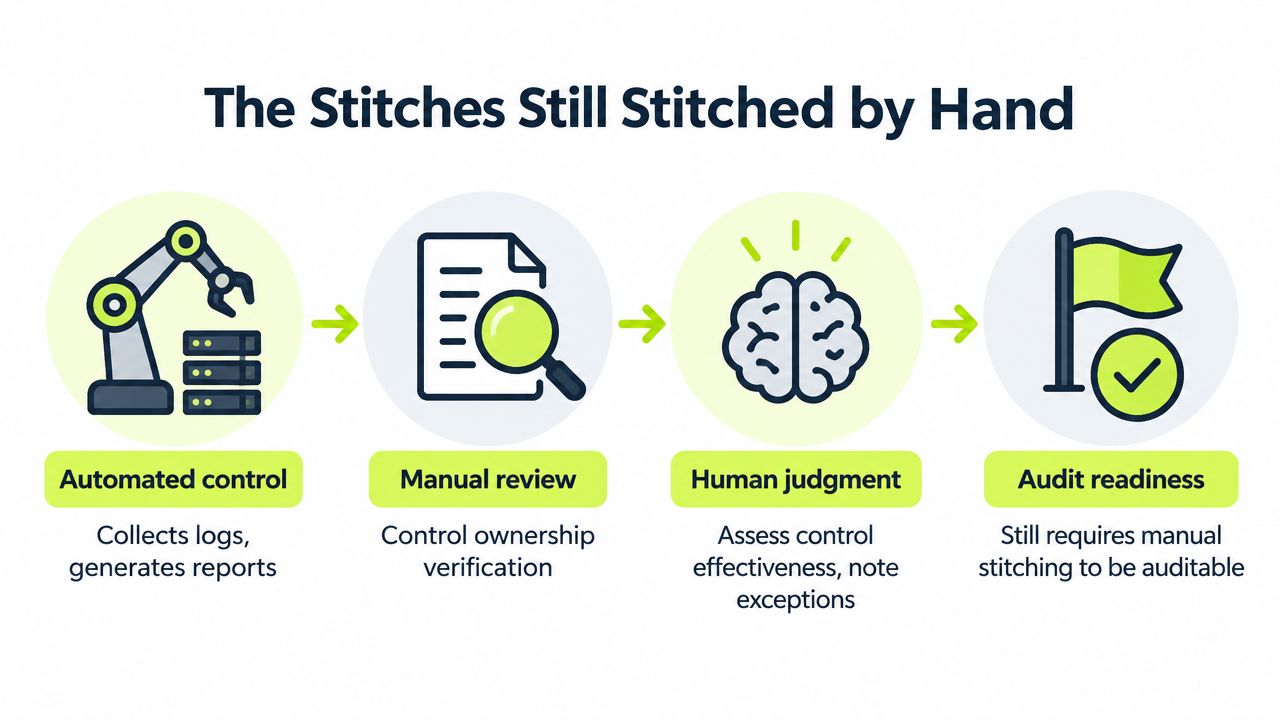
Evidence Automation and the Manual Gap That Remains
Automation helps, but it doesn't make an audit honest by itself. A tool can show that a control ran. It can't always prove that the control ran correctly, that the right owner reviewed the result, or that an exception was handled in a way an auditor can trust.
The green dashboard problem
That's why evidence automation has to be treated like a control problem, not just an admin shortcut. Modern platforms can produce a lot of evidence automatically, including hourly tests and automated pulls mapped to controls, and independent reporting notes that API-based compliance automation can cover about 80% of SOC 2 evidence, leaving the remaining 20% as manual gap work that can still take 40 to 60 hours per audit (audit automation and evidence collection). The number matters less than the lesson. Automation reduces the scramble, but it doesn't delete the human layer.
A common failure mode is simple. A Jira workflow gets misconfigured, so four quarterly reviews are skipped. The evidence collector still reports green because the system sees a completed workflow somewhere else, or it pulls the wrong status field. Nobody notices until the reviewer asks where the approvals went. That's not a tooling problem alone. It's a source-of-truth problem.
The safest test is to separate three questions:
- Did the control run?
- Did it run on the right schedule and with the right owner?
- Can we explain any exception in plain language?
Practical rule: if your dashboard cannot answer ownership, cadence, and exception handling, the evidence is incomplete.
A recent compliance guidance cycle also emphasizes that teams should map controls before automating evidence, validate data integrity, and connect the evidence path to remediation workflows. That's the only way to keep automated records trustworthy when auditors ask how they were produced. For a Slack-native team, a platform like Vigil Security can sit in the human-risk layer by generating awareness evidence alongside training, phishing feedback, and role-aware workflow records, while the broader GRC stack handles control mapping and audit packaging.
The point is not to automate everything. The point is to automate the repeatable part, then make the manual part visible so it doesn't become a surprise.
A Practical GRC Maturity Checklist for This Quarter
A useful maturity push doesn't start with a framework purchase. It starts with the inventory, because you can't control what you can't name. If your team is under pressure this quarter, work in four phases and keep the scoring lightweight.
Phase 1, stabilize the inventory
- List the controls that matter: assign each one a human owner and a review date.
- Map one framework crosswalk first: pick the controls that support the most audits and document the overlap.
- Score your current state: note whether evidence lives in one place, many places, or mostly in inboxes.
Phase 2, prove the controls
- Test the top controls on a real cadence: don't wait for the next audit cycle.
- Confirm exception handling: write down who approves deviations and where they're stored.
- Review third-party entries: make sure vendor risk results feed the same repository used by the rest of GRC.
Phase 3, embed awareness
- Tie phishing results to risk language: record failed simulations as human-risk signals, not just training misses.
- Use recurring refreshers: if the training is annual only, the behavior signal will go stale.
- Keep one dashboard: align awareness metrics with the technical controls leadership already reviews.
Phase 4, close the manual evidence gap
- Identify the 20% that automation can't cover: approvals, screenshots, and narrative explanations still need owners.
- Check that workflows didn't skip steps: review the path, not just the final status.
- Store the why, not only the what: auditors trust evidence more when the exception story is documented.
For a quick self-check, compare your current program against a short readiness exercise like the internet safety quiz questions approach, then see whether the results change any control, training, or evidence decisions.
If you're trying to make risk and compliance feel less like duplicate admin work and more like one operating system, Vigil Security can help with Slack-native training, phishing simulations, and audit-ready evidence that fits distributed teams. Visit Vigil Security to see how human-risk controls and compliance evidence can sit in the same operational loop.