You're probably staring at the same problem right now. The training exists, the LMS shows green checkmarks, and the next audit is still going to ask whether the right people got the right content at the right time. That gap is where role based training either becomes a real control or turns into a report that looks tidy and proves very little.
The difference is rarely the course itself. It's whether assignments stay aligned as people move between teams, pick up temporary access, inherit new systems, or drop out of a risk tier after a reorg. In cloud-first companies, that lifecycle problem is the whole game.
Why Most Training Programs Fail Auditors
A CISO is sitting across from a SOC 2 auditor who wants proof that engineers with production access completed secure coding training in the last 12 months. The CISO opens the LMS and finds a flat report labeled “Annual Security Awareness 2025,” with everyone from software engineers to the receptionist marked complete on the same date in a twelve-minute burst. The auditor doesn't need another attendance sheet. The auditor needs evidence that the people with the highest risk got the right depth of training.
That scene is common because generic programs optimize for completion, not for defensibility. A completion report says someone clicked through a module. It doesn't show that the content matched a job function, a system entitlement, or a compliance scope. NIST's recent publication on role-based training found that 65% of surveyed organizations evaluate effectiveness using completion rates, while just under half use audit reports or formal evaluations, which tells you how often evidence quality stops at the easiest metric (NIST SP 1288).
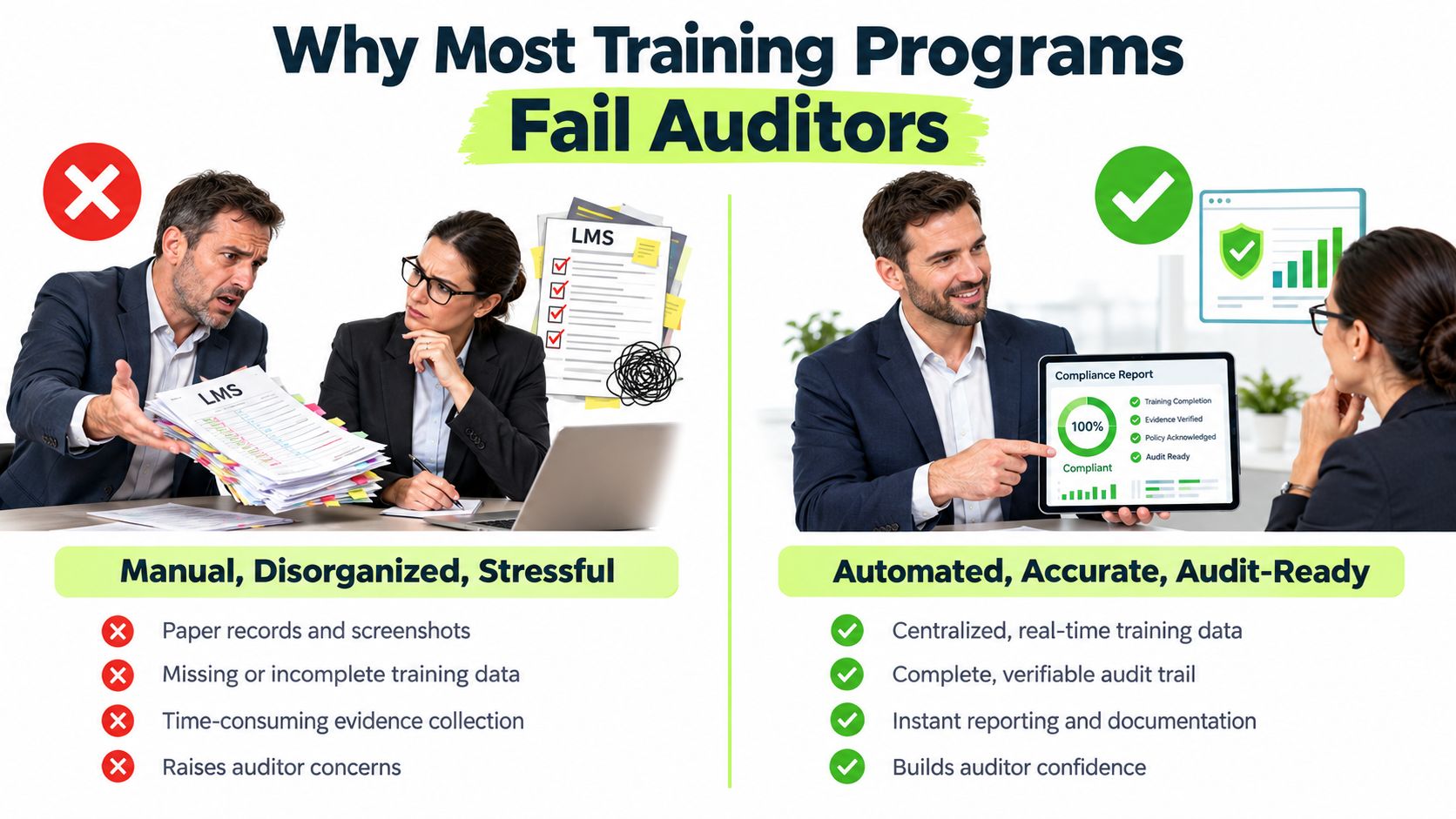
The failure mode is that manual programs don't survive change. A team transfer, a new admin entitlement, or a merger can make last quarter's matrix wrong overnight. Auditors notice that disconnect fast, especially when the evidence trail can't answer who was trained, what they saw, when they saw it, and whether they demonstrated competence.
Practical rule: if the record can't survive an org chart shuffle, it's not audit-ready.
What Role Based Training Actually Means
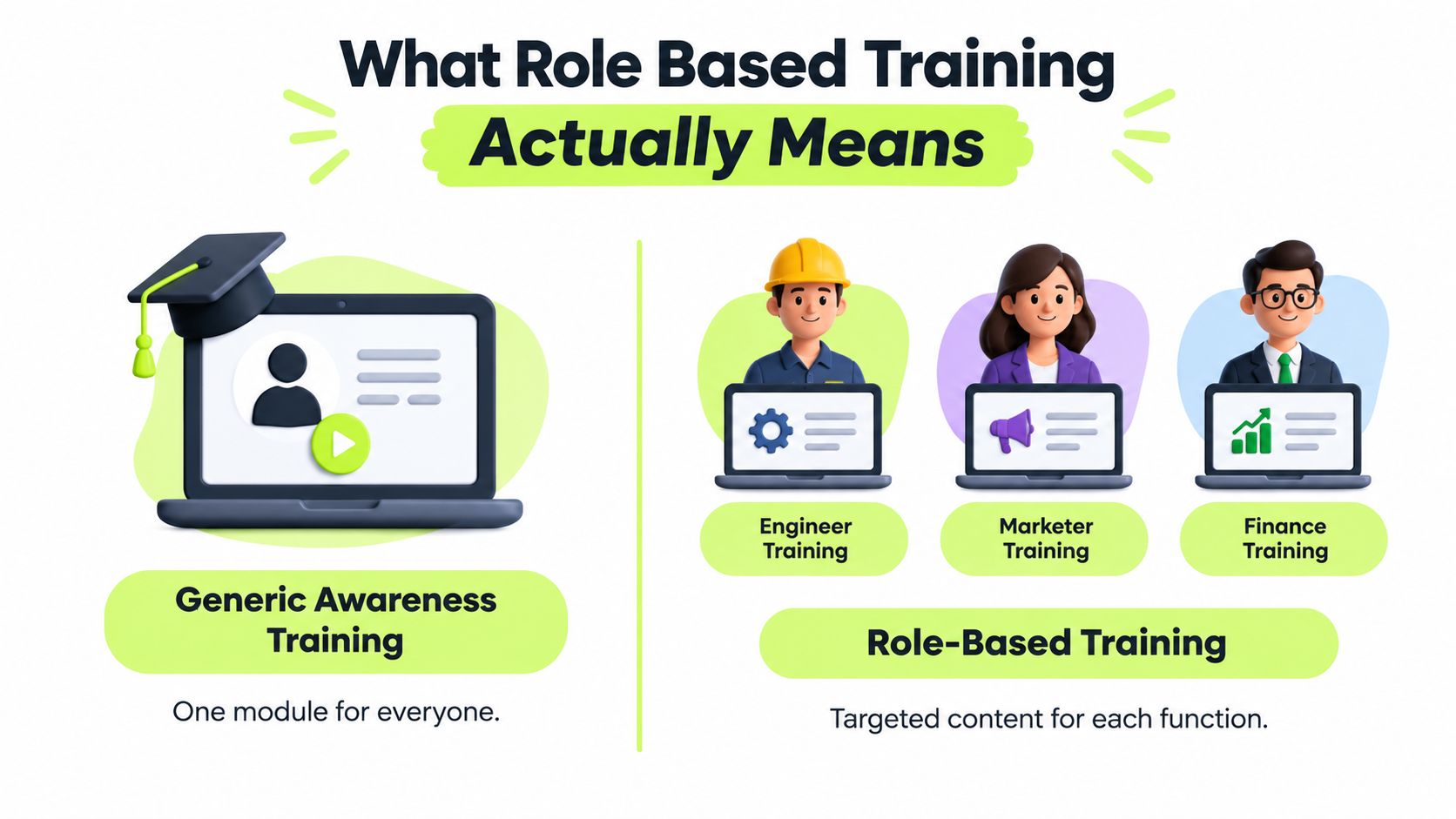
Role based training is training assigned according to what people do, what systems they can reach, and what risk they carry. Generic awareness training treats the workforce as one audience and sends the same module to everyone. Role based training breaks that assumption and segments learners by duty, access, and exposure so the content lines up with the job.
A hospital makes the difference obvious. A surgeon, a nurse, an ICU technician, and a front-desk clerk all work in the same building, but they don't need the same preparation before patient care. A single hospital-wide safety video can't replace role-specific drills, and the same logic applies to security and compliance. A person handling wire transfers needs fraud scenarios. A backend engineer pushing code to production needs secure coding, secrets handling, and incident-response context.
The target is competence, not sameness
The goal isn't to make everyone see the same content with a slightly different logo. The goal is to make sure each person can behave correctly in the situations they're likely to face. That's why role based training usually starts with a baseline, then adds depth for the functions that touch regulated data, privileged systems, or higher-value workflows.
For a practical comparison of how simple quizzes can fit into a broader awareness program, the internet safety quiz questions guide is a useful reference point. The point isn't the quiz itself, it's the idea that assessment should reflect the role, not just attendance.
In practice, that means training can be mapped to job family, system access, and regulatory exposure. A finance analyst, a customer support lead, and a cloud engineer may all need phishing awareness, but they shouldn't get the same scenario set or the same escalation logic. If your program treats them as interchangeable, it's not role based. It's just a prettier version of generic training.
Mapping Roles to the Right Content
A useful role matrix starts with job family, because different functions have different threat surfaces. Engineering, finance, customer support, sales, and executive leadership all interact with different systems and different attackers. A finance analyst handling vendor onboarding needs anti-bribery, payment verification, and fraud detection content that a sales rep usually doesn't. A sales rep, on the other hand, may need stronger guidance on deal-related impersonation and document sharing.
Add location, worker type, and risk tier
Location matters because the same role can carry different obligations in different places. A person in one office may need material shaped by GDPR expectations, while a similar role elsewhere faces another regulatory set or data-handling rule. The title doesn't tell you that. The operating environment does.
Worker type matters too. Contractors, interns, and full-time staff don't always get the same systems, the same data, or the same escalation rights. Treating them identically creates either undertraining or overtraining, and both are problems. Undertraining leaves a gap. Overtraining creates noise and weakens attention.
Risk tier is the layer many organizations forget to operationalize. A person with production access, admin console privileges, or exposure to customer PII usually needs deeper training than someone whose work never touches sensitive systems. That tier should influence content depth, delivery speed, and follow-up cadence. If you skip it, you'll eventually discover that someone with privileged access got the same lightweight content as a low-risk employee.
| Role Matrix Dimensions and Their Training Impact | |||
|---|---|---|---|
| Dimension | Example Value | Training Triggered | Why It Matters |
| Job Family | Engineering | Secure coding, secrets handling, incident response | Matches content to the way work is actually done |
| Location | EU-based team member | Privacy and data-handling material aligned to regional obligations | Different legal scopes change the required curriculum |
| Worker Type | Contractor | Scoped access training and confidentiality expectations | External workers often have narrower permissions and different obligations |
| Risk Tier | Production access | Deeper control-specific training before access is granted | Higher entitlement means higher consequence if something goes wrong |
A mature matrix combines all four dimensions into one profile. That profile should drive assignments automatically, not sit in a spreadsheet waiting for someone to remember it. If your content logic only uses job title, you're leaving coverage gaps that are hard to defend when the auditor asks how assignments stayed current.
Why Microlearning Fits Role Based Delivery
Long annual modules were designed for a workforce that sat at desks, took training on a fixed schedule, and didn't change risk posture mid-quarter. Cloud-first organizations don't work that way. People move between projects, pick up temporary access, and get interrupted all day. Microlearning fits that reality because the unit of training is small enough to attach to a real event.
Short units fit role changes better
A role change doesn't need to trigger a full rewatch of a forty-minute course. It can trigger one focused unit tied to the new duty, such as secure code review, invoice verification, or production data handling. That makes the assignment logic more precise and less disruptive. It also means the learner gets exactly what changed, not another full lap through topics they already know.
Evidence is cleaner when learning is frequent
Short units also produce better evidence. A single annual quiz says almost nothing about what a person can do months later. Frequent low-stakes checks show whether the behavior is holding up over time. That matters because auditors care about whether competence was demonstrated, not just whether a module was opened.
The delivery surface matters too. A short lesson delivered through Slack, email, or an in-app nudge is more likely to be finished than a long course that requires tab switching and calendar coordination. For a practical example of how recurring reminders and simulations can reinforce behavior, the phishing simulation training guide is worth reviewing.
| Microlearning vs Annual Modules for Role-Based Delivery | ||
|---|---|---|
| Dimension | Annual Module | Microlearning |
| Assignment response | Usually delayed until the next cycle | Can trigger immediately after a role or risk change |
| Learner burden | Harder to finish in one sitting | Easier to complete between meetings |
| Evidence quality | One score, often stale by the time of review | Multiple small signals that show ongoing competence |
The trade-off is real. Microlearning takes more authoring effort and needs a deliberate calendar of touchpoints. It pays off when content can be reused across roles and refreshed often. I've found it works best for practical skills, like secure coding snippets or phishing handling for finance, while deeper regulatory topics still deserve longer treatment when the context can't be broken apart cleanly.
Automating Assignments as Roles Change
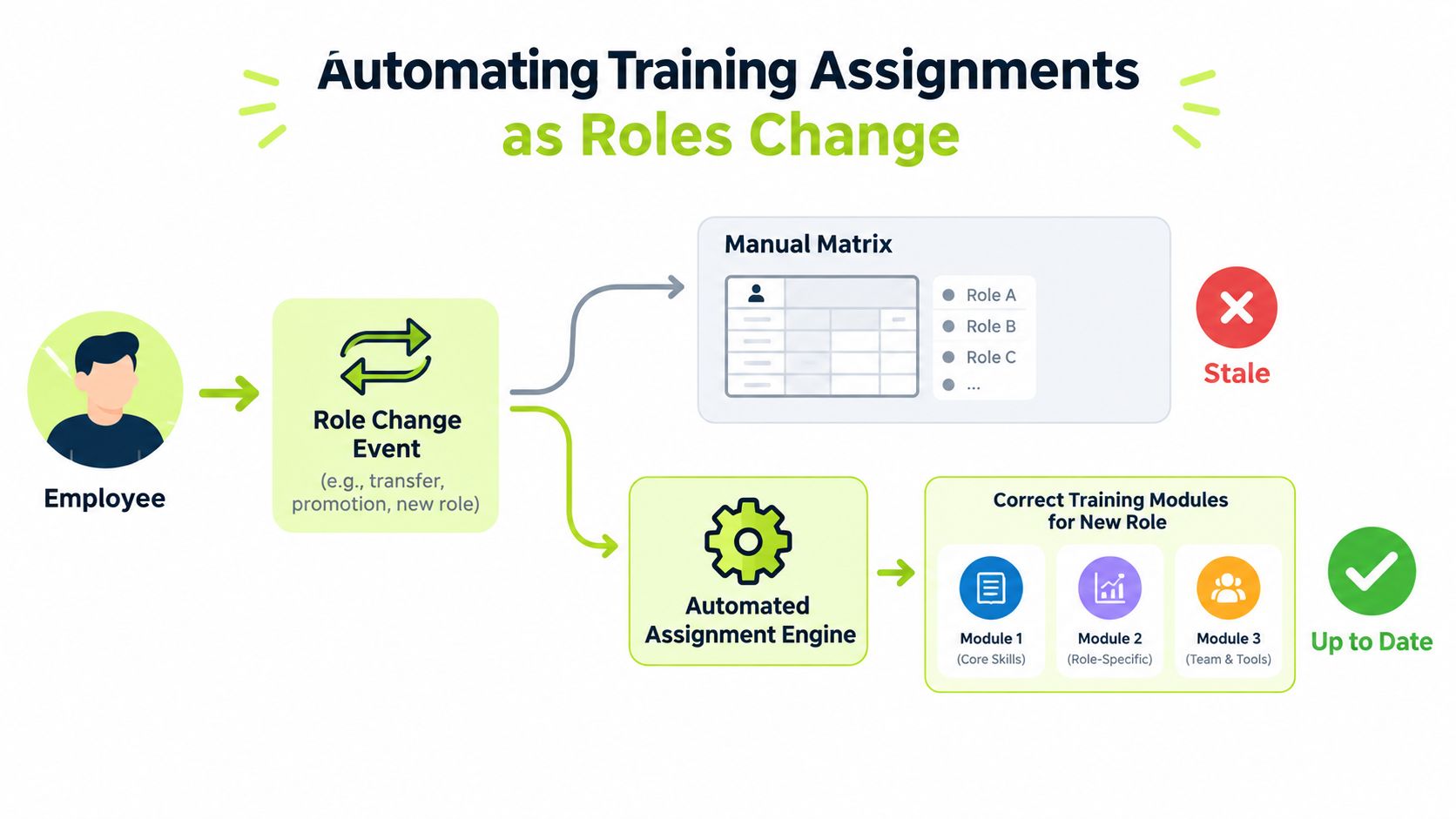
The hardest part of role based training isn't creating content. It's keeping assignments accurate when people move. Manual matrices go stale the moment someone transfers teams, takes temporary higher access, or comes back from leave with a different system footprint.
A workable automation pipeline starts with a single source of truth for role data, usually the HRIS. That data should be joined with system signals from the identity provider, ticketing system, code repository roles, finance entitlements, and temporary access grants. When the join changes, the assignment engine should evaluate the rule set and decide whether training needs to fire.
The trigger matters as much as the course
A new joiner should receive baseline content tied to their job family and risk tier. A role change should update the learning track without waiting for a monthly admin cleanup. A temporary admin grant should trigger training before the access becomes active. When access is revoked, the learner record should be archived but retained so the evidence survives later review.
Operational rule: every assignment trigger needs a durable artifact, or the automation doesn't exist for audit purposes.
The implementation pattern most organizations land on is event-driven. A webhook from the HRIS or identity system lands in a queue, the rules engine evaluates the person's attributes, the LMS issues the correct module, and the logging layer captures the chain. That chain should include assignment reason, timestamp, completion record, and any exception entry when a rule was waived or fired incorrectly.
The trap is treating automation as a one-time integration project. Role taxonomies evolve. New risk tiers appear. Acquisitions bring weird data shapes. Someone has to own false-positive reviews and rule maintenance, or the system slowly drifts back into manual cleanup. That's where many good programs fail, not because the training was weak, but because the assignment logic stopped reflecting reality.
A Real Example of Role Based Training in Slack
An engineering manager joins a new product pod at a 600-person SaaS company and gets production access on day three. The identity provider emits a role-change event. The assignment engine sees Engineering Manager plus Production Access and immediately queues two units, one on incident-response roles and one on customer data handling in production. The learner gets both inside Slack, where the team already works.
The message isn't generic. It says the access change triggered the assignment and that completion is required before the first deploy. The bot records the click, tracks whether the lesson was read, and ends with a short check for comprehension. If the manager skips twice, the bot escalates to the skip-level manager and posts a reminder in the team's training channel.
Context makes the reminder useful
That reminder works because it lands where the work happens. No separate portal, no extra password, no separate mental context. The manager sees why the lesson exists, and the team sees that completion is normal, not a private chore. That public visibility matters more than most leaders expect.
Two weeks later, the same manager participates in a post-incident review. The bot surfaces one more lesson inside the incident channel, this time tied to what just happened. The evidence trail now includes the assignment reason, delivery timestamp, completion score, escalation history, and the contextual trigger that created the learning moment.
For teams already using Slack-native delivery, a product like Vigil Security fits this pattern by assigning lessons by workspace, channel, team, or person and delivering short interactive training inside Slack. That doesn't solve the policy design for you, but it does reduce the friction between role change and learning assignment.
The practical lesson is simple. Training works better when it follows the work instead of waiting for a quarterly clean-up. Slack is just the surface. The control is the event logic beneath it.
Evidence Auditors Will Actually Accept
Auditors usually care about four things, and each one needs a different artifact. The first is the assignment matrix, which proves a role was tied to a specific curriculum on a specific date. The second is the per-person completion record with timestamps and content versioning. The third is the assessment score, because attendance alone doesn't show competence. The fourth is the exception log, which explains extensions, reassignment, and remediation.
Match the artifact to the question
An assignment matrix typically answers, “Who was supposed to take what, and why?” That record usually lives with the HRIS or the assignment engine. A completion record answers, “Did this person finish the assigned content, and which version did they see?” That usually comes from the LMS. The assessment record answers, “Did they demonstrate understanding?” The exception log answers, “Who was late, remediated, or waived, and who approved it?”
The weaknesses are predictable. Missing content version numbers make it impossible to prove the learner saw the right material. Merged acquisitions can break inheritance logic. Screenshots look neat, but they usually don't carry exportable metadata. That's one reason many teams are moving toward stronger evidence workflows, including the kind of role-aware tracking discussed in the risk en compliance guide.
| Evidence Artifacts vs Auditor Questions | ||
|---|---|---|
| Artifact | Auditor Question | System of Record |
| Assignment matrix | Who was assigned which curriculum, and when did the mapping change? | HRIS, assignment engine |
| Completion record | Who finished, what version did they see, and when did they finish? | LMS |
| Assessment score | Did the learner demonstrate competence, not just attendance? | LMS, assessment platform |
| Exception log | Who was late, remediated, or waived, and why? | Ticketing system, governance log |
Retention matters too. Evidence has to outlive the LMS contract and the annual program cycle. If the records disappear when the vendor relationship changes, the control disappears with them. That's why a role based program should be built as a data trail, not just a training calendar.
Operational Checklist for Security Leaders
Security leaders need to own five decisions or the program will drift. First, define who maintains the matrix. If HR owns role data but security owns risk tiers, document the handoff. If nobody owns the edge cases, the matrix stops matching reality.
Second, pick the source of truth. HRIS data is usually cleaner than ad hoc spreadsheets, but identity groups and system entitlements still matter when access changes faster than job titles. If engineering manages its own groups, the assignment logic will break within a quarter.
Third, document the automation triggers and their failure modes. New joiner, role change, temporary access, and access revocation should each map to a rule and a fallback path. If a trigger fails, the program will miss people without anyone noticing.
The rest of the operating model
Fourth, set a content refresh cadence tied to policy and threat changes. Stale modules create false confidence. Fifth, define exception governance. Someone has to decide who can grant extensions, who can waive a course, and who reviews repeat misses.
Keep a standing slot in change advisory for role-impacting changes. Training logic should be part of the change, not a follow-up after the fact.
The cadence I'd enforce is straightforward, quarterly matrix diffs, monthly completion audits, and a review of any change that affects access, system ownership, or reporting lines. That rhythm keeps the program from becoming a static compliance file and turns it into a living control that can survive the next reorg.
If you want a role based training program that lives where work happens, Vigil Security delivers short, interactive lessons inside Slack and supports automated, role-aware assignments with audit-ready evidence. Visit Vigil Security to see how Slack-native delivery can fit your compliance workflow without adding another portal for people to ignore.