A security awareness program can move a workforce's global phish-prone rate from 33.1% before training to 4.1% after 12 months, an 86% reduction, according to Proofpoint's security awareness training research. That result reframes the question “what is security awareness training?” It is more than an annual video, a quiz, or a compliance certificate. It's a behavior-change program designed to help people recognize threats, make safer decisions, and report suspicious activity before it becomes an incident.
Why Security Awareness Training Has Become a Core Security Control
A 2025 global report found that 94% of organizations run security awareness sessions regularly, including 46% quarterly, 32% monthly, and 16% annually (Fortinet report). That adoption level reflects a practical shift. Security leaders increasingly treat awareness as an operating control that needs scheduling, ownership, measurement, and improvement.
So, what is security awareness training in operational terms? It's the structured effort to change how employees recognize and respond to cyber risk. The content may cover phishing, social engineering, password misuse, data handling, physical security, privacy, or incident reporting. The important distinction is that the program connects those topics to decisions people make during real work.
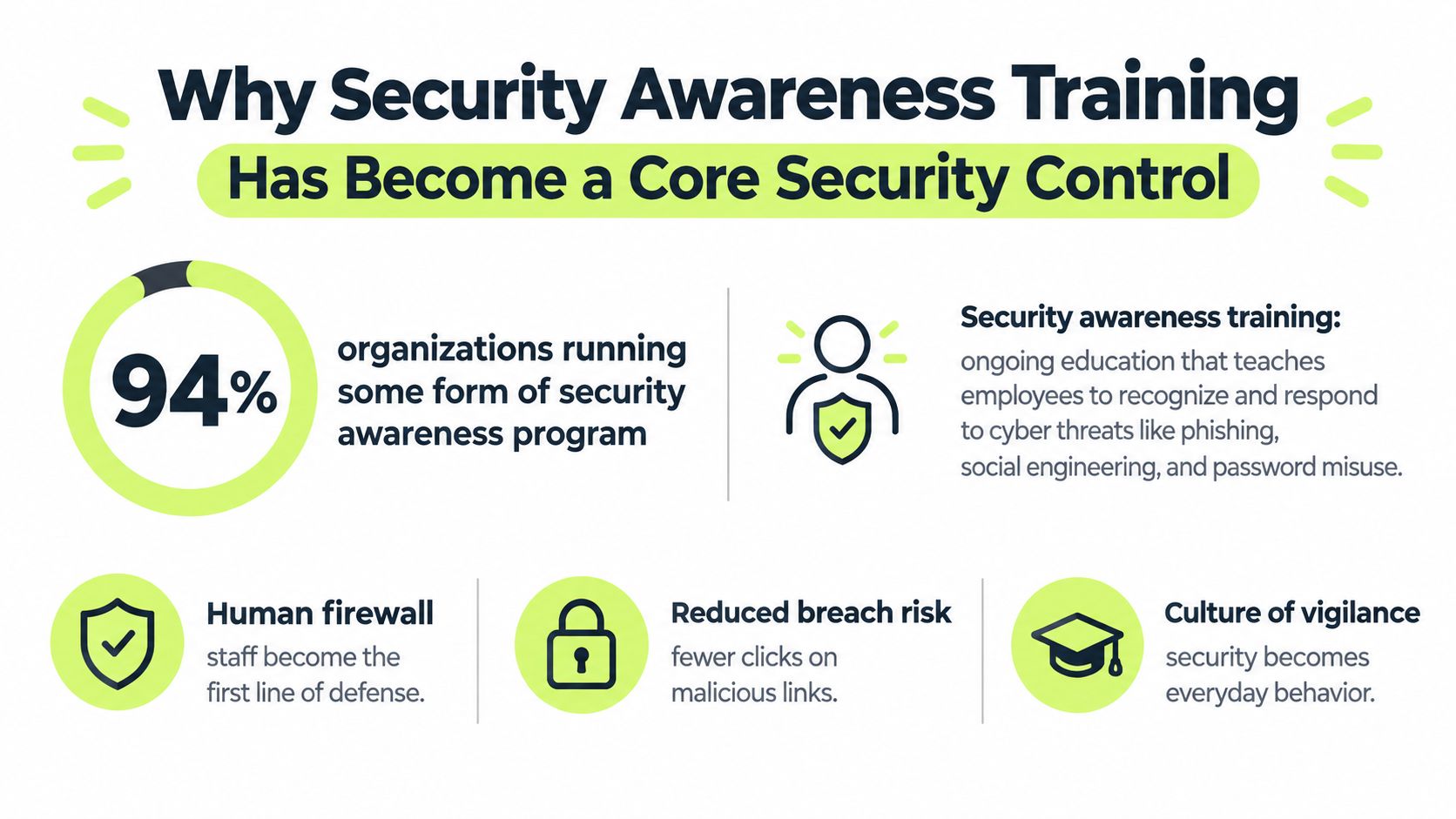
Employees sit between external messages and the security operations center. A firewall can block some malicious traffic, but it can't decide whether a finance employee should approve an unusual payment request. An email gateway can quarantine known threats, but it can't guarantee that someone will report a convincing impersonation attempt. Awareness training gives people a repeatable response: pause, inspect, verify, and report.
A credible program has four jobs:
- Define the risk: Identify the behaviors that could expose the organization.
- Teach the response: Show employees what to do in the tools and workflows they already use.
- Measure behavior: Track susceptibility, reporting, comprehension, and repeat failures.
- Produce evidence: Keep records that demonstrate scope, completion, evaluation, and improvement.
That evidence matters for governance frameworks and regulated environments, including ISO 27001, PCI DSS, HIPAA, SOC 2, and NIS2. Compliance evidence can prove that training happened, but a mature program also shows whether people are becoming safer in practice. Guidance from Vigil Security on protecting against social engineering attacks is useful when translating that risk into everyday employee actions.
How Security Awareness Training Evolved Into a Modern Discipline
Early awareness programs relied on reminders about passwords, antivirus software, and acceptable use. Organizations later moved to mandatory computer-based courses followed by knowledge checks. Those courses created completion records, yet they often showed only that an employee finished training, not whether the person could recognize a deceptive message under pressure.
As attacks began using trust, urgency, impersonation, and distraction, security teams needed evidence of decisions. Phishing simulations added that practical layer. They could show whether an employee clicked, entered credentials, or reported a suspicious message.
The discipline also gained structure through public awareness campaigns and security governance standards. National Cybersecurity Awareness Month launched in 2004, while ISO/IEC 27001 standards by 2005 helped place human behavior within information security governance. By the mid-2010s, interactive lessons, simulations, and gamified reinforcement were increasingly common.
The operating principle is simple: attendance measures administration. Clicks, reports, comprehension, and repeated behavior provide evidence of control performance.
Continuous delivery followed because behavior changes through repeated exposure and feedback, not a single annual event. Published research has reported lower phish-prone rates after sustained training, with improvement visible during the first months of a program. The Proofpoint research illustrates why program owners track behavior over time rather than treating course completion as the outcome. Employees receive repeated opportunities to recognize patterns, correct mistakes, and build safer responses.
Modern awareness training therefore operates like a feedback system. Microlearning introduces one observable behavior, simulations test the decision in context, and timely coaching reinforces the expected response. Audit records then connect delivery to evidence, while phish-prone rates and related measures show whether the control is improving in practice.
The Core Content Types Inside a Modern Awareness Program
A working program combines several formats because no single format can close every behavior gap. Microlearning supports retention, simulations expose decisions, role-based lessons add context, and reinforcement keeps security visible between formal sessions.
Microlearning reduces the burden of attention
Short modules work well when employees need practical instruction without leaving their workflow for a long course. A lesson might focus on checking a sender, verifying a payment request through a separate channel, or reporting a suspicious message. The point isn't to compress an entire security curriculum into tiny fragments. It's to isolate one decision and give employees a chance to practice it repeatedly.
Recurring delivery also gives program owners a way to refresh content as threats and workflows change. A short lesson about suspicious login prompts can be followed later by one about callback scams or collaboration-platform invitations.
Simulations reveal what knowledge checks miss
A quiz can show that someone knows the definition of phishing. A simulation can show whether that person recognizes the tactic in context. That difference is central to phishing simulation programs, because the security team can observe clicks, credential attempts, reports, and response timing.
Simulations should be designed as learning events, not traps. An employee who interacts with a test message should receive clear, immediate coaching that explains the clues and shows how to report similar messages. Program owners also need varied scenarios, because a workforce may respond differently to an invoice request, an executive impersonation, a password reset, or a shared-document notification.
Role-based content connects risk to real work
A finance employee may need practice validating payment changes. An executive may face impersonation and sensitive-data requests. An administrator may receive privileged-access lures, while a developer may encounter repository invitations or secrets-handling scenarios. Generic lessons establish a baseline, but role-based content makes the decision relevant.
Reinforcement keeps the lesson alive
Posters, newsletters, Slack reminders, policy nudges, and just-in-time prompts help employees recall the right action when a suspicious message arrives. These assets shouldn't become background noise. Each should reinforce a small number of behaviors, use language employees recognize, and point to a clear reporting channel.
| Content Format | Behavior Gap Addressed |
|---|---|
| Microlearning | Forgetting key behaviors between formal training events |
| Phishing simulations | Clicking, entering credentials, or failing to report realistic lures |
| Role-based lessons | Applying generic advice poorly in higher-risk workflows |
| Reinforcement assets | Losing awareness during busy periods or between lessons |
The strongest programs combine these formats into a sequence. Teach one behavior, test it in context, explain the outcome, and reinforce it later.
How a Mature Awareness Program Is Designed and Operated
NIST describes awareness and training as a lifecycle involving program design, target audiences, administration, maintenance, and evaluation (NIST guidance). That framing changes the operating question from “Which course should we assign?” to “How will this control identify risk, influence behavior, and improve over time?”
Design starts with risk
Leaders should define learning objectives from incidents, near misses, threat intelligence, and business workflows. “Understand phishing” is too broad to guide measurement. A stronger objective might be helping employees verify unexpected access requests or report suspicious messages through the approved channel.
Targeting makes content relevant
Assign a common baseline to the workforce, then add depth where exposure differs. Finance, executives, IT, developers, HR, and customer-facing teams often encounter different forms of social engineering and data risk. Role-based training guidance can help structure those assignments without creating disconnected curricula.
Administration should fit the workday
An LMS, Slack workflow, or another delivery system should handle assignments, reminders, completion records, and access by audience. Short recurring lessons generally create a more sustainable rhythm than a single long module that employees rush through once a year.
Measurement must observe behavior
Completion and quiz scores matter, especially for audit evidence, but the control needs behavioral indicators too. Track simulation susceptibility, reporting, response time, and patterns among repeat offenders. The reporting design should let security and GRC teams compare trends over time and by role.
Improvement closes the loop
Review metrics and incidents regularly. If a simulation exposes confusion about invoice verification, update the lesson, adjust the scenario, and check whether the next campaign produces a different response. NIST's lifecycle is useful precisely because maintenance and evaluation are part of the program, not optional activities after launch.
Metrics That Actually Show Whether Training Is Working
A completion rate answers one narrow question: did assigned users finish the activity? It doesn't show whether they understood the lesson or changed what they do with suspicious messages. Keep completion as audit evidence, but don't present it as proof of resilience.
Separate administrative evidence from behavioral evidence
Comprehension scores provide a stronger signal than attendance because they show whether employees understood the material. They still represent knowledge, not necessarily action, so pair them with simulation and reporting data.
| Metric | What It Measures | Behavioral Signal |
|---|---|---|
| Completion rate | Whether assigned training was finished | Program reach and audit coverage |
| Comprehension score | Whether learners understood the lesson | Knowledge retention |
| Simulated click rate | Whether users interacted with a test lure | Susceptibility to a tactic |
| Report rate | Whether users flagged suspected phishing | Strength of the human detection layer |
| Time to report | How quickly users alerted security | Speed of defensive response |
| Repeat-offender rate | Whether the same users fail repeatedly | Need for targeted coaching |
Click rate shouldn't stand alone. A low click rate with little reporting may indicate that employees are cautious but don't know how to escalate. A higher report rate can show that the workforce is identifying threats even when some users still need coaching.
The benchmark data provides a useful reference point. One industry report found a 33.2% global average phish-prone rate before training, falling to 4.2% after a full year of continuous training, an 87% reduction (KnowBe4 benchmarking report). The same source describes weekly testing as 2.74 times more effective at reducing risk than testing less than quarterly. Those figures shouldn't become a universal target detached from context, but they do show why cadence belongs in the measurement model.
Board-level question: Can the program demonstrate fewer risky interactions, more reports, faster escalation, and targeted improvement for people who continue to struggle?
Rolling trend views are more informative than a single campaign result. Compare results by role, lure type, business unit, and reporting behavior. Then connect those findings to remediation, rather than treating the dashboard as the endpoint.
What the Research Says About Whether Training Changes Behavior
A 2025 field study across more than 19,500 employees found no significant relationship between recently completed annual training and falling for phishing (2025 field study). In a multi-month study covered by the research, embedded training reduced clicking by only about 2%, while risk rose as employees encountered more phishing attempts.
The result does not make awareness programs ineffective. It shows that course completion is a weak proxy for behavior. Annual training can meet a policy requirement without giving employees enough repetition, context, or feedback to recognize a deceptive request during a busy workday.
Format and timing influence the result
General cybersecurity instruction did not immediately reduce phishing risk in the research, while phishing-specific instruction improved susceptibility. Regular incident reporting helped at first, but its effect faded over time. The same 2025 study found that lure difficulty strongly predicted clicks, with harder lures producing materially higher click rates than easier ones. Together, these findings show why a phish-prone rate needs context: a change in clicks may reflect both training and the difficulty of the scenarios used to test it.
Microlearning fits this evidence when it supports a behavior rather than merely shortening a course. A short lesson can introduce one decision, such as checking an unusual payment request. A later simulation can test that decision, and immediate feedback can explain the warning signs. Repeated cycles create evidence that connects instruction with observed behavior and gives program owners a clearer audit trail than completion records alone.
The practical test for program owners
A behavior-change program should include:
- Phishing-specific practice: Employees repeatedly apply the decisions they must make.
- Immediate coaching: A failed simulation becomes a teachable moment.
- Role relevance: Scenarios reflect the requests, tools, and authority patterns employees face.
- Sustained cadence: Reinforcement continues because behavior can weaken with repeated exposure.
- Multiple measures: Owners review clicks, reports, comprehension, and repeat patterns together.
The useful question is whether training produces a credible path from instruction to behavior. Phish-prone rates, reporting patterns, and documented remediation should support that conclusion, while audit evidence shows how the program responded when results fell short.
Key Takeaways for Building an Effective Awareness Program
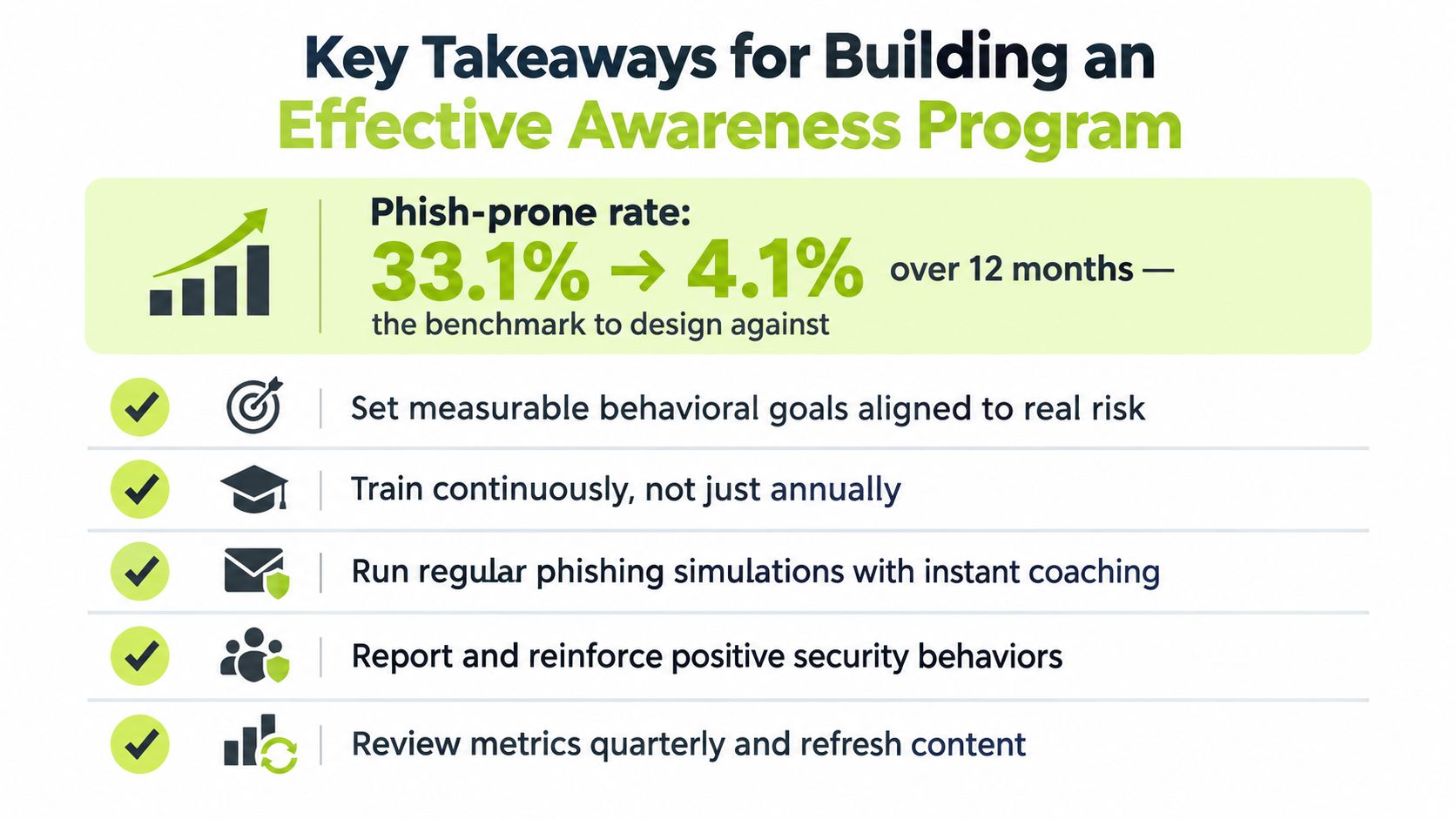
A strong awareness program has one operating test: does it change decisions employees make, and can the organization prove that change? Course completion supports coverage, while behavior measures and audit records show whether the control works. Annual-only delivery can underperform. The benchmark to design against is a phish-prone rate moving from 33.1% to 4.1% over 12 months, as noted earlier.
A security or compliance leader can turn that standard into next-quarter commitments:
Set a written risk objective. Define the behavior to change, such as reducing clicks on credential lures or increasing reports through the approved channel. Assign an owner and review date.
Audit content by behavior gap. Remove lessons that only repeat broad topic coverage. Map every module to a decision employees must make, such as verifying an unusual request or handling sensitive data correctly.
Replace the annual centerpiece with recurring microlearning. Short modules fit the workday, but their value comes from repetition and follow-up. Reinforce each behavior through targeted reminders and later practice.
Run regular phishing simulations with immediate coaching. Vary scenarios, record clicks and reports, and explain the warning signs as soon as each exercise ends. The simulation tests the decision, while the coaching connects the result to the next action.
Score the reporting habit, not only failure. Reports give the security team more visibility and response time. Track reporting rate and time to report alongside susceptibility so the program recognizes protective behavior as well as mistakes.
Connect telemetry to the GRC evidence binder. Preserve assignments, completion, comprehension, simulation outcomes, remediation, and program reviews for ISO 27001, PCI DSS, HIPAA, SOC 2, and NIS2 evidence needs. This record shows what the organization taught, what employees did, and how owners responded.
Review the program quarterly. Use incidents, near misses, role trends, and simulation results to reweight the curriculum. Keep the lifecycle active rather than allowing content to become a static annual requirement.
For teams that work primarily in Slack, Vigil Security provides short interactive security and compliance lessons, recurring refreshers, phishing campaigns with instant coaching, role-aware assignments, reporting, and audit evidence synchronization with Vanta and Drata. Visit Vigil Security to assess whether its Slack-native approach fits the next awareness-training cycle and evidence workflow.