Phishing simulation meaning is a controlled cybersecurity exercise that mimics real phishing attacks to test whether people can recognize and respond safely. The point isn't to embarrass staff, it's to find out how your team reacts before a real attacker does.
Your inbox already gives the scenario. Someone gets a fake password reset, a Slack-looking request, or a text that feels urgent, and the key question is whether they report it, ignore it, or click. That's why phishing simulation matters in busy organizations.
Understanding Phishing Simulation Meaning
A finance manager opens an email that looks like a vendor invoice. The sender name is familiar, the tone is calm, and the timing is awkward because everyone's rushing to close the books. One wrong click can create a problem, but the deeper issue is whether the person knows what to do next.
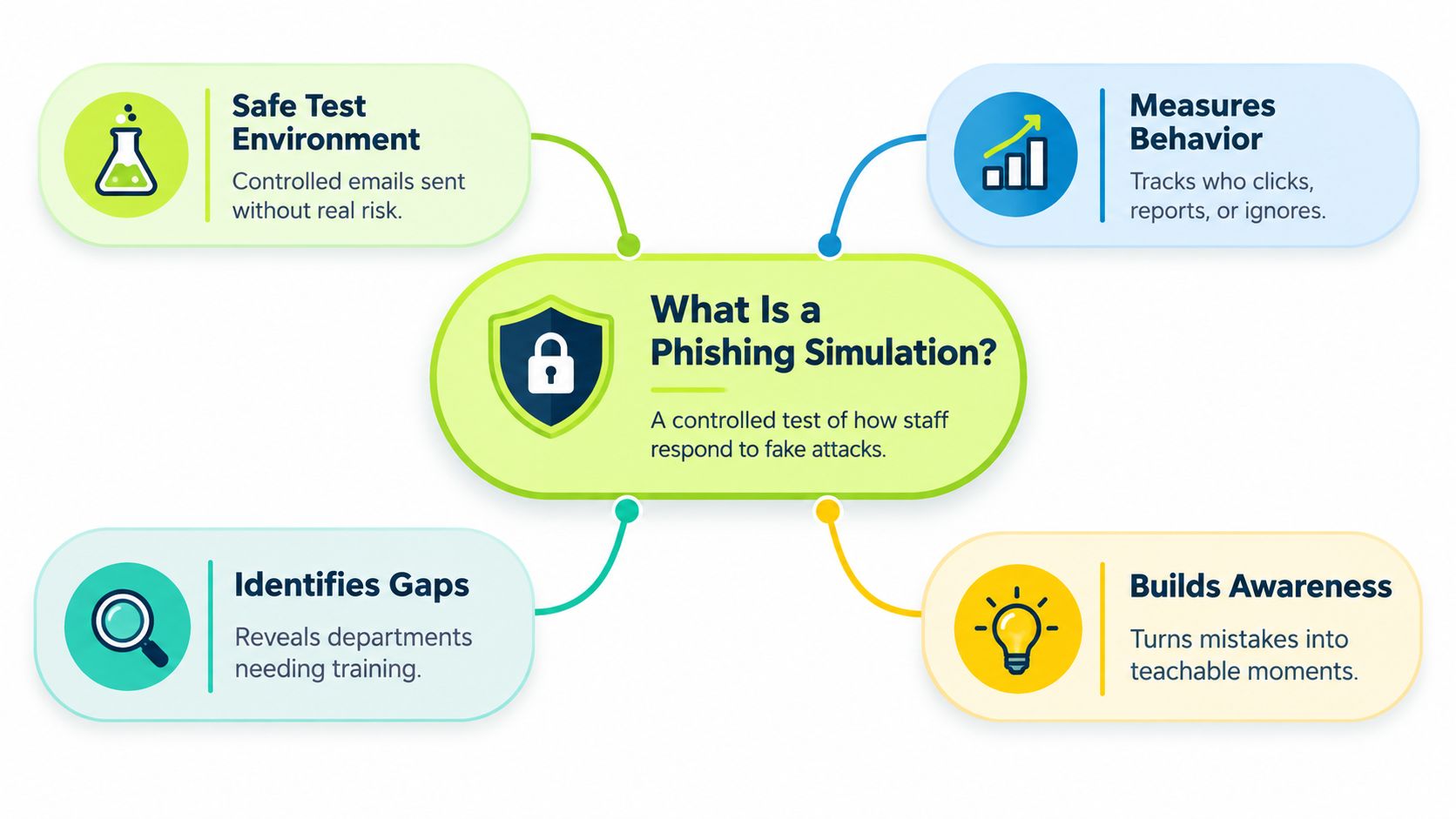
Phishing simulation is a controlled test that sends fake emails, texts, voice calls, QR codes, or other lures that imitate real phishing attempts. IBM describes phishing simulation as receiving fake messages that mirror real-world phishing attempts, and that's the core idea, a safe way to see how people react without exposing the organization to actual harm. The aim is not punishment, it's practice, and repeated practice builds better judgment than a single surprise test. IBM's phishing simulation overview
Why organizations use it
Security teams run simulations to train recognition, not to catch people out. They want to see whether workers can spot urgency, verify a request, and report suspicious activity before damage spreads.
Practical rule: if the exercise only proves someone clicked, it hasn't told you enough to improve behavior.
That's where the meaning goes beyond a simple quiz. A real program looks at how people respond under pressure, then turns the result into a teachable moment.
For teams building a broader awareness program, the concept fits naturally with security awareness training basics. Phishing simulation is one part of that discipline, not a separate compliance stunt.
What Phishing Simulations Actually Measure
A lot of people assume the only useful metric is the click. That's too narrow, and it misses the behavior that matters most when a real attack lands in the middle of a workday.
Clicks are only the beginning
Modern simulations can track whether someone clicks, enters credentials into a fake form, opens an attachment, replies to a message, or reports the message through the right channel. The last one is especially important, because reporting is the action that helps security teams respond quickly.
That shift matters because a low click rate doesn't always mean a strong security culture. People may still hesitate to report suspicious messages, or they may forward them to colleagues instead of using the official process.
Behavior tells you where the workflow breaks
A good simulation doesn't just ask, “Who failed?” It asks, “Where did the process break down, and why?” That can point to weak reporting habits, unclear escalation paths, or a department that needs role-specific coaching.
Organizations also use these exercises to compare patterns across teams, not to shame individuals. If one group consistently reports suspicious messages faster than another, that difference can point to local habits, manager behavior, or a training gap that deserves attention.
What you measure shapes what you improve, so measure the actions that protect the business, not just the mistakes that are easy to count.
That's why the value of a phishing simulation is closer to a workflow test than a pop quiz. It shows whether your people know how to react, and whether your reporting path is usable when stress is high.
Evidence Behind Simulation Effectiveness
A single test can tell you something. Repeated practice can change what people do next time, and that difference is where the evidence becomes useful for leaders.
Repetition changes the curve
A 2026 global benchmark found that the average Phish-prone Percentage started at 33.2% before training, fell to 20.1% after 90 days, and dropped to 4.2% after one year, showing that ongoing simulation-based training can reduce susceptibility by about 87%. That pattern tells a clear story, continuous practice beats one-off exposure when the goal is lasting behavior change. KnowBe4 benchmark report
Small training effects still need pressure and feedback
NIST-cited research adds an important caution. One organizational study reported only a 2% reduction in phishing susceptibility from training overall, while the same research found simulated phishing lures could still induce 10% to 30% of employees to click. That suggests the value of simulation isn't just awareness measurement, it's repeated pressure plus immediate corrective coaching while the risk is still fresh. NIST-cited study
In plain terms, a simulation works best when people get the message, the feedback, and another chance to practice. A one-time test can expose weakness, but it rarely builds the habit you need on a normal Tuesday morning.
The most useful programs treat the result as a baseline, not a verdict. That's the difference between a report that sits in a folder and a process that changes what people do.
When Simulations Work Versus When They Fail
Some simulation programs teach. Others only create paperwork. The difference is less about the tool and more about how the organization uses it.
Programs that build habits
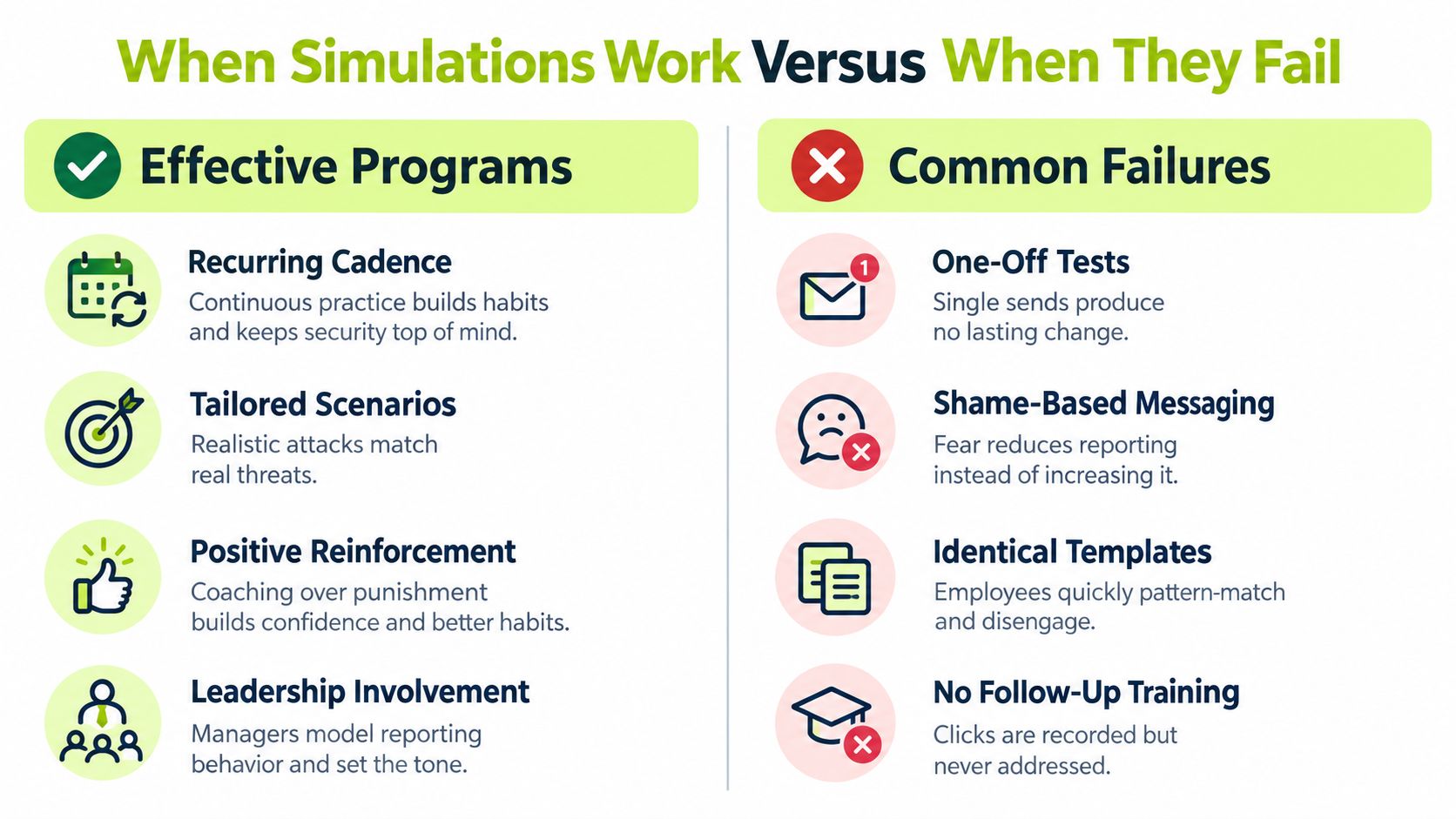
Effective programs use recurring scenarios, realistic lures, and immediate coaching. They also involve managers, because people notice what leaders ignore and what leaders report.
If the simulation matches the way attackers work, employees learn to slow down and verify requests instead of just looking for obvious mistakes. That's especially important now that phishing appears in more than one channel, not just email. Doppel's overview of what counts as a phishing simulation today
Programs that backfire
One-off tests can become theater. So can shame-based programs that treat failure as proof of carelessness instead of a signal that the organization needs better training and clearer reporting paths.
A program that makes people afraid to report has already weakened itself.
That's the risk with checkbox training. People complete the requirement, but the behavior you wanted never sticks.
For teams evaluating vendors or managed services, phishing simulation service options should be judged on whether they improve behavior over time, not on whether they generate a tidy completion report. The metric that matters is whether people get better at spotting, reporting, and responding.
Building Effective Simulation Programs
A useful program starts with a baseline. You need to know where people stand before you can tell whether the training changed anything.
Start with realistic scenarios
Use examples that match how your staff works. That might mean invoice requests for finance, shared document prompts for operations, or message-based lures that fit your collaboration tools. The closer the simulation is to daily work, the more honest the response.
Then keep the program moving. Repetition matters because people forget, routines drift, and attackers keep changing tactics.
Close the loop fast
Feedback needs to arrive while the moment is still memorable. If someone clicked, they should get a clear explanation of what gave the message away and what to do next time. That quick correction turns a mistake into learning instead of frustration.
A simple operating pattern helps:
- Measure baseline behavior before training starts.
- Run varied simulations across the channels your staff uses.
- Coach immediately after a miss so the lesson lands.
- Track reporting behavior so you can see whether people are escalating faster.
A tool like Vigil Security fits this model when a team wants phishing drills tied to short Slack-native training and corrective feedback. The important point is the workflow, not the label, because the program has to support behavior change without turning into admin burden.
Keep the program sustainable
The best programs don't depend on manual follow-up for every event. They use automated assignments, role-aware scenarios, and reminders so the security team can focus on trends, not clerical work. That's how simulation becomes part of normal operations instead of a special event people forget by next week.
Common Misconceptions About Phishing Simulations
The biggest myth is that any phishing test counts as training. It doesn't. A single surprise email can reveal risk, but without repetition and feedback it won't reliably change behavior.
Transparency doesn't weaken the lesson
Some teams think the exercise has to stay mysterious to work. In practice, clear communication about why the program exists can make it more useful, because people learn the purpose and recognize that the goal is safer behavior, not blame.
Another common mistake is treating annual testing as enough. Human habits decay, and people who only see one exercise a year often treat it like an audit event instead of a working skill.
Clicks are not the whole story
A low click rate can look good on paper, but it doesn't tell you whether people reported the message, ignored it, or forwarded it to someone else without saying so. That's why leaders should ask whether a program measures response behavior, not just failure.
Good question to ask vendors: does the program help people improve, or does it just generate a score?
The most misleading programs are the ones that produce tidy dashboards without changing daily decisions. If your team can't tell whether reporting improved, whether response time got faster, or whether coaching followed the exercise, then the simulation is probably measuring compliance more than resilience.
The practical standard is simple. Use simulations as a living training system, not a yearly scare tactic, and judge them by whether your people become steadier, faster, and more likely to report suspicious messages when it matters most.
If you want a phishing simulation program that supports behavior change instead of just counting clicks, visit Vigil Security and review how Slack-native lessons, phishing campaigns, and automated coaching fit into your training workflow. It's a practical way to connect simulation results to real follow-up, so your team can build stronger habits without adding another disconnected portal to manage.