A support agent is trying to resolve a billing question quickly. They paste a screenshot into a Slack thread, and it shows a masked card number beside the customer's home address. The image looks routine, but it raises two different questions: did payment-card data enter a place it shouldn't, and did personal information become visible to people who didn't need it?
As the security lead, you'd need to establish what the screenshot contains, where it traveled, who could access it, and what evidence to preserve. The response depends on understanding both PCI data and personally identifiable information (PII), where the two overlap, and how everyday habits in Slack and cloud tools can expose them. The practical aim is to give your team clear definitions, usable decision rules, and training that helps prevent the next support ticket from becoming an incident.
What PCI and PII Actually Mean
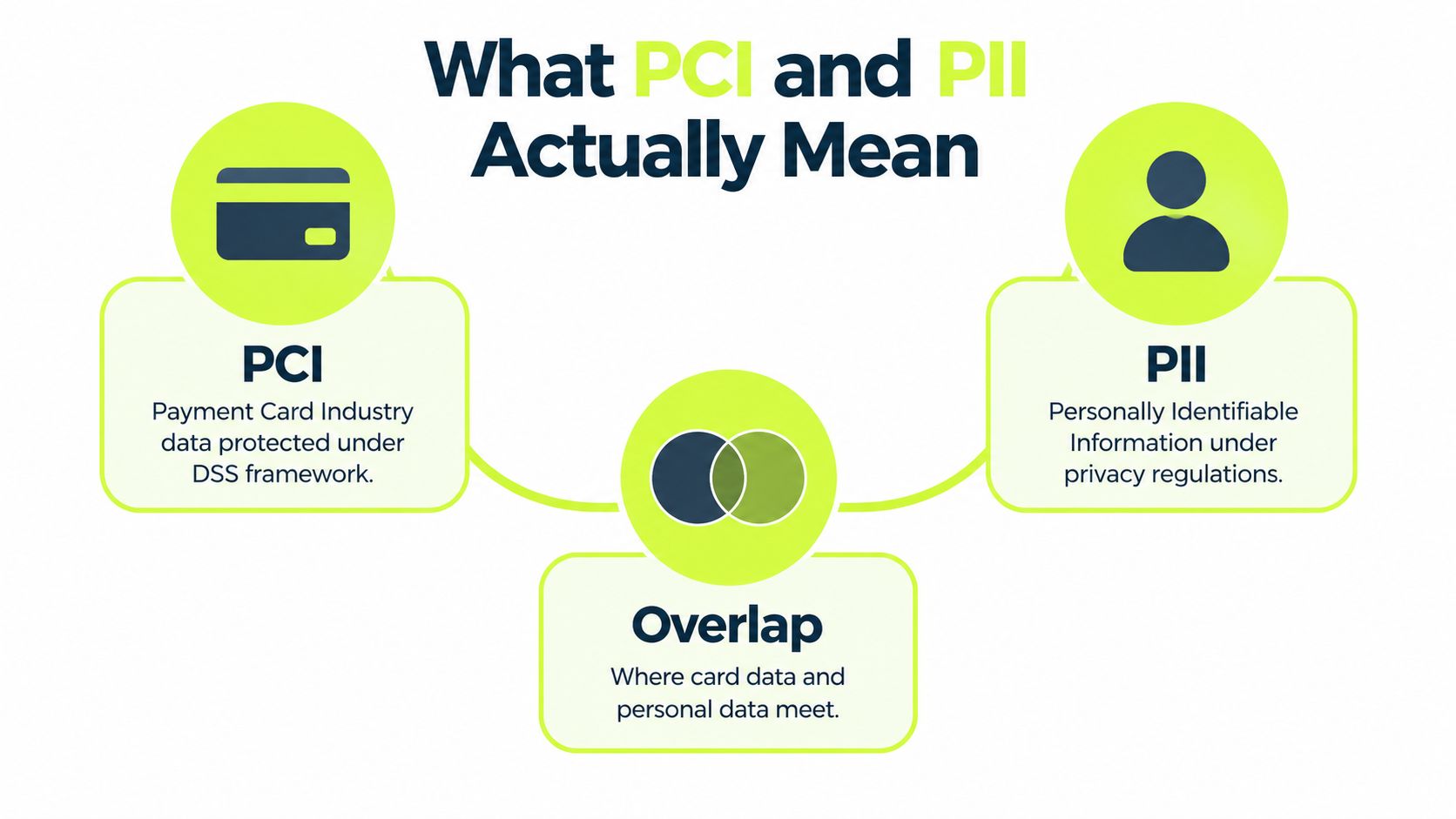
Start with the plain-language distinction. PCI refers to payment-card data governed by the Payment Card Industry Data Security Standard (PCI DSS). PII refers to information that can identify a person, either by itself or when combined with other linked information.
The PCI Security Standards Council created PCI DSS as a baseline of technical and operational controls for protecting account data. PCI scope follows the data: a system may be in scope if it stores, processes, or transmits account data, or connects to systems that handle it. That means a system used during a payment flow isn't automatically in scope just because it's used for payments, and a system outside the checkout screen isn't automatically out of scope.
PII is broader than a name or account number. NIST defines it as information that can distinguish or trace someone's identity, alone or in combination with information linked or linkable to them. Examples include Social Security numbers, birth information, biometrics, medical and educational records, financial data, and employment information. NIST's guidance on protecting PII confidentiality treats protection as a lifecycle responsibility, from inventory and access control through handling, retention, and incident response.
That definition makes PII a context-sensitive category, not a fixed checklist. A work email, job title, location, device identifier, or timestamp might not identify someone alone. Combined, those details can point to a particular employee, especially on a small team.
Working definitions: PCI is account data covered by the payment-card security standard. PII is information that identifies a person directly or through its combination with other data.
When a team needs outside support to map obligations and controls, it can find compliance consulting help while building its own understanding of the data involved.
How the Two Categories Compare Side by Side
PCI and PII differ in what they protect and how their obligations are organized. PCI DSS is a defined industry security standard. PII is a broad information category that may fall under different privacy laws depending on the person, organization, data, and location involved.
| Comparison point | PCI | PII |
|---|---|---|
| What it covers | Payment-card account data and the systems that store, process, transmit, or connect to it | Information that identifies or can help identify an individual |
| Primary framework | PCI DSS, maintained by the Payment Card Industry Security Standards Council | A patchwork of privacy laws and rules, with no single global equivalent to PCI DSS |
| How scope is assessed | Trace where account data flows and which systems handle or connect to it | Identify personal information and the contexts in which it can identify someone |
| Typical examples | A primary account number (PAN) and related payment data | Names, contact details, biometrics, employment information, and linkable combinations |
| Practical focus | Protect the account-data environment and maintain evidence of controls | Limit inappropriate access, use, disclosure, and retention of personal information |
PCI DSS was created by the Payment Card Industry Security Standards Council to establish a baseline for protecting account data. Its requirements are tied to systems and data flows, not to whether an organization belongs to the payments industry. An organization that accepts card payments needs to examine where account data goes, including behind-the-scenes services and connections.
PII doesn't have one universal standard that applies identically in every jurisdiction. Privacy obligations may come from sector-specific laws or broader regional frameworks, such as GDPR for relevant international operations. The details depend on the organization's circumstances, so this comparison is a starting point for classification, not legal advice.
The categories can overlap. A customer record could contain a name and billing email, which are PII, alongside a PAN, which may bring the record or connected system into PCI scope. That doesn't make PCI and PII interchangeable: each classification asks a different question and can require a different assessment.
For a GRC analyst, the useful habit is to track both dimensions in the same inventory. Record what fields exist, where they move, which systems can access them, and why access is needed. Then assess privacy obligations and PCI scope independently instead of assuming that satisfying one automatically satisfies the other.
Why PCI DSS 4.0 and 4.0.1 Change the Training Calculus
PCI DSS v4.0 changed more than the version number. Published in March 2022 after a three-year development process that collected more than 6,000 items of feedback from over 200 organizations worldwide, it expanded multifactor authentication under Requirement 8, replaced firewall-specific terminology with the broader concept of network security controls, and added targeted risk analyses. Those analyses let organizations determine appropriate activity frequencies based on their own risks.
The previous version, v3.2.1, remained active during a two-year transition period and was retired on March 31, 2024. PCI DSS v4.0.1 followed as a limited revision with corrections and clarifications rather than new requirements. These milestones are set out in the PCI compliance awareness training overview, which can help teams connect standard changes to workforce practices.

The training implication is practical: people's daily decisions affect whether controls work. A support agent who shares a sensitive screenshot, an administrator who changes a cloud configuration, or an employee who approves an unexpected authentication request can undermine processes that look sound on paper.
Teach the behavior behind the control
A useful PCI lesson connects the requirement to a recognizable task. For authentication, employees need to know how to respond to prompts they didn't initiate and how to report suspicious requests. For data handling, they need to recognize when a payment detail belongs in an approved payment system rather than a ticket, Slack message, or screenshot.
Documentation matters, too. Teams should be able to show that controls are operating, that responsibilities are understood, and that decisions tied to risk analysis are recorded. Attendance alone doesn't demonstrate that an employee can distinguish a token from a PAN or knows where to report accidental disclosure.
A standard sets expectations for the organization. Training helps each person recognize what those expectations mean in the workflow they actually use.
PCI readiness is therefore ongoing operational work, not a one-time certification exercise. Teams need to review controls as technologies and threats change, preserve evidence over time, and reinforce the everyday actions that keep account data from drifting into unapproved tools.
The Overlap Zone Where Card Data and Personal Data Live Together
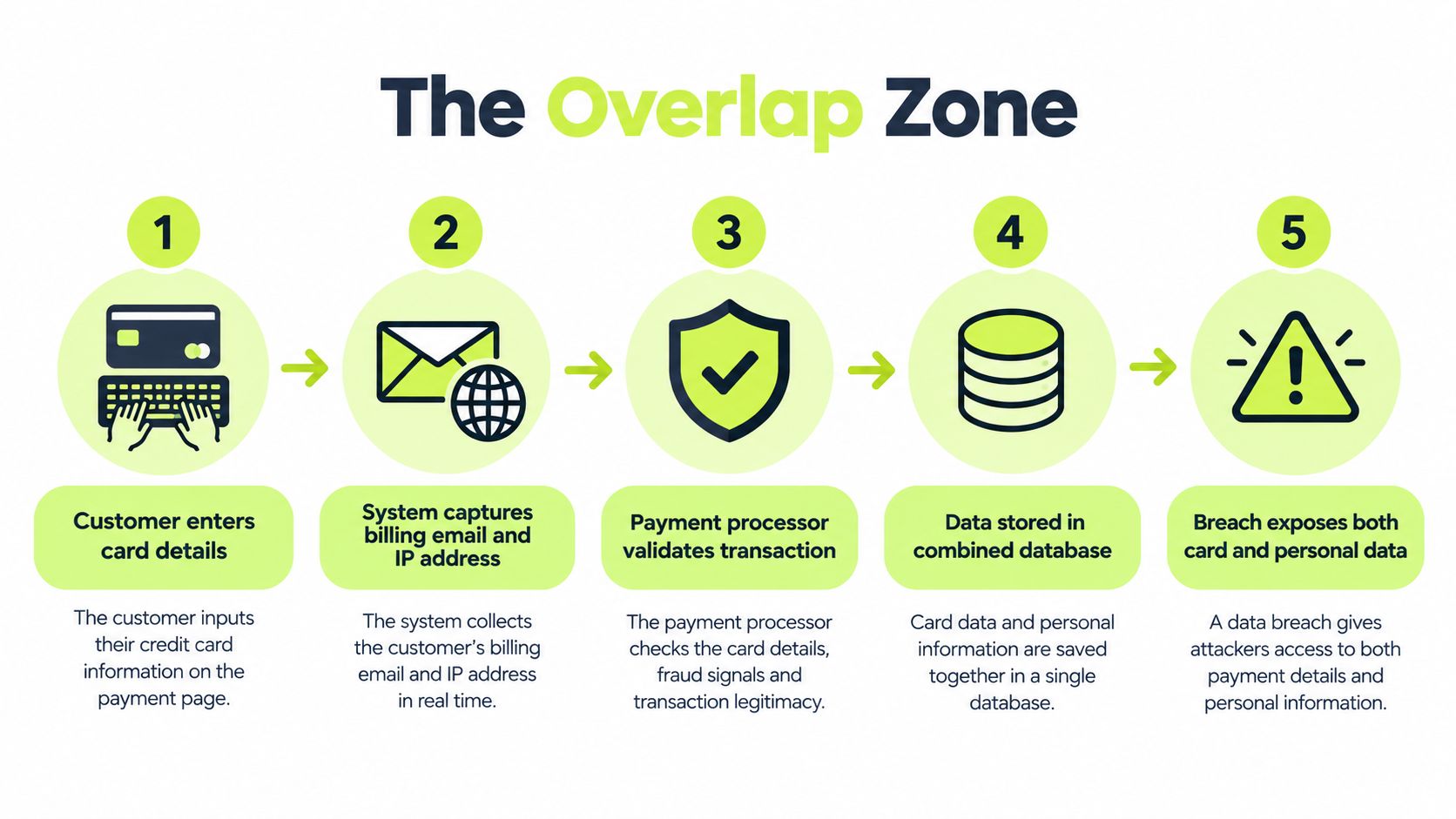
A payment record rarely contains only payment information. A customer may provide a card number through an approved checkout flow, while the surrounding systems retain a name, billing email, IP address, device details, or shipping address. Those fields can travel into analytics platforms, support tools, logs, backups, and customer-service systems. Some may identify the customer even when they don't contain card data.
Tokenization can reduce exposure to card numbers by replacing a PAN with a payment token. But a token doesn't erase privacy obligations for the customer's name, email, or other linkable details. PCI scope also depends on the architecture: the payment token's treatment, any detokenization service, connected systems, key management, and systems that still handle the underlying PAN all matter.
The PCI Security Standards Council's tokenization guidance explains that a token used according to the EMVCo Payment Tokenisation Specification can fall outside PCI DSS scope when it exists outside the token service provider environment. Systems that also handle the PAN, or connect to systems that handle account data, can remain in scope. So tokenization may reduce the number of systems exposed to card numbers, but it doesn't automatically remove compliance obligations.
Trace fields, not just systems
Take the support-ticket example. A screenshot may show a masked card number, a home address, and a billing email. The card detail raises a PCI scoping and handling question. The address and email raise PII handling questions. If someone posts the image in a broad Slack channel, the team must also establish who could see or retain it and whether the channel creates a new storage or transmission path.
A field-by-field data-flow map helps expose this collision zone. Track PANs, tokens, keys, logs, backups, administrative connections, and personal details separately. For additional guidance on organizing practical safeguards, teams can review these customer data protection best practices.
A simple rule works well for frontline teams: if a detail can identify a person, handle it as PII, whether or not a PAN appears beside it. For payment data, staff should never paste PANs into Slack channels, tickets, screenshots, or support conversations. A recurring scenario exercise can ask employees to distinguish a harmless payment reference from a token and a PAN, then record completion and comprehension.
For a deeper look at recognizing personal information in everyday work, see PII training for employees.
Here's a short visual explainer to reinforce how data can converge during a payment workflow.
How Real Breaches Expose the Human Layer
A sound policy can't prevent every mistake unless employees can apply it in the tools they use. Verizon's 2025 breach report identifies misdelivery, misconfiguration, and publishing errors among leading action varieties. These patterns map directly to everyday cloud work: sharing a screenshot in the wrong channel, exposing a file through a misconfigured storage setting, or publishing a customer detail where a wider audience can see it.
Turn common mistakes into short practice
A support employee might paste a customer reference into a public Slack channel while looking for help. A finance worker could mistake a convincing message for an authorized payment change. An engineer might share a configuration screenshot that reveals personal data in a corner of the image. Each is a distinct behavior worth rehearsing, not just a warning buried in a general policy.
Social engineering adds another route into the same collision zone. IBM's 2025 report says phishing accounted for 37% and deepfake attacks for 35% of analyzed social-engineering-driven breaches. Those figures are specific to the analyzed breach category, but the training lesson is broadly useful: employees need a reliable way to question unexpected requests, verify identity through an approved channel, and report suspicious messages.
For a Slack-first team, training scenarios can use familiar moments:
- Misdelivery: An employee chooses the wrong channel or recipient. Practice checking the audience before sending and knowing how to report a mistaken post.
- Misconfiguration: A cloud folder or shared document exposes information too broadly. Teach staff to pause before changing access and to escalate uncertainty.
- Phishing or impersonation: A message asks an employee to disclose customer information or approve an unusual request. Rehearse independent verification rather than relying on the message's apparent urgency.
A single annual module may leave long gaps between instruction and the moment someone needs to act. Short, recurring refreshers can address the specific risks a role encounters, while just-in-time coaching can respond to a risky event with a relevant reminder. Teams can build on this approach with social engineering training for employees.
Designing Slack-Native Microlearning for Both Data Classes
PCI and PII controls meet inside daily workflows, so training should reach people there. For a team that already works in Slack, short interactive lessons can teach employees how to handle payment data, spot indirect identifiers, report suspicious requests, and avoid sending sensitive information into the wrong conversation.
Role-aware training makes the practice more relevant. Finance staff can rehearse an unexpected payment-change request; support teams can learn to remove customer details from screenshots and tickets; engineering teams can practice checking cloud access and keeping sensitive fields out of logs. Everyone may need a shared baseline, but each role also needs examples that match its access and responsibilities.
A workable program can combine short lessons, brief recurring reminders, pulse quizzes, phishing simulations, and coaching after a risky action. The point isn't to add activity for its own sake. It's to give employees repeated, realistic chances to apply the rule before they face the actual decision.
For compliance teams, training records should show more than attendance. Track completion, comprehension, overdue assignments, and remediation, then retain certificates or other evidence with the relevant control documentation. Where tools support it, synchronize evidence with systems such as Vanta or Drata to reduce manual collection.
Vigil Security offers interactive lessons inside Slack, recurring refreshers, quizzes, phishing campaigns with coaching, role-aware assignments, and evidence synchronization with Vanta and Drata. Teams should still check that any training platform fits their controls, audience, and evidence needs. The important design principle is to connect each lesson to a behavior employees can perform in the tools they already use.
A useful lesson ends with an action the learner can take immediately, such as removing a customer detail from a draft before posting.
A 30-Day Plan to Operationalize PCI and PII Readiness
A joint inventory gives a security team a practical starting point. The aim isn't to force PCI and PII into a single category. It's to document where they overlap, where they don't, and which people and systems need clear handling rules.
Build the work into four weeks
- Week one: Map payment and personal-data flows. Separate PANs and tokens from names, addresses, emails, device identifiers, logs, and support records. Identify systems that store, process, transmit, or connect to account data.
- Week two: Assign role-specific Slack training to finance, support, and engineering teams. Schedule a phishing simulation, and confirm how training evidence will reach your compliance records or tools.
- Week three: Run a tabletop exercise in a Slack channel. Use a misdelivered support screenshot as the scenario, then ask who should respond, what data is involved, and what evidence needs to be preserved.
- Week four: Review completion, comprehension, overdue assignments, and any remediation. Export certificates or other records, and update the inventory where the exercise exposed gaps.
A compliance checklist template guide can help organize owners, evidence, and follow-up actions. Use it to support the inventory, not as a substitute for validating actual data flows and access.
The key distinction remains: PCI minimization isn't the same as privacy minimization. Reducing PAN exposure can narrow the card-data environment, but personal information may remain in the surrounding tools and workflows. Keep training tied to people's roles, record whether they understand the rules, and revisit the plan when systems or processes change.
Vigil Security delivers short, interactive security and compliance lessons in Slack, with role-aware assignments, phishing coaching, and evidence synchronization for tools such as Vanta and Drata. If your team needs a practical way to reinforce PCI and PII handling in everyday workflows, visit Vigil Security to explore the platform.