Cyber security compliance training can be complete on paper while risk is getting worse. Verizon's 2025 Data Breach Investigations Report found that the human element was involved in approximately 60% of analyzed breaches, a proportion broadly stable compared with the previous year (Verizon's 2025 DBIR executive summary). That's why I treat training as a preventive control with evidence of ongoing operation, not an annual course and a stack of completion certificates.
The audit question isn't just, “Did people finish the module?” It's whether the organization can show that the right people received relevant instruction, understood it, and got follow-up when their behavior showed a gap. The practical answer is a continuous evidence system: role-based assignments, short lessons in the tools employees already use, and behavior measures that tell you what's changing.
What Cyber Security Compliance Training Actually Does
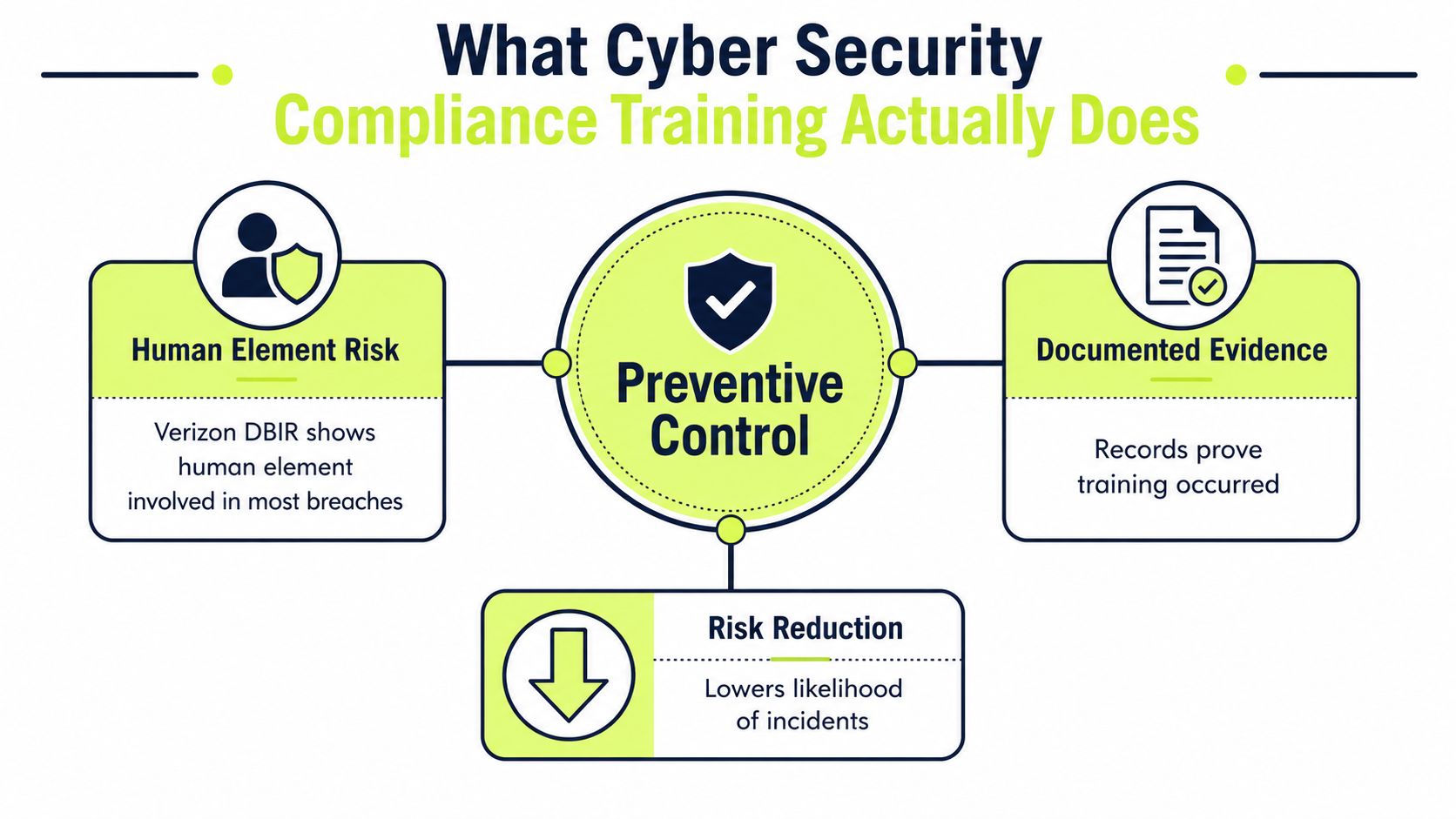
Security training belongs in the risk register, not only in onboarding. Verizon's finding that the human element appeared in approximately 60% of analyzed breaches points to a clear operational risk: employees, contractors, and other authorized users can become part of an attack through phishing, social engineering, credential theft, misconfiguration, or unsafe information handling (Verizon's 2025 DBIR executive summary).
That doesn't mean employees are the problem. It means an organization needs to help people make secure decisions within the systems and processes they use. Cyber security compliance training is a documented preventive control: the organization assigns relevant instruction, records participation and comprehension, and follows up when someone needs remediation.
Translate control language into evidence
Frameworks use different language, but auditors are looking for evidence that responsibilities are communicated and that the control operates. SOC 2 CC1.4, ISO 27001 A.6.3, PCI DSS 12.6, and HIPAA 164.308(a)(5) are familiar touchpoints for training and awareness programs. For each applicable requirement, map the control to an owner, an assigned population, the training content, completion records, assessment results, and remediation records.
A certificate proves an event happened. It doesn't establish that the lesson was relevant to the person's work, that the person understood it, or that the organization addressed a failed assessment. Build records that connect who was assigned what, when they completed it, how they performed, and what happened next.
Evidence, not attendance: A useful training record shows the control working, not merely the learner showing up.
This is the standard I'd apply before an audit: could someone unfamiliar with the program trace the requirement from policy to assignment to learner result to any corrective action? If not, the organization has a course catalog, not a defensible control.
The Regulatory Drivers Behind the Training Requirement
Cybersecurity has moved from an IT-only concern into formal governance and public reporting. In 2023, the U.S. Securities and Exchange Commission adopted rules requiring public companies to disclose material cybersecurity incidents and material information about cybersecurity risk management, strategy, and governance. A domestic registrant must file a Form 8-K within four business days after determining that an incident is material; annual disclosures under Regulation S-K Item 106 apply to fiscal years ending on or after December 15, 2023 (SEC cybersecurity disclosure guidance).
The SEC rules don't mandate a specific training platform or cadence. They do make it more important to demonstrate how the organization communicates responsibilities and manages cyber risk. That's where well-maintained training evidence supports governance: it can show that people received relevant policies and instruction, and that managers followed up on gaps.
Match the artifact to the framework
The refresh column below is an operating recommendation, not a claim that every framework prescribes the same schedule. Check the specific requirements and commitments that apply to your organization, then set a cadence that matches risk and job changes.
Training Evidence Expected by Major Frameworks
| Framework | Training Evidence Artifact | Refresh Expectation |
|---|---|---|
| SOC 2 | Security-awareness policy, assigned training records, assessment results, remediation evidence | On hire, recurring, and when roles or policies change |
| ISO 27001 | Awareness and training records tied to information-security responsibilities | Recurring and when relevant responsibilities change |
| PCI DSS | Security-awareness materials, participation records, and evidence of ongoing awareness | Follow the applicable PCI DSS requirements and document the organization's cadence |
| HIPAA | Security-awareness and training records for workforce members | Maintain a documented cadence and update for relevant policy or workflow changes |
| SEC disclosure rules | Governance and risk-management documentation, supported by relevant control evidence | Maintain evidence continuously; disclose material matters under the applicable rules |
The distinction matters: requirements differ from good operational practice. Don't tell an auditor that a framework requires a particular training interval unless you've verified that requirement for your scope. Do show who owns the program, which populations it covers, how the organization refreshes content, and where the records live.
For public companies, incident disclosure can become a governance issue on a compressed timeline. A preventive control that's assigned, measured, and documented is easier to explain than a last-minute claim that training happened sometime during the year.
Designing a Program That Changes Behavior, Not Just Checkboxes
An annual video and quiz can be easy to administer, but they give employees little practice making decisions under pressure. A NIST-reviewed study found that static training produced no measurable benefit, while interactive training made participants approximately 20% less likely to fail subsequent phishing simulations than untrained participants. Simulated lures still attracted clicks from roughly 10–30% of employees (NIST-reviewed interactive-training study).
Build a continuous learning loop around practice, feedback, and repeat testing. Treat each assignment and follow-up as part of an evidence system that shows how training connects to employee behavior.
Build around the decision employees need to make
Use role-specific scenarios. Engineers need practice handling secrets, repositories, and production access. Finance staff need to recognize payment redirection attempts and verify unusual requests. Executives need to respond safely to impersonation and sensitive-data requests. Assigning relevant scenarios gives each group practice tied to its work. Start with this guide to role-based security training.
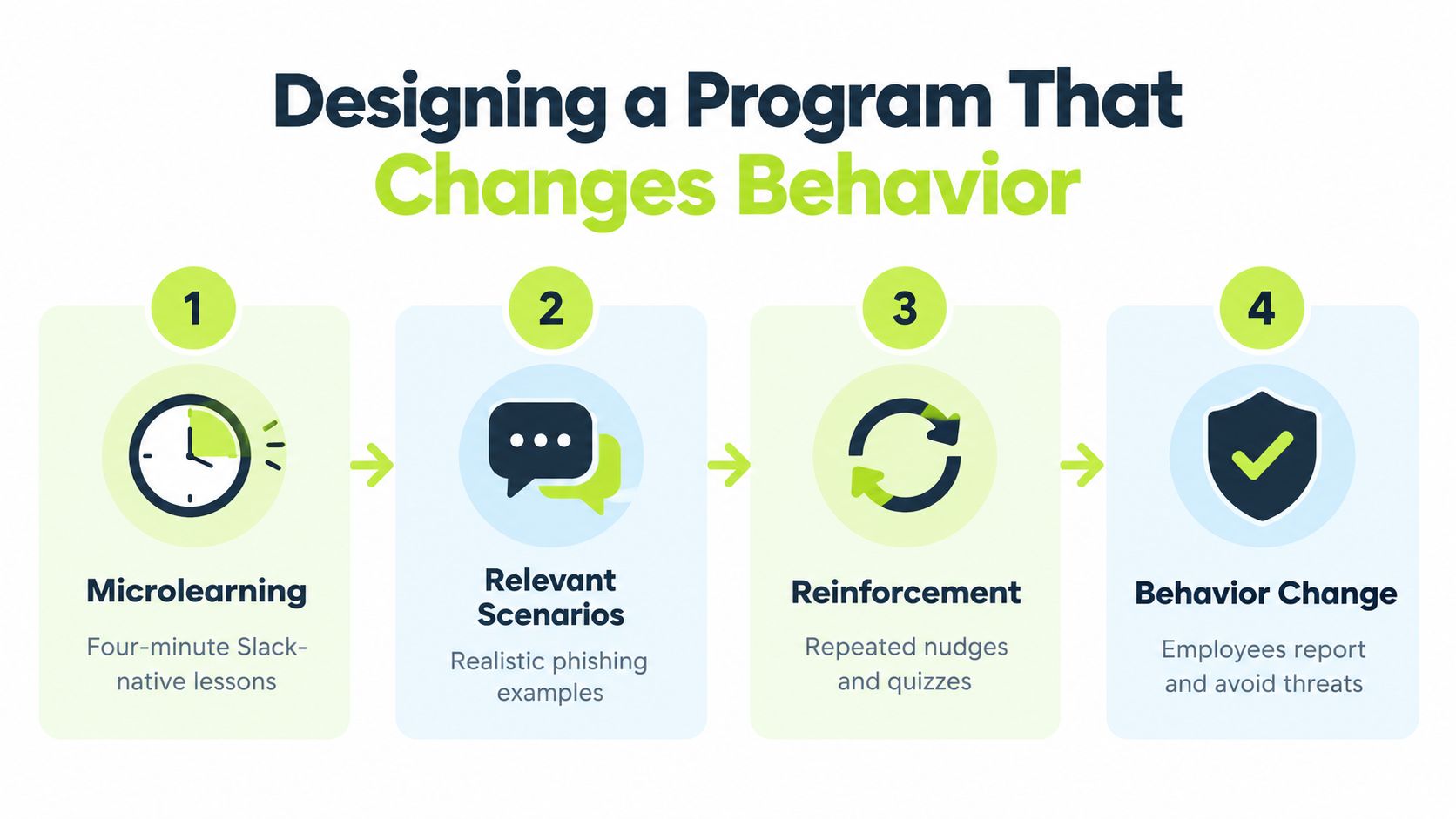
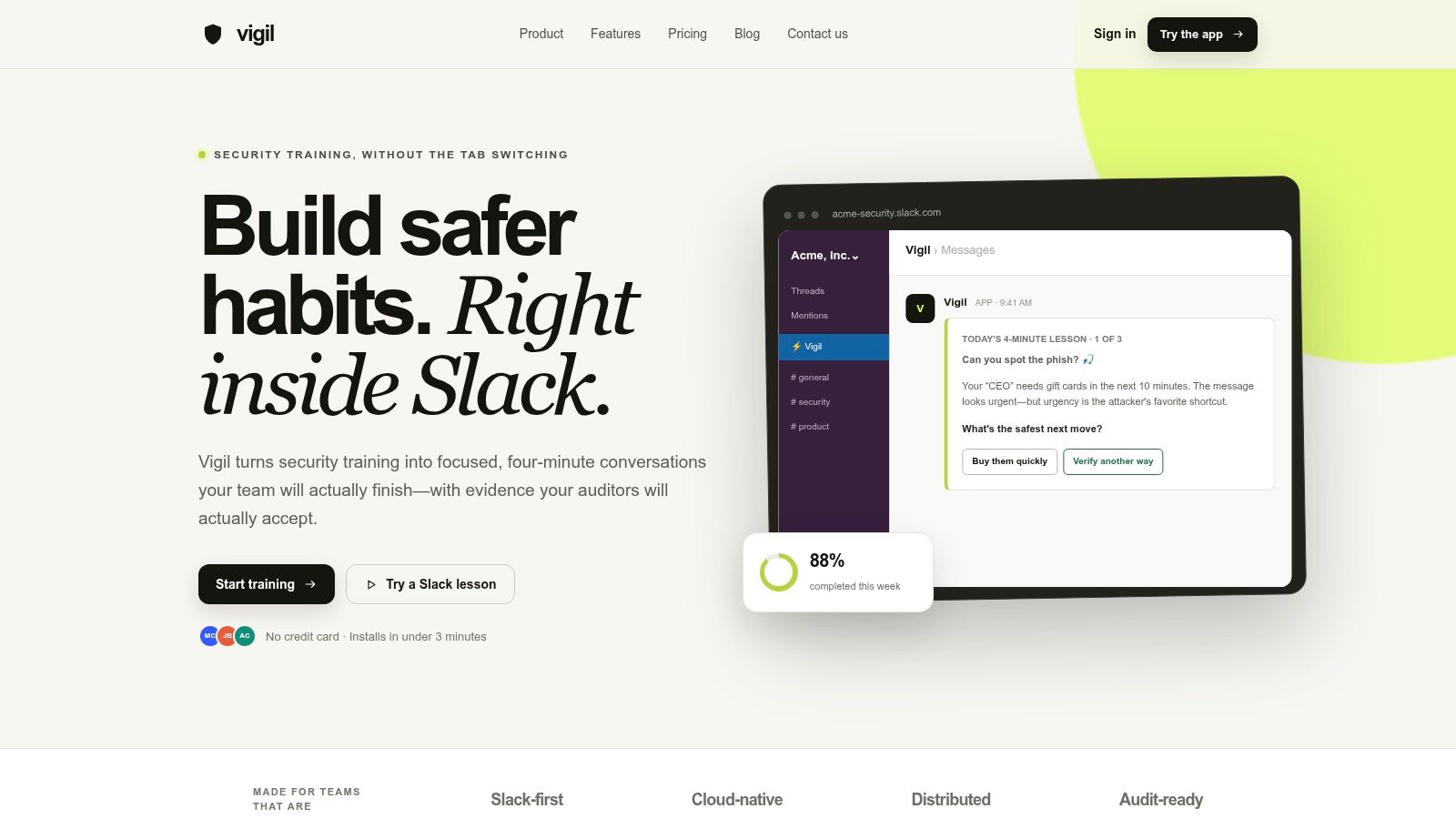
Deliver short lessons where employees already work. Slack-native microlearning can place a focused lesson, a question, and corrective feedback in a conversation, without requiring learners to open an external portal. Follow each lesson with recurring refreshers and phishing simulations to check whether employees apply the decision beyond the lesson.
Coach employees after simulations. When someone clicks, explain the signal they missed and the action to take next time. Reinforce reporting behavior as well. Track reporting, repeat failures, and time to report, then use those results to target the next lesson.
Trigger instruction when the work changes
Set assignments to respond to onboarding, contractor enablement, access to sensitive systems, policy updates, and job changes. Review content when workflows change, rather than waiting for the annual cycle.
This gives a steering committee a clear connection between risk, role, intervention, and observed behavior. Review an LMS vendor's default annual video and quiz against the practice, feedback, and follow-up your program needs. If the system cannot capture those elements, it is built to administer courses, not support behavior change.
Measuring Effectiveness and Producing Audit-Ready Evidence
Completion is an administrative metric. It shows who finished an assignment, not whether behavior changed. Pair it with phishing reporting rate, repeat-failure rate, time to report, comprehension results, and overdue status. As noted earlier, interactive training calls for measures that capture what employees do afterward. Weight reporting and repeat-failure trends alongside completion, rather than treating completion percentage as the main indicator.
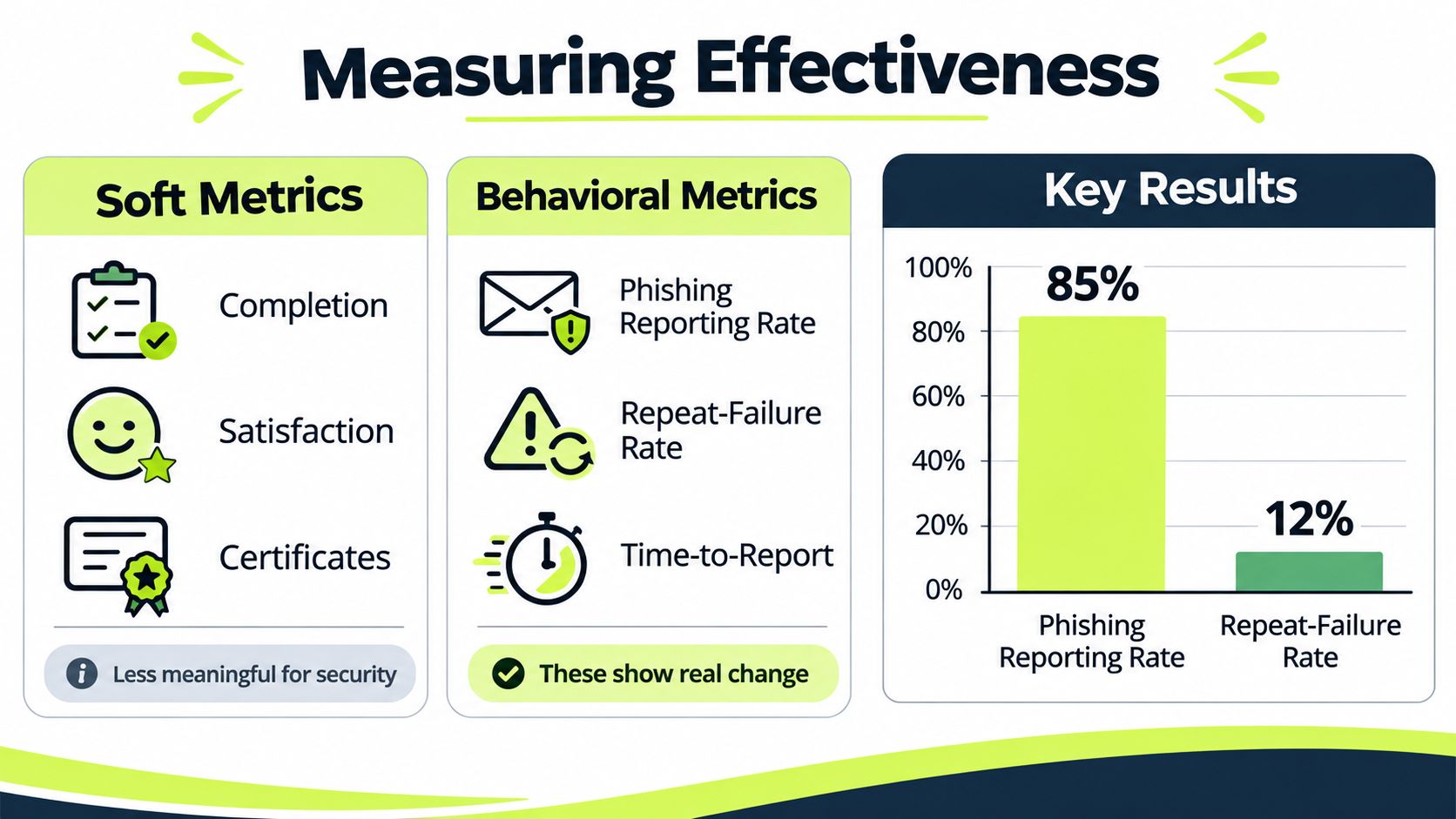
The infographic's percentages illustrate possible measures; they are not verified benchmarks. Set baselines using your workforce's results, define each metric consistently, and compare performance over time. Use the findings to assign targeted follow-up, not to present illustrative figures as expected outcomes.
Create evidence an auditor can trace
For every assignment, retain the learner or population, role or team, assigned content, assignment and completion dates, assessment result, overdue status, and remediation. For simulations, keep the campaign and behavior outcome, such as reporting or repeat failure. Assign an owner and align retention with your evidence process. A completion certificate alone does not show whether the control reached the right population or prompted follow-up.
Connect the training platform to Vanta or Drata only if the integration captures the fields your control requires. Test the evidence before audit season: check that the correct population appears, completion status updates, failed assessments trigger follow-up, and exports reconcile with the source system. A quarterly CSV may support a specific workflow, but it should not be the only way to check whether training is current.
Measure the gap, then act on it. A metric without an owner or follow-up is decoration.
Compare learner experience with audit requirements using this overview of compliance training that boosts adoption. Then establish a repeatable process for retaining and retrieving records, informed by guidance on archiving and compliance. Treat those records as part of a continuous evidence system: preserve assignment, behavior, and follow-up history so an auditor can trace the control beyond a one-time completion record.
Choosing Slack-Native Delivery Over a Traditional LMS
A traditional LMS can centralize courses and certificates. Slack-native delivery puts short lessons and checks into a workspace employees already use. Neither delivery method automatically creates an effective control. The decision should turn on whether the system can reach the right people, capture useful evidence, and support follow-up without adding unnecessary friction.
Use a vendor review to test the workflow, not just the feature list. Ask an administrator to assign training to a role or team, ask a learner to complete it, and then verify what the compliance owner can retrieve.
Slack-Native Training Versus Traditional LMS
| Decision Axis | Traditional LMS Portal | Slack-Native Delivery |
|---|---|---|
| Completion | Requires employees to visit a separate portal | Places lessons in a familiar workspace |
| Audit effort | May require manual exports and reconciliation | Can support direct evidence sync, depending on the platform |
| Behavior metrics | Depends on available simulation and assessment features | Can combine lessons, quizzes, and in-workspace coaching |
| Admin overhead | May require separate assignment and reminder workflows | Can automate assignments and reminders within the workspace |
| Access friction | May require a separate login or password | Uses the workspace learners already access |
Slack-native delivery fits distributed, Slack-first organizations that want focused lessons, refreshers, quizzes, and phishing coaching without sending learners to another portal. Ask how the vendor handles role mapping, contractor access, failed assessments, evidence exports, and platform changes. For teams reviewing workspace integrations, it can help to browse Slack connectors and assess what permissions and workflows an app may require.
Vigil Security is one option in this category. It delivers interactive lessons, recurring microlearning, quizzes, phishing coaching, assignment workflows, and evidence synchronization with Vanta and Drata inside Slack. Compare those functions against the needs of your control environment rather than assuming that Slack delivery alone proves effectiveness.
For a closer look at simulation design and follow-up, review these phishing simulation services. Then watch the product overview below as one input to your evaluation, not as a substitute for testing the workflow against your own evidence requirements.
Closing the Gaps Annual Training Leaves Behind
An annual completion certificate is weak evidence if people still mishandle AI tools, suppliers have access to sensitive systems, or recurring failures go unaddressed. Treat training as a continuous evidence system: assign learning by role, deliver timely refreshers in the tools people use, and track behavior alongside completion.
AI guidance should specify what employees may enter into approved tools, how to verify outputs, and when a person must review AI-assisted work. The SANS security-awareness report identifies AI as the second-most-cited human risk among security-awareness professionals, up from fourth place in one year. Put role-specific scenarios and policy reminders into your program. Train staff to use approved AI safely and escalate uncertain cases, rather than banning useful tools by default.
Extend the population beyond employees
A signed vendor questionnaire does not teach the people handling your data how to protect it. Verizon's 2025 DBIR, cited earlier in this article, points to a clear action: extend training expectations to suppliers and service providers before they handle sensitive systems or data.
Map assignments to access and responsibility. Give contractors and partner personnel relevant instruction before access begins, then retain records showing who completed it. If guest Slack channels are part of your operating model, use them only when identity, access, and evidence controls meet your requirements. The channel supports the control; it does not own it.
Don't confuse completion with control
A 2025 survey of IT and security professionals found that 93% of organizations had increased security-awareness budgets, while 94% still experienced more human-error-related incidents; 57% of administrators said better employee awareness could have prevented most or nearly all incidents (2025 survey coverage). These figures do not prove training failed. They do show why spend and completion records alone cannot demonstrate improvement.
Track whether employees report suspicious activity, which learners repeat failures, and whether managers remove barriers to secure behavior. Review those findings with your vendor-risk process, and document the follow-up. Use Slack-native microlearning and role-based assignments to keep instruction close to daily work, while retaining evidence of assessment results and remediation. Auditors need more than a certificate: they need a traceable record connecting assigned training to behavior, identified gaps, and corrective action. A program that excludes third parties, ignores AI workflows, or leaves workplace friction untouched has drawn its control boundary too narrowly.
A 60-Day Rollout Plan for Cyber Security Compliance Training
Use the next two months to establish the operating loop, not to produce another annual module. Assign one owner from security or GRC, and get HR, IT, and workspace administration involved before assignments go live.
- Days 1–10: Confirm applicable controls, define the training population, and map roles to the risks and policies they need to understand.
- Days 11–20: Select short lessons and scenario questions. Add AI, phishing, data handling, and role-specific content where it fits your risks.
- Days 21–30: Configure workspace, channel, team, and individual assignments. Set reminders and decide how new hires, contractors, and role changes trigger training.
- Days 31–40: Launch a phishing simulation with immediate coaching. Record reporting, repeat failures, and follow-up actions.
- Days 41–50: Connect evidence workflows to Vanta or Drata, if used. Test synchronization and export, and check that records are complete and traceable.
- Days 51–60: Run a dry audit. Select a sample of learners and trace assignment, completion, comprehension, and any remediation from source record to audit evidence.
Before the next audit window, verify the owner, population, role mapping, current content, overdue assignments, assessment results, simulation follow-up, retention process, and evidence retrieval. If any of those checks rely on someone manually reconstructing a spreadsheet, fix that workflow before the auditor asks for it.
If your current program ends at a completion certificate, Vigil Security offers Slack-native interactive lessons, recurring microlearning, phishing coaching, role-aware assignments, and audit-ready evidence synchronization with Vanta and Drata. Review Vigil Security and assess whether its workflow fits your control requirements, learner population, and audit process.