The largest template library isn't automatically the best phishing simulation service. A simulation program succeeds when employees encounter believable threats, receive useful coaching after risky actions, and build reporting habits in the tools they already use. Buyers also need to evaluate reporting depth, compliance evidence, identity and email dependencies, recurring campaign administration, and the risk of training people to recognize a drill instead of an attack.
That makes operational fit more useful than a simple feature count. The comparison below covers Vigil Security, KnowBe4, Proofpoint, Cofense, Hoxhunt, Terranova Security, Microsoft Attack Simulation Training, Barracuda, Mimecast Engage, and Infosec IQ. The list includes Slack-native and Microsoft-native options, platforms bundled with email security, threat-intelligence-led services, and products that can support managed or partner-led delivery.
The evidence also argues against one-off awareness campaigns. A 2026 benchmark covering 42 million phishing simulations, 14.8 million users, and 64,000 organizations recorded global susceptibility falling from 33.2% before training to 4.2% after one year, a 79% reduction, when continuous security awareness training was used (KnowBe4's benchmark report). That doesn't prove every platform will produce the same result, but it does establish the buying question: which service can your team run consistently, realistically, and measurably?
1. Vigil Security
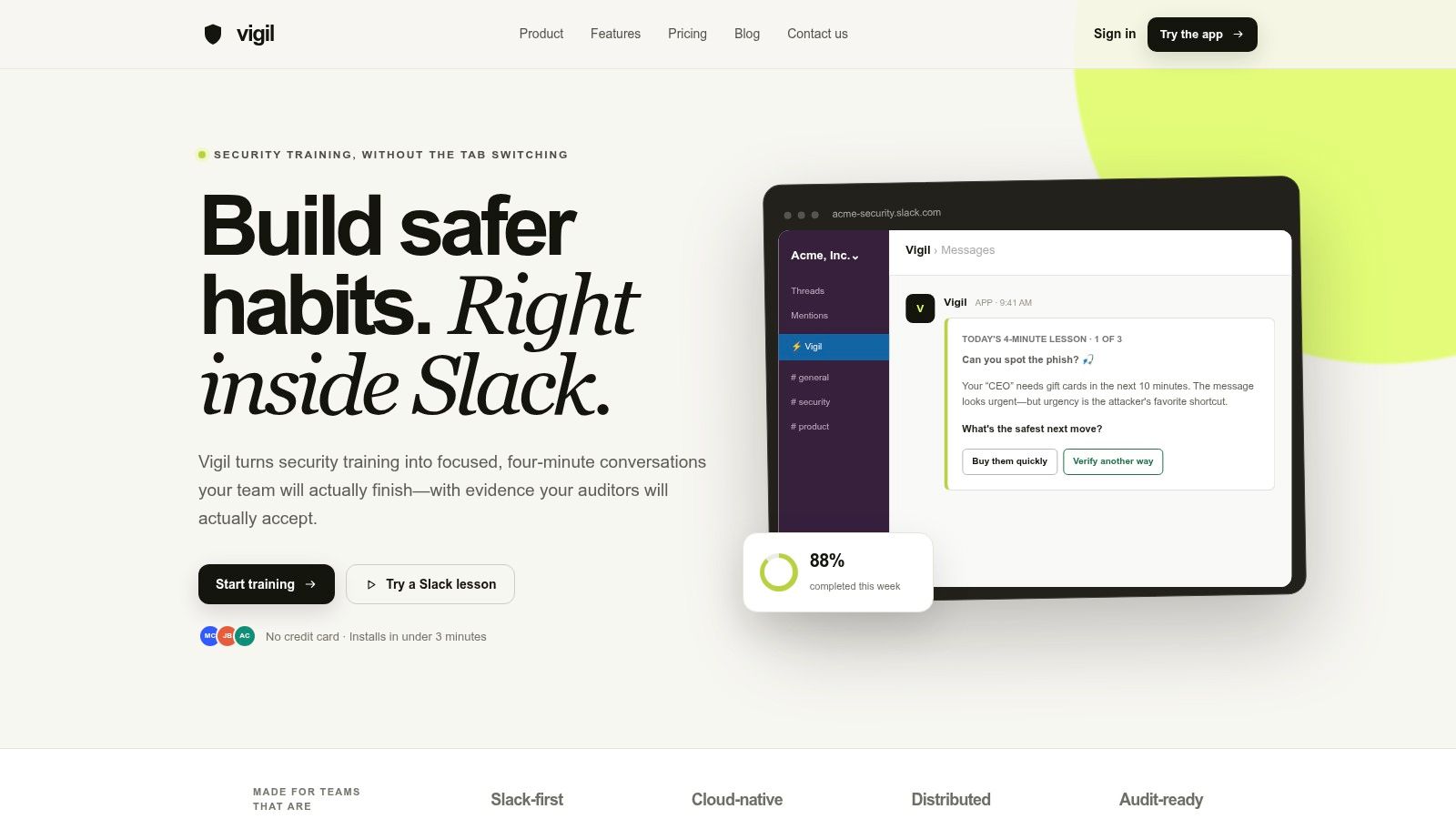
Vigil Security takes a different operational route from portal-first awareness platforms. It delivers security education and phishing coaching inside Slack, where employees already communicate, so learners don't need another password, dashboard, or context switch. That makes it a particularly strong fit for Slack-first, cloud-native, distributed teams whose main problem is sustained participation rather than a shortage of content.
The learning experience combines four-minute interactive lessons, pulse quizzes, scenario-based phishing drills, and weekly 30 to 60 second refresh Streams. When someone responds incorrectly to a phishing simulation, Vigil can provide immediate corrective feedback in Slack. The emphasis is on turning a risky action into a teachable moment, not just recording a failed test.
Best fit for recurring, audit-ready programs
Administrators get automated assignments, reminders, grading, certificates, scheduling, and CSV or PDF exports. Authored assessments use an 80% passing standard, while evidence can synchronize with Vanta and Drata through preview adapters. Vigil also maps lessons to frameworks including SOC 2, ISO 27001, HIPAA, PCI DSS, GDPR, and NIST CSF, which reduces the manual work involved in assembling audit evidence.
The platform supports assignment by workspace, channel, team, or individual. Optional BYOK AI personalization lets an organization use its own OpenAI or Anthropic key for private, role-aware examples, with keys encrypted at rest. Vigil is an employee education platform, not an endpoint security replacement, so buyers should treat it as the behavior and evidence layer alongside email, identity, and device controls.
Practical rule: Choose Vigil when Slack delivery and low administrative friction matter more than access to a very large standalone simulation catalog.
Vigil lists a single plan at $2 per learner per month, with plans starting at 25 learners, or $50 per month. Annual billing starts at $500 per year, which works out to an effective $1.67 per learner per month at that minimum. Setup takes under three minutes, and the service offers a 14-day free trial without requiring a credit card. The trade-off is clear: organizations that don't use Slack as a primary collaboration platform, or teams seeking a conventional email-only service, should look elsewhere.
2. KnowBe4
KnowBe4 is the broadest catalog-oriented option in this comparison. Its platform combines templated and custom phishing campaigns with training, benchmarking, risk-based targeting, and administrative integrations. The published plan structure and per-seat MSRP tiers help procurement teams build an initial budget without waiting for a sales quote, although the available content and capabilities vary by tier.
The service is designed for organizations that want one central console for a wide program. Its features include 200-plus Foundation assets, 1,000-plus Advanced assets, AI-selected phishing templates, just-in-time feedback, Smart Groups, SSO and SCIM integrations, and reporting APIs. Campaign types extend beyond standard email, including USB and QR tests as well as callback and vishing scenarios.
Strong breadth, heavier administration
That scenario range is useful for security teams that need to test different delivery methods or segment users by risk. Smart Groups can support targeting based on campaign results and user attributes, while industry benchmarking gives administrators a reference point for interpreting performance. The platform's maturity also helps larger teams standardize enrollment, reporting, and identity management.
The cost of that breadth is operational complexity. Smaller organizations may find it easy to launch a basic campaign but harder to govern the many content, targeting, training, and reporting choices. Some libraries require premium tiers, so buyers should validate the exact scenarios and integrations included in the proposed package.
A useful comparison is whether the platform reinforces real decision-making or merely increases test volume. This explanation of phishing simulations provides helpful context for evaluating the difference between a simulated click, useful coaching, and durable behavior change.
Best fit: organizations that want a mature, general-purpose platform with broad scenario coverage, published pricing tiers, and extensive administrator controls.
3. Proofpoint Security Awareness Training
Proofpoint Security Awareness Training is strongest when a buyer wants phishing simulations connected to a broader threat-intelligence and email-security environment. The platform uses Proofpoint's view of real-world lures to inform scenarios, while its Very Attacked People model helps identify users who warrant more focused intervention.
The service supports phishing, SMS or smishing, and USB simulations. It also includes culture and knowledge assessments, adaptive learning, People Risk Explorer insights, and automated enrollment into additional training after a user clicks. That workflow matters because a failure can trigger a relevant learning path instead of disappearing into a monthly report.
A natural choice for Proofpoint customers
Proofpoint's main advantage is ecosystem alignment. Organizations already using its email security stack can connect simulation design, user-risk analysis, and awareness workflows more closely than they might with a disconnected vendor. That can reduce duplicate administration and help security teams prioritize people who face higher exposure.
The limitation is procurement transparency. Pricing isn't publicly listed and is typically quote-based, while the platform's full value is most apparent when paired with other Proofpoint products. A standalone buyer should therefore compare the cost of the complete workflow, not just the awareness module.
A simulation is more useful when the person who fails receives a clear next action, and the security team can see whether that intervention changes future behavior.
Proofpoint's approach suits organizations that want threat-intelligence-aligned scenarios and automated remediation. Teams specifically researching social engineering training for employees should also compare whether each platform tests the psychological and operational context behind an attack, rather than only the message format.
Best fit: Proofpoint email-security customers and larger organizations that prioritize threat intelligence, risk-based targeting, and automated follow-up training.
4. Cofense PhishMe
Cofense PhishMe is built around the relationship between phishing simulation, threat intelligence, and the security operations center. Its scenarios can reflect active attacker tactics observed through Cofense Intelligence and the Phishing Defense Center, rather than relying only on generic awareness examples.
The platform supports responsive delivery, campaign playbooks, user provisioning synchronization, scheduling automation, and reporting designed for security operations. A particularly relevant capability is the use of SEG misses, which helps model messages that bypass the secure email gateway. That makes the simulation more representative of the messages employees are most likely to encounter after technical filtering has already failed.
Reporting beyond the click
Cofense places more emphasis on reporting behavior than on click rate alone. That distinction is important because a resilient employee may encounter a malicious message, avoid interacting with it, and report it to the right team. A dashboard that records only clicks can miss that positive behavior.
The service is enterprise-focused, and pricing is quote-based. Buyers may also need additional subscriptions for broader training libraries, so the procurement conversation should separate threat-relevant simulation capability from general awareness content.
Its strongest practical fit is a mature security team that already has incident workflows and wants simulations to reinforce them. The platform is less compelling for a small organization seeking a simple, low-touch compliance program with minimal configuration.
Best fit: security operations teams that want active-threat scenarios, SOC-ready reporting, responsive delivery, and stronger alignment between employee reporting and incident response.
5. Hoxhunt
Hoxhunt treats phishing practice as a continuous and adaptive behavior program. Its agentic reasoning engine adjusts difficulty and cadence according to role, skill, and observed behavior, while gamification gives employees a more visible reason to participate. That model is designed for organizations that worry a fixed campaign schedule will become predictable.
The channel coverage is one of Hoxhunt's clearest differentiators. Simulations can extend across email, SMS, voice, callback, Microsoft Teams, and deepfake scenarios. Outlook and Gmail report-button integrations also reduce the distance between spotting a suspicious message and sending it to the security team.
Strong global and cross-channel coverage
Support for 40-plus languages makes the platform relevant to multinational programs that need more than translated policy documents. Real-time micro-coaching can occur after reporting or clicking, which supports the principle that feedback should arrive close to the decision that created the learning opportunity.
The trade-off is governance. An adaptive system can make many decisions automatically, but regulated organizations still need rules for campaign approval, acceptable scenario boundaries, privacy, escalation, and manager visibility. Hoxhunt's pricing isn't publicly listed and is typically enterprise-oriented, so buyers should evaluate the cost of its automation against the administrative savings it creates.
The platform's value is highest when the organization wants more than periodic email testing. For teams comparing phishing simulation training approaches, the key question is whether users need multi-channel practice and adaptive coaching, or whether their risk profile is concentrated in email and can be handled with a simpler workflow.
Best fit: global organizations seeking adaptive, gamified, multi-channel training with strong in-the-moment coaching.
6. Terranova Security by Fortra
Terranova Security by Fortra combines customizable simulations with short, just-in-time learning. Administrators can adjust templates and landing pages to resemble the threats their workforce is likely to see, while users who fail can receive a short nanovideo explaining the issue at the point of failure.
That pairing gives Terranova a practical middle position. It offers more contextual remediation than a simulation-only product, without requiring every organization to build a complex adaptive program. The platform also includes an administrative interface, performance analytics, multilingual content, and design resources for running an ongoing awareness program.
A balanced option for enterprise programs
Terranova's strongest feature is the link between a failed action and immediate education. A user who submits credentials or follows a risky path needs a clear explanation of the warning signs, not merely a score in a dashboard. Short video remediation can be easier to consume than a full course, particularly when the organization wants to keep the interruption focused.
Pricing is gated behind demo or quote requests. Buyers should also check which analytics and content are included at each tier, because the practical value depends on whether the selected plan supports the reporting and language requirements of the workforce.
The product fits companies that want realism, multilingual delivery, and manageable campaign administration. It may be less suitable for teams that require Slack-native delivery, deep GRC synchronization, or a broad non-email channel strategy as their primary differentiator.
Best fit: enterprise teams looking for customizable phishing scenarios, multilingual content, and integrated just-in-time remediation without adopting a highly complex adaptive model.
7. Microsoft Attack Simulation Training
Microsoft Attack Simulation Training is the ecosystem-first choice for organizations standardized on Microsoft 365. The capability is built into the Microsoft Defender portal for customers with Defender for Office 365 Plan 2 or eligible Microsoft 365 E5 and security add-on arrangements. That native position can remove the need to establish a separate mail-flow relationship or identity integration.
The service supports credential-harvesting, malware, and other attack scenarios, with targeting and reporting managed in the Defender environment. Training flows are integrated into the same administrative surface, which can simplify access management and evidence collection for organizations already using Microsoft's security controls.
Integration is the main reason to choose it
Microsoft's advantage isn't necessarily a broader behavior-change methodology. It's deployment coherence. If employee identities, mail routing, security policies, and reporting already live in Microsoft 365, the organization can avoid introducing another vendor into the message-delivery path.
That benefit comes with a dependency. The capability requires the relevant Defender plan or Microsoft security licensing, and list pricing isn't consistently published because Microsoft and its resellers commonly sell the service as part of a wider package. A buyer should calculate the marginal cost and confirm which attack types, training experiences, reports, and administrative controls are available in the existing tenant.
Ecosystem test: If your security team already manages mail flow and identity in Microsoft Defender, native deployment may outweigh the appeal of a larger standalone content library.
Microsoft is a strong fit for organizations that value centralized control and minimal third-party integration. Teams using Slack as the primary learning and collaboration environment, or those seeking a vendor-neutral GRC workflow, may need a different operational layer.
Best fit: Microsoft 365 organizations that already hold the required Defender licensing and want native tenant administration.
8. Barracuda Security Awareness Training
Barracuda Security Awareness Training is aimed at customers that want phishing simulations and awareness reporting connected to Barracuda Email Protection. The offering includes simulation templates, analytics, user-risk tracking, and integrations with Barracuda's email gateway and inbox defense APIs.
The practical case for Barracuda is vendor consolidation. A team already operating Barracuda's email controls may prefer to manage awareness and email protection through a related ecosystem rather than maintain another integration, allowlist, reporting pipeline, and contract.
Useful for bundled procurement
Barracuda's managed awareness options also make it relevant to managed service providers and partners. That can help organizations without a dedicated awareness administrator, provided the service agreement clearly defines campaign ownership, user communications, escalation, evidence exports, and remediation responsibilities.
The main drawback is that the bundle may be more than a buyer needs. Awareness pricing isn't typically published as a standalone product, and customers interested only in simulations should compare the full Barracuda Email Protection Premium Plus package against specialist alternatives.
Barracuda suits teams that value a consolidated email-security relationship over maximum independence. It isn't the obvious choice for a Slack-native program, a threat-intelligence-led SOC workflow, or a highly customized cross-channel behavior program.
Best fit: Barracuda email-security customers and MSP-supported organizations that want bundled awareness training, integrated risk tracking, and fewer vendors to administer.
9. Mimecast Engage
Mimecast Engage combines phishing simulation, short-form training, customization, reporting, and risk scoring. Its content strategy emphasizes high-production modules and regular refreshes, which is useful for organizations that struggle to keep training material relevant and engaging.
The platform also connects naturally with Mimecast email security. Direct message delivery can improve simulation deliverability and reduce the need for manual whitelisting, while automation is intended to reduce the work involved in recurring campaigns. For an email-security team already working in Mimecast, that can simplify both launch and maintenance.
Content engagement versus ecosystem dependence
Mimecast's strongest fit is a buyer that wants polished, short learning modules without building a content program internally. Frequent updates can also help avoid the stale-template problem that makes simulations easier for employees to recognize.
Pricing isn't publicly listed and the buying process is enterprise-oriented. Some advanced functionality may also assume adoption of the broader Mimecast stack, so organizations should ask whether the product remains useful if Mimecast email security is not already in place.
The platform is less differentiated for buyers whose primary requirement is training inside a collaboration tool or connecting simulation evidence directly to a specific GRC platform. Those teams should compare the amount of manual export and mapping required after campaigns run.
Best fit: Mimecast customers that want polished, regularly refreshed training, direct message delivery, and automation around email-based awareness campaigns.
10. Infosec IQ
Infosec IQ is a broad awareness and anti-phishing platform with a strong emphasis on content, role-based learning, and administration across multiple environments. It includes unlimited phishing simulations, a drag-and-drop campaign builder, a PhishNotify reporting add-in, culture surveys, risk scoring, APIs, and multi-tenant administration.
Its training library includes 350-plus modules across 34-plus languages, while LMS and SCORM support makes it a practical option for organizations that need to connect security awareness with an existing learning system. The product can also be combined with Infosec Skills for technical development, which may appeal to companies that want one supplier for general awareness and security upskilling.
A good fit for structured learning environments
The Standard, Enterprise, and IQ plus Skills structure gives buyers a clear way to compare packages, although advanced capabilities are gated to higher tiers. Global administrators can manage multiple tenants or business units, while APIs and LMS support help larger organizations fit the product into established training operations.
Pricing requires form submission and is quote-based. That means procurement teams should request a feature-by-feature breakdown, especially for campaign automation, reporting, multi-tenant administration, language coverage, and the exact capabilities included in each plan.
Infosec IQ is strongest when the organization values a substantial learning catalog and LMS compatibility. It may be less suitable for teams that want all learning and coaching delivered natively in Slack, or buyers that prioritize threat-intelligence-driven simulations over broad course administration.
Best fit: organizations with formal LMS, SCORM, multilingual, or multi-tenant requirements that want phishing simulations inside a wider learning program.
Top 10 Phishing Simulation Services Comparison
| Product | Core features | Quality (★) | Value & Pricing (💰) | Target (👥) | Unique selling points (✨) |
|---|---|---|---|---|---|
| Vigil Security 🏆 | Slack-native 4-min lessons, weekly refresh Streams, phishing sims, BYOK AI, Vanta/Drata evidence sync, automated workflows | ★★★★☆, high engagement (~88% weekly) | 💰 $2/seat/mo (annual), min 25; 14‑day free trial | 👥 Slack-first CISOs, GRC, HR/People Ops, Eng teams | ✨ Native Slack delivery, audit-ready sync, fast setup, role-aware BYOK |
| KnowBe4, Security Awareness Training | 1,200+ training assets, templated/custom phishing, benchmarking, APIs | ★★★★, broad coverage | 💰 Published per-seat MSRP tiers; scalable pricing | 👥 Large orgs, regulated enterprises, training teams | ✨ Massive template library, USB/QR/vishing support, benchmarking |
| Proofpoint Security Awareness | Threat-intel–driven phishing/SMS sims, adaptive learning, VAP targeting | ★★★★, intel-aligned results | 💰 Quote-based enterprise pricing | 👥 Enterprises needing threat-intel alignment, Proofpoint customers | ✨ VAP (Very Attacked People) insights, tight email-security integration |
| Cofense PhishMe | Active-threat templates, SEG-miss filtering, SOC-ready reporting & playbooks | ★★★★, high realism | 💰 Quote-based, enterprise-focused | 👥 SOC teams, security ops, orgs prioritizing intel-driven sims | ✨ Real-time threat templates, SOC playbooks, reporting emphasis |
| Hoxhunt, Adaptive, Gamified | Adaptive cadence, gamification, cross-channel sims (email/SMS/voice/Teams), 40+ languages | ★★★★★, very high engagement | 💰 Quote-based (enterprise) | 👥 Global orgs, multilingual workforces, gamified programs | ✨ Agentic engine, gamification, multi-channel & localization |
| Terranova Security (Fortra) | Customizable phishing templates, nanovideo just-in-time training, analytics | ★★★★, balanced engagement | 💰 Quote/demo-based tiers | 👥 Enterprises, global teams seeking easy admin | ✨ Nanovideo remediation, strong multilingual support |
| Microsoft Attack Simulation (Defender) | Built into Defender portal: credential/malware simulations, native tenant integration | ★★★★, integrated for M365 users | 💰 Included with Defender Plan 2 / M365 E5 (or add-on) | 👥 Microsoft 365 tenants and centralized MS stacks | ✨ Native tenant identity/mailflow integration, centralized control |
| Barracuda Security Awareness | Phishing templates, continuous testing, integration with Barracuda Email Protection | ★★★, solid when bundled | 💰 Bundle-driven pricing; often part of Premium Plus | 👥 Barracuda customers, MSPs seeking consolidation | ✨ Bundled with email protection, managed MSP options |
| Mimecast Engage | High-production short modules, phishing sims, automation & reporting | ★★★★, content-forward | 💰 Enterprise/quote-based | 👥 Mimecast users, orgs wanting engaging content | ✨ High-production content, frequent refreshes, DM delivery |
| Infosec IQ (Cengage) | 350+ modules, unlimited sims, LMS/SCORM support, multi-tenant admin | ★★★★, comprehensive | 💰 Clear tiered bundles (Standard/Enterprise/IQ+Skills); quote-based | 👥 OrgS needing LMS integration, combined skill training | ✨ LMS/SCORM support, combine awareness with Infosec Skills |
How to Choose the Right Service
Start with the workforce's primary collaboration and email ecosystem. A Slack-first organization should test whether native Slack delivery increases participation and simplifies coaching. A Microsoft 365 customer should first confirm what Attack Simulation Training already provides under its existing Defender licensing. Barracuda, Mimecast, and Proofpoint deserve closer consideration when their email-security products already sit in the message path.
Then compare the attack surface, not just the number of templates. Email remains important, but the strongest operational fit may require QR codes, SMS, voice, callback, USB, Teams, or identity-oriented scenarios. Ask vendors how they keep simulations realistic without making them predictable, how they prevent repetitive campaigns from creating fatigue, and whether administrators can vary timing, audience, language, and difficulty.
Post-click coaching should be a procurement requirement. Confirm what the employee sees immediately after a risky action, whether the explanation identifies the social-engineering technique, and whether the system automatically assigns follow-up learning. A click-rate report tells you what happened. It doesn't tell you whether the employee understood the lesson or whether the organization made the next safe action easier.
Reporting needs the same scrutiny. Look for:
- Behavior signals: reporting, clicking, credential submission, repeat failures, and completion should be distinguishable rather than combined into one score.
- Evidence exports: confirm whether the service produces CSV, PDF, API, or GRC-ready records and whether it supports your audit workflow.
- Targeting controls: check whether campaigns can be assigned by role, team, location, risk level, or business unit.
- Administrative effort: ask how long campaign setup, reminders, remediation, exception handling, and quarterly reporting take in practice.
- Managed delivery: determine whether a vendor or MSP can handle planning, execution, user communications, and incident escalation if internal capacity is limited.
The available evidence supports recurring programs, but it also warns against treating frequency as the only answer. A separate 2026 analysis covering more than 60,000 organizations, 32,604,108 users, and 493,871,295 phishing tests found that groups testing weekly were 2.74 times more effective at reducing risk than groups testing less than quarterly (KnowBe4's analysis of continuous testing). That finding supports regular practice, but a good program still needs varied scenarios, sensible governance, and useful feedback.
Run a pilot with representative users from finance, HR, engineering, executives, remote teams, and frontline roles. Define success measures before launch, including reporting behavior, comprehension, completion, repeat-risk patterns, and administrator hours. Don't approve recurring campaigns until you document rules for scenario approval, privacy, sensitive populations, manager access, escalation, data retention, and what happens after a user fails.
Finally, treat market growth claims carefully. Published estimates differ substantially because reports use inconsistent market definitions, but the forecasts consistently describe a growing segment and identify cloud delivery as a dominant deployment model in one market analysis (phishing simulator market estimates). That signals continued vendor investment, not proof that any particular service is effective for your workforce. The best choice is the platform your team can operate continuously, connect to its existing controls, and use to demonstrate better decisions rather than more completed tests.
Vigil Security delivers Slack-native security awareness training, recurring microlearning, phishing simulations, and instant coaching with automated assignments and audit-ready evidence for tools such as Vanta and Drata. If your organization wants lower-friction behavior practice inside the workflow employees already use, visit Vigil Security to evaluate its Slack-based approach.