Three-factor security requires three independent authentication categories, knowledge, possession, and inherence, rather than multiple credentials of the same type. Factor independence matters more than raw count, because three checks tied to one compromised device or recovery channel can be weaker than well-designed phishing-resistant two-factor authentication.
Your organization may already have MFA enabled across critical systems. Employees enter passwords, approve phone prompts, and receive one-time codes, while security dashboards show reassuring green indicators. Then an attacker sends a convincing help-desk message, captures the password and live code through a phishing proxy, or persuades a user to approve an unexpected request. The login succeeds because the controls were present, but they didn't create separate barriers.
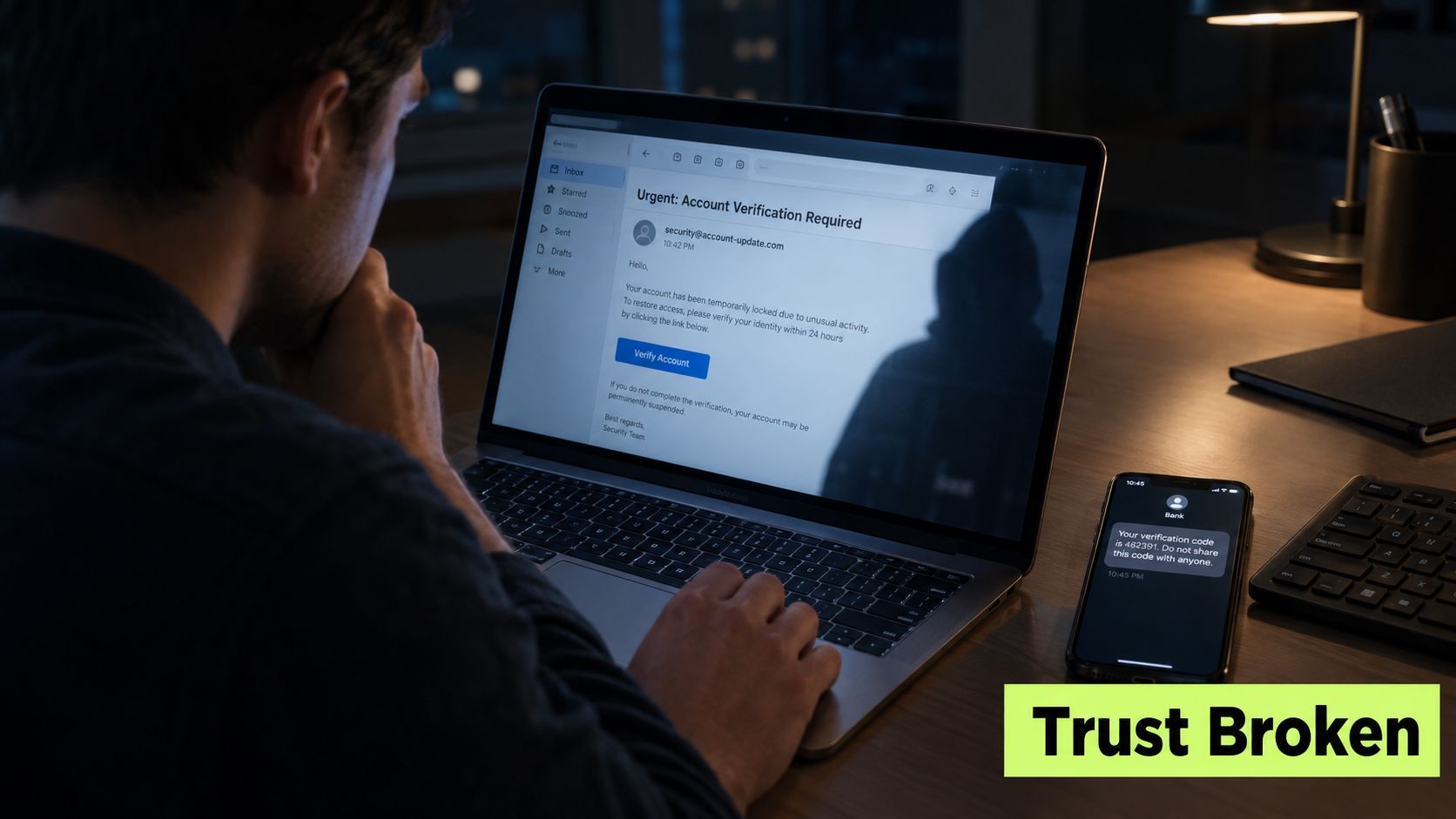
The issue isn't that MFA has no value. The issue is treating authentication as a checklist instead of a layered defense system. A password and a code can block a stolen password, but a real-time attacker may capture both. A biometric prompt may add another screen while still depending on the same already-accessed device, session, or recovery process.
Security leaders should therefore ask a more useful question than “How many factors do we have?” Ask whether compromising one factor gives an attacker the information, device access, or session control needed to defeat the others. That distinction is central to security in layers, where each control should reduce the consequences of a failure elsewhere.
The adoption gap behind the concern
Authentication weaknesses remain common. Verizon's 2024 Data Breach Investigations Report found that credentials were involved in more than 44% of confirmed breach incidents, while external threat actors were responsible for 65% of breaches. Those figures don't prove that every MFA deployment is weak, but they show why password-centric access still deserves attention. Verizon's 2024 breach report findings place credential protection at the center of modern defensive planning.
Adoption is uneven as well. The same Expert Insights summary of a 2024 global survey reported MFA use among 89% of U.S. small and medium-sized businesses, compared with 35% of SMBs globally, and 87% of companies with more than 10,000 employees. These numbers point to a maturity gap, not a universal security baseline. Smaller and distributed organizations may have MFA enabled while still relying on vulnerable methods, weak recovery workflows, or user approvals that attackers can manipulate.
Understanding the Three Core Authentication Factors
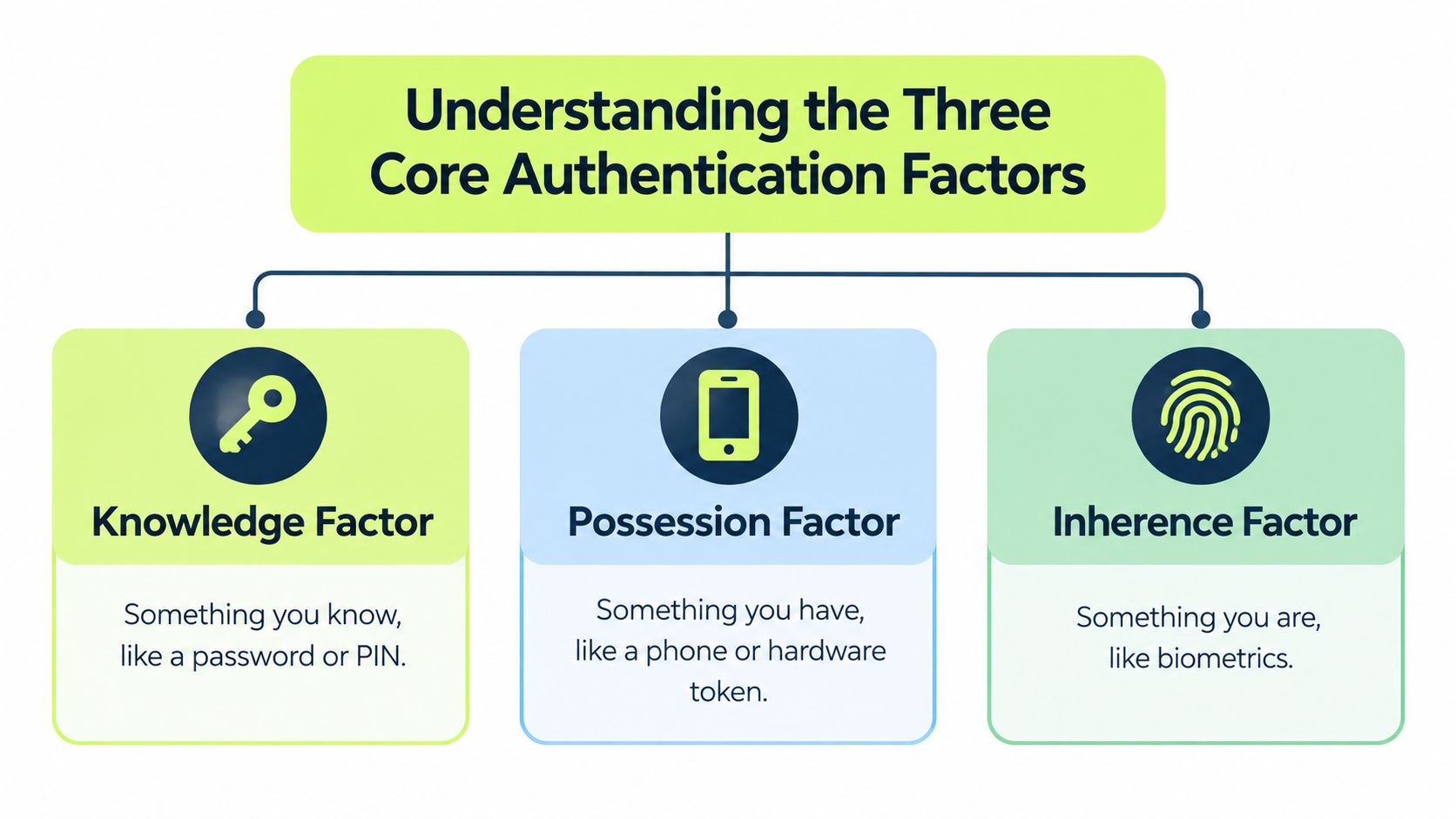
The traditional three-factor model classifies authentication evidence into knowledge, possession, and inherence. Each category answers a different question about the claimant. What do they know? What do they control? What are they?
Knowledge
A knowledge factor is something the user knows. Common examples include a password, passphrase, PIN, or answer to a security question. A password manager can help users create and store stronger secrets, but the category remains knowledge because access depends on presenting information the claimant possesses mentally or through a secret store.
Knowledge factors are useful, familiar, and easy to deploy. They're also exposed to phishing, reuse, credential stuffing, malware, and social engineering. If an attacker obtains the password, the knowledge category may be compromised without affecting the user's physical device or biometric characteristic.
Possession
A possession factor is something the user controls. That might be a phone, hardware token, smart card, or cryptographic key. The important property isn't only that the user owns an object. The system should verify control of a registered authenticator in a way that prevents an attacker from replaying a captured response.
A phone-based one-time code is still a possession-oriented control, but its security depends heavily on how the code is delivered and validated. A device-bound cryptographic credential generally provides stronger protection because the secret key can respond to a challenge without revealing reusable authentication material.
Inherence
An inherence factor is something the user is, usually a biometric characteristic such as a fingerprint, face, iris, or voice. Biometrics can make local authentication quick and convenient, but they aren't passwords that users can replace after exposure. That makes privacy, device protection, liveness controls, and enrollment governance important parts of the design.
The categories matter because defeating one doesn't automatically defeat the others. A stolen password doesn't grant control of a registered hardware key, and possession of a phone doesn't automatically produce a matching fingerprint. The Financial Action Task Force describes MFA as using at least two independent authenticators from different categories, not merely requiring two passwords or two steps based on the same evidence. Its digital identity guidance provides the conceptual foundation for distinguishing independent factors.
Practical rule: Three passwords are three credentials, not three factors.
A development organization applying this model should also protect its build systems, repositories, and deployment credentials. Teams reviewing secure CI/CD with MFA can use the same test: each authentication element should represent a separate kind of evidence, with recovery and administrative access held to comparable standards.
What Truly Makes Factors Independent
Independence means that compromising one factor shouldn't disclose, enable, or permit replay of the others. It isn't enough for the login screen to display three prompts. The security boundary must separate the evidence, the authenticator, and the recovery path.
Consider a flow that asks for a password, a fingerprint, and a phone approval. At first glance, it appears to cover all three categories. In practice, the password may be entered into a phishing site, the fingerprint may only access the same phone that receives the approval, and the recovery process may let a help-desk operator replace both controls after a persuasive call. The system has three labels but one concentrated trust boundary.
Test the trust boundaries
Use these questions during architecture reviews:
- Disclosure: If the password is stolen, does the attacker learn anything reusable about the device or biometric check?
- Replay: Can an attacker capture a code, approval, or session artifact and use it at another site?
- Device binding: Is the possession factor cryptographically tied to a registered device or key?
- Origin binding: Does the authenticator verify the legitimate website rather than merely responding to a prompt?
- Recovery independence: Can an attacker reset all factors through one email address, phone number, or support interaction?
- Revocation: Can security staff revoke one factor without disabling auditability or weakening the remaining controls?
NIST's assurance model separates AAL2, which uses two-factor authentication, from AAL3, which requires a hardware-based authenticator and verifier-impersonation resistance. The distinction shows why adding prompts isn't equivalent to choosing a stronger authenticator. NIST's authentication guidance emphasizes independent factors and the security properties of the authenticator, not a mechanical count of login steps.
Factors versus credentials
A credential is the specific secret, device, key, or biometric record used by a system. A factor is the category of evidence that credential represents. Two passwords are separate credentials in the same knowledge category. A password plus two SMS codes still doesn't create three independent categories.
A stronger cloud design might use a memorized secret alongside a device-bound cryptographic authenticator, with a local PIN or biometric granting access to that authenticator. That arrangement can be useful when the local activation step stays on the trusted device and the cryptographic response is bound to the legitimate origin. It still requires careful analysis of whether the PIN, biometric, and key are being treated as separate evidence or as multiple steps inside one possession boundary.
Factor independence also applies outside the primary login. Enrollment, recovery, step-up authentication, privileged actions, and session renewal must preserve the same separation. A carefully designed login can be undermined by a reset process that accepts a weak email confirmation. Teams strengthening this human layer should pair technical controls with guidance on protecting against social engineering attacks.
Comparing Practical Three-Factor Architectures
Architecture decisions become clearer when each option is evaluated against the threat it must resist. A password, a hardware key, and a biometric may offer three categories, but it can introduce hardware enrollment, accessibility, privacy, and recovery demands. A password, passkey, and device posture signal may reduce friction, but the posture signal isn't necessarily an authentication factor in the classic sense.
| Architecture | Main strengths | Main concerns |
|---|---|---|
| Password, hardware token, biometric | Covers the three classic categories and can protect high-value access | Hardware logistics, biometric privacy, accessibility, and recovery complexity |
| Password, FIDO2 or WebAuthn credential, local PIN or biometric | Uses phishing-resistant cryptography and device-local activation | Requires compatible authenticators, careful enrollment, and secure recovery |
| Password, authenticator-app OTP, biometric | Familiar and easier to deploy across existing systems | OTP can be disclosed to a real-time attacker, while device compromise can join the checks |
| Password, passkey, managed-device posture | Strong cryptographic login paired with organizational device assurance | Device posture is a contextual control, not automatically an independent factor |
| Password, push approval, SMS or email code | Broad compatibility and low initial deployment friction | Prompt bombing, phishing proxies, SIM-related abuse, and shared recovery dependencies |
Prefer cryptographic possession
NIST states that passwords aren't phishing-resistant. Where phishing resistance is required, its guidance calls for approved cryptographic algorithms with at least 112 bits of security strength. It also distinguishes between merely adding OTP prompts and using authenticators that resist verifier impersonation. NIST's authenticator requirements should therefore shape the selection process.
OTP methods still have a role. They improve resilience when the only threat is password compromise, but a user can disclose a valid code to a live attacker, or an attacker can proxy the interaction. FIDO2 and WebAuthn credentials are stronger choices when the organization needs origin-bound authentication and challenge-response that doesn't expose a reusable secret to a fake site.
Keep recovery out of the blind spot
Don't let the strongest login coexist with a weak fallback. Prohibit email as an out-of-band authentication channel where the risk profile demands stronger assurance, monitor every recovery and enrollment event, and require independent verification before support staff replace an authenticator. A new device or altered recovery method should generate an investigation signal, not disappear into routine account administration.
Network access deserves the same treatment. Guidance on zero-trust network access is useful because it shifts attention from a single successful login to resource-specific authorization, device context, and ongoing verification. Three-factor authentication should open an appropriately limited path, not create a permanent assumption that every subsequent request is trustworthy.
Why More Factors Don't Guarantee Safety
A third factor can add protection, but it doesn't automatically outperform well-designed phishing-resistant two-factor authentication. NIST's guidance recognizes that two factors can satisfy the highest relevant authentication requirements, while its newer material says biometrics should be used only with a physical authenticator and presented for each authentication operation.
A password, biometric, and phone prompt may all be attached to one compromised device, browser session, or recovery channel. If an attacker obtains an authorized session after the user completes the checks, the factors may have done their job at login while failing to protect the session that follows.
Authentication ends, but the session continues
Vendor-reported industry data cited in a recent analysis found that MFA was enabled on 59% of accounts attackers successfully took over in 2025, and that MFA failed in 84% of cases reviewed by the incident-response source. The figures are not universal breach rates, but they illustrate why security leaders should treat them as warning signals about bypass techniques, including session hijacking, token theft, and phishing aimed at authenticated sessions. The reported MFA bypass analysis makes the post-login gap difficult to ignore.
After authentication, attackers may target session cookies, refresh tokens, device-code flows, or application permissions. They may also exploit a newly registered authenticator or a reset performed by a manipulated help desk. A system that checks three factors once and then trusts a long-lived session has concentrated its defense at the front door while leaving internal movement less protected.
A successful login proves that an authentication event passed. It doesn't prove that every later request is safe.
Measure resistance, not ceremony
Security teams should distinguish between factor inflation and genuine resilience. A biometric prompt can improve local assurance, but it won't repair a phishing-prone possession method or a weak recovery channel. An additional code can create user fatigue without preventing an adversary-in-the-middle attack.
Account takeover prevention also depends on what happens after the initial challenge. Resources on preventing account takeover fraud reinforce the operational need to monitor unusual sessions, protect recovery, and detect behavior that doesn't fit the user's normal access pattern.
Evaluate these controls alongside factor count:
- Session protection: Use short-lived, device-bound tokens where practical, and revoke sessions after confirmed compromise.
- Sensitive actions: Require reauthentication for payment changes, privilege elevation, recovery changes, and authenticator enrollment.
- Risk detection: Flag unusual devices, locations, impossible behavior patterns, and suspicious token reuse.
- User behavior: Teach employees that unexpected approval prompts, pasted login links, and urgent help-desk requests remain dangerous after MFA is enabled.
- Administrative paths: Apply stronger controls to identity administrators and support personnel because they can alter the authentication system itself.
Deploying Three-Factor Security Effectively
Effective 3 factor security starts with a risk decision, not a product setting. Protect privileged accounts, sensitive applications, and high-impact workflows according to their consequences, then select authenticators that create separate trust boundaries without making recovery impossible for legitimate users.
Build the control set
Start with a design review that maps every authentication event, not just the standard login. Include enrollment, device replacement, password reset, help-desk escalation, privileged actions, session renewal, and emergency access. For each path, document what evidence the user presents, where that evidence is verified, and whether one compromised channel can replace the others.
A practical deployment sequence looks like this:
- Choose phishing-resistant possession first. Prefer FIDO2, WebAuthn, or PKI credentials that bind the response to the legitimate origin. Don't assume a larger number of OTP prompts creates equivalent protection.
- Define the local activation method. Use a PIN or biometric to activate a trusted authenticator, while keeping the device's local operation distinct from the server-side cryptographic proof.
- Harden recovery before rollout. Require independent verification, log every reset, alert on new authenticator enrollment, and test lost-device procedures with support staff.
- Limit the resulting session. Apply device posture, resource authorization, risk signals, short-lived tokens, and reauthentication for high-impact actions.
- Train for active attacks. Practice recognition of real-time phishing, device-code abuse, unexpected approval prompts, and fake support requests.
Design test: If an attacker controls one factor and one session, identify exactly what they can do next.
Monitor the system as a living control
Authentication logs should connect identity events with application activity. A suspicious sign-in followed by a new authenticator, unusual API access, or large-scale repository activity deserves more attention than any single event in isolation. Security teams should review failed challenges, recovery requests, device changes, token reuse, and privileged access patterns on a recurring basis.
Usability belongs in the design as well. Offer accessible alternatives for users who can't or won't use a particular biometric, maintain a controlled process for lost authenticators, and avoid forcing employees into unsafe workarounds. In containerized and cloud-native environments, teams evaluating how to deploy auth on Kubernetes should make identity boundaries, workload access, secrets handling, and operator recovery part of the same threat model.
For teams that need a visual reminder of the operating model, this video provides an additional explanation of layered authentication and deployment considerations.
The right success metric isn't the number of prompts users complete. It's whether a stolen password, compromised device, phished code, hijacked session, or manipulated recovery request can independently defeat the rest of the system. Review that question during architecture changes, tabletop exercises, vendor assessments, and compliance audits.
Vigil Security helps distributed teams reinforce these behaviors through short, interactive security lessons, phishing simulations, and recurring microlearning delivered directly in Slack. Visit Vigil Security to turn three-factor security principles into measurable, repeatable user practice and audit-ready evidence.