A user signs in from home, a developer opens a cloud console from a personal laptop, and a contractor needs one internal application for a short assignment. All three may pass the same identity check, yet their devices, locations, roles, and requests carry different levels of risk. If your security model still treats “inside the network” as safe, the boundary no longer matches the way your organization works.
Zero Trust Network Access (ZTNA) addresses that mismatch by evaluating access around a specific user, device, session, and resource. It doesn't assume that a successful login makes every later action safe. Instead, it limits what the requester can reach and keeps checking whether access should continue.
Understanding Zero Trust Network Access Principles
A traditional office network often worked like a building with one guarded entrance. Once an employee passed the front desk and entered the building, many rooms were easier to reach. That model becomes fragile when employees work from home, applications run across several cloud environments, and contractors connect from devices the security team doesn't manage directly.
An attacker who compromises one account shouldn't automatically gain a tour of the entire corporate environment. Zero trust changes the question from “Are you inside?” to “Should this verified requester access this specific resource right now?”
Trust is not a network location
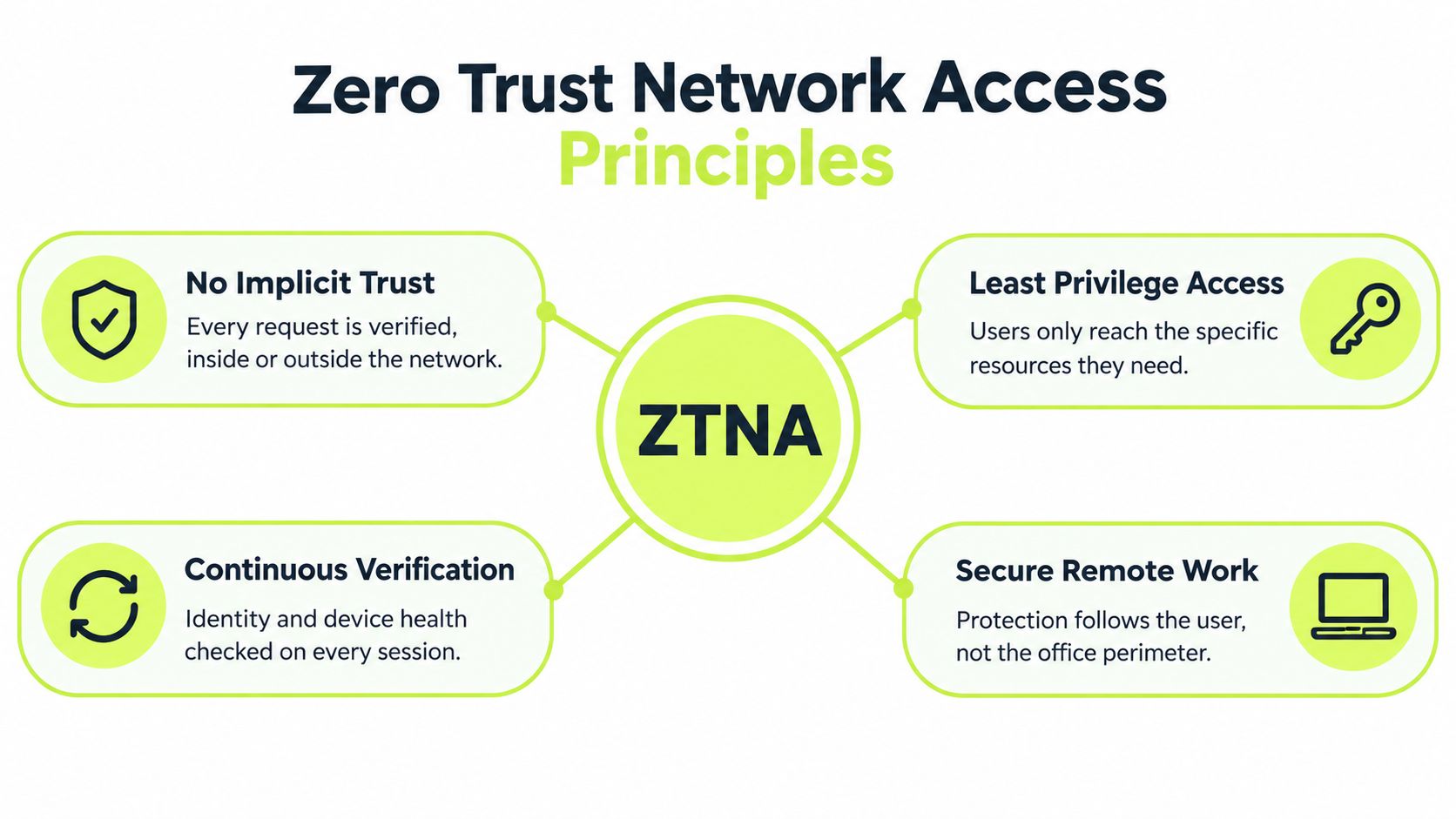
The NIST Zero Trust Architecture publication, published on August 10, 2020, formalized zero trust as an evolving cybersecurity model. NIST defines its central premise as the absence of implicit trust. A user account or asset shouldn't receive trust just because it sits on an internal network, uses a local network connection, or belongs to the enterprise.
That principle doesn't mean every employee is treated as malicious. It means the access system relies on evidence rather than location. Identity assurance, device condition, requested application, session context, and resource sensitivity can all influence the decision.
Access should match the task
Suppose a designer needs a project-management application but has no reason to access a production database. A resource-focused policy grants the application and keeps the database out of reach. This is the practical meaning of least privilege, and the least privilege access guide provides a useful foundation for applying it.
ZTNA also supports remote work without extending the whole corporate network to every user. Protection follows the person, device, and application relationship instead of depending on an office perimeter.
Practical rule: If a user only needs one application, don't give that user a path to the network containing every application.
The approach is not a single appliance or a one-time configuration. It's an operating model that reduces unnecessary reach, verifies requests, and limits the damage caused when an identity or endpoint is compromised.
How Zero Trust Architecture Works in Practice
ZTNA works by separating the act of proving identity from the decision to expose a resource. A successful sign-in supplies an important signal, but it isn't the complete authorization decision.

Start with the resource
A useful implementation sequence looks like this:
- Identify the resource. Define the application, service, data store, or administrative function the requester wants to use.
- Establish the requester's identity. Use your identity provider and relevant authentication controls to determine who or what is making the request.
- Inspect context. Consider device posture, workload context, session details, and the sensitivity of the resource.
- Apply the policy. Allow, deny, request stronger verification, limit the session, or provide temporary access according to defined conditions.
- Monitor the session. Reassess access when relevant signals change, and revoke the session when the policy no longer permits it.
This differs from opening a broad tunnel and trusting the user to stay within acceptable boundaries. The policy engine makes a decision about a destination, not merely about network membership.
Use five connected sources of evidence
CISA describes zero trust implementation through five pillars: identity, devices, networks, applications and workloads, and data. Each pillar supplies context that helps the organization make a narrower decision.
- Identity establishes the human, service account, or workload requesting access.
- Devices provide information about the endpoint and whether it meets organizational requirements.
- Networks describe the connection path and relevant environmental conditions.
- Applications and workloads identify what is being accessed and how it operates.
- Data determines the sensitivity and consequences associated with the request.
A policy that only knows a username has limited precision. A policy that also knows the device condition, application risk, and data sensitivity can respond more intelligently when conditions change.
The CISA Zero Trust Maturity Model emphasizes precise, least-privilege, per-request decisions while assuming the environment may already be compromised. That makes telemetry a security requirement, not a reporting convenience. Weak inventory and incomplete logs force teams into broad rules that either grant too much access or frustrate legitimate work.
Make enforcement observable
An enforcement point should record the decision, watch the session, and support immediate termination when policy conditions change. Security teams should measure progress through operational signals such as applications protected by resource-level policies, standing privileged entitlements, access decisions that include device and identity context, and the time required to revoke risky sessions.
ZTNA also works best as part of a security-in-layers approach. Identity controls, endpoint protections, application gateways, segmentation, monitoring, and data safeguards should reinforce one another rather than leave one control responsible for the entire defense.
Comparing VPN and Zero Trust Network Access
A VPN and ZTNA can both help a remote user reach company resources, but they solve the access problem differently. A VPN typically establishes a connection to a network boundary. ZTNA establishes an access relationship with a particular application or resource.
That distinction affects the blast radius of a stolen account. If a VPN session places a user inside a broadly reachable network, the user may have visibility or connectivity beyond the original business need. A ZTNA policy can keep the session focused on the approved application.
| Feature | Traditional VPN | Zero Trust Network Access |
|---|---|---|
| Connection model | Connects the user to a network or defined network segment | Connects the user to approved applications or resources |
| Trust boundary | Relies heavily on the boundary and the authenticated session | Evaluates identity, device, context, and resource policy |
| Access scope | May provide broader reach after connection | Limits reach to the resources included in the policy |
| Verification | Often emphasizes the initial login | Supports continuous and adaptive evaluation |
| Remote experience | Can depend on centralized network gateways and routing | Directs access through resource-aware enforcement points |
| Operational model | Extends an existing network access pattern | Rebuilds access around users, assets, and resources |
The migration decision
A VPN isn't automatically unsafe, and replacing it without understanding dependencies can disrupt important workflows. Start by mapping who uses the VPN, which applications they reach, and whether those applications can support a more granular access path.
Prioritize resources where broad network access creates unnecessary exposure. Administrative interfaces, sensitive cloud applications, partner portals, and systems used by contractors often provide clear opportunities to narrow access.
A successful migration isn't measured by how quickly a team turns off its VPN. It's measured by whether people can complete legitimate work without receiving more access than they need.
A staged approach also gives teams time to improve identity records, device signals, application inventory, and user guidance. The technical target is narrower access. The operational target is access that people can understand and use.
The comparison matters most during planning. ZTNA isn't just a newer tunnel. It's a different authorization model, one that treats the application as the protected destination instead of treating the network as the destination.
Analyzing Zero Trust Adoption and Implementation Gaps
Zero trust adoption has moved beyond theory, but implementation remains uneven. A 2024 Ponemon Institute study sponsored by Entrust surveyed 4,052 IT and IT-security practitioners across the United States, United Kingdom, Canada, Germany, Australia, New Zealand, Japan, Singapore, and the Middle East. The study's executive summary found that 61% said their organizations had begun a zero trust journey, while only 18% reported implementing all zero trust principles.
That gap is the important finding. Starting a program can mean creating an inventory, selecting a pilot application, improving identity controls, or defining a roadmap. None of those steps proves that the organization has achieved consistent, resource-level authorization across its environment.
Read the maturity signal correctly
The same study reported that 12% of respondents described their organizations as partially implementing zero trust, 14% had laid the foundation for a strategy, and 17% were still exploring solutions. These stages shouldn't be treated as failures. They show that zero trust is a transformation with dependencies, not a product installation completed during a maintenance window.
A team that has started should ask practical questions:
- Coverage: Which applications use resource-level policies today?
- Context: Do access decisions include both identity and device information?
- Privilege: Which users or service accounts retain standing administrative access?
- Revocation: Can the organization terminate a risky session when conditions change?
- Reachability: What can a compromised account access before detection?
Those questions convert an abstract maturity label into an engineering backlog.
Understand the business pressure
Concern about cyber-breach risk was the leading global driver in the study, cited by 37% of respondents. An expanding attack surface followed at 30%, while regulations or standards accounted for 29%. In the United States, breach risk was cited by 50% of organizations and expanding attack surfaces by 29%.
These drivers explain why traditional perimeter assumptions are losing influence. Cloud services, hybrid work, partner access, and distributed identities make it harder to define one trusted internal zone. They also create pressure to prove that controls reduce exposure rather than merely add another security console.
A sensible roadmap begins with visibility and a contained use case. Teams can then establish policy, observe legitimate behavior, fix exceptions, and expand coverage. Progress means reducing unnecessary reach while preserving a usable path for approved work.
Addressing Human Workflow and Behavioral Challenges
ZTNA can make an access decision more precise, but it can't guarantee that people will accept the decision. If an employee needs to complete a customer task and the approved path repeatedly fails, that employee may search for a faster route. A control that creates unexplained friction can push work into personal devices, unapproved software, or shared credentials.
Recent survey data found that 83% of respondents had circumvented security measures to get work done, while 42% cited workflow or integration disruption as a barrier to zero trust adoption. These figures come from Tailscale's 2025 secure networks survey. They point to a design problem, not just a training problem.

Design the safe path
A denial should answer three questions for the user:
- What happened? Explain which condition prevented access.
- What should the user do next? Provide a clear recovery or request path.
- Why does the control exist? Connect the decision to the protected resource and the user's role.
Security teams should create role-specific journeys for employees, developers, contractors, and administrators. Temporary access should have an explicit purpose and expiration. Exceptions should be approved, recorded, and reviewed rather than handled through informal messages.
Education must connect to daily work. A developer needs guidance about approved tools and elevated access. A contractor needs a clear onboarding and offboarding path. An employee working remotely needs to know how to respond when a device check blocks an application.
Measure bypass pressure
Repeated access denials, frequent exception requests, abandoned authentication flows, and attempts to use unapproved tools can reveal policy friction. Treat those signals as feedback about the workflow, while still investigating whether a bypass attempt indicates unsafe behavior or a legitimate gap in the design.
Behavioral checkpoint: Explain the safer alternative before you punish the workaround. People need a usable path that security can support.
Training should reinforce the decisions users encounter, including credential protection, suspicious requests, secure sharing, and reporting. Guidance on protecting against social engineering attacks becomes more effective when it appears alongside the actual access and verification workflows.
The objective isn't to make users memorize security language. It's to create a control loop: explain the decision, teach the alternative, record acknowledgment, and reassess whether the policy is causing risky workarounds.
Key Benefits and Considerations for Distributed Teams
For a distributed organization, ZTNA can align access controls with the way work really happens. Employees may use cloud applications from home, developers may manage workloads across environments, and partners may need narrow access without becoming part of the corporate network. A resource-centric policy gives security teams a more precise way to define those relationships.
The strongest benefit is containment. If a compromised identity can reach only a small set of approved resources, the organization has a better chance of limiting lateral movement. NIST describes zero trust architecture as a way to prevent data breaches and limit internal lateral movement, so compromising one identity or endpoint doesn't automatically expose neighboring systems.
Build around usable evidence
ZTNA decisions improve when the policy engine receives reliable signals. Security leaders should establish ownership for:
- Identity data: Roles, employment status, contractor status, and privileged functions.
- Device data: Enrollment, security posture, and the relationship between the device and its user.
- Application data: Resource sensitivity, dependencies, and approved user groups.
- Session data: Current activity, authentication strength, and changes in risk.
- Human feedback: Denials, exception requests, support cases, and repeated bypass attempts.
Missing signals create blunt policies. Excessive prompts create fatigue. The design challenge is to collect enough context for a narrow decision without turning every routine action into an obstacle.
Define progress in operational terms
A mature program should show more than a list of deployed connectors. Track whether more applications use resource-level policies, whether privileged access is temporary and justified, whether decisions include useful identity and device context, and whether risky sessions can be revoked promptly. Pair those technical measures with behavior indicators, such as recurring exception patterns and successful completion of role-specific security education.
ZTNA also needs resilience planning. Access enforcement points, identity systems, device signals, and policy services must remain available enough for the business to operate. Teams should document recovery procedures and test how users regain legitimate access when a control fails.
The best architecture is one employees can follow. Technical enforcement narrows access, monitoring detects changes, and education gives people the judgment to respond safely. Treat those elements as one program, and zero trust network access becomes a practical operating model for distributed work rather than another layer of disconnected security tooling.
Vigil Security provides Slack-native security awareness and compliance training through short, interactive lessons, recurring refreshers, phishing simulations, and role-aware workflows. Visit Vigil Security to connect behavior change with your ZTNA rollout and build audit-ready evidence without sending employees to a separate training portal.