You've probably already built a security stack that looks impressive on paper. Your identity provider enforces MFA, the email gateway filters suspicious messages, endpoint detection watches laptops, and employees complete an annual awareness course. Yet a single well-timed attack can still move through the gaps between those controls because each tool sees only part of the event.
A finance employee may receive a message that passes the mail filter, visit a legitimate cloud service, approve a convincing sign-in prompt, and give an attacker a valid session. Security in layers addresses that chain by assuming every control can miss something. The purpose isn't to buy more products. It's to make sure the next control can limit, detect, or contain a failure before it becomes a business-impacting incident.
What Happens When One Control Is All You Have
A mid-sized SaaS company relied heavily on its email gateway to stop phishing. The gateway inspected messages, blocked known malicious domains, and quarantined suspicious attachments. It did its job against familiar threats, but it missed a newly registered credential-harvesting URL hosted on a legitimate SaaS domain.
A finance clerk opened the message, entered her password, and was redirected to a fake MFA prompt. The page looked routine, the request arrived during a busy workday, and she approved it without stopping to question the context. The attacker now had more than a suspicious email. They had a valid identity event that looked normal to a control focused on message delivery.

The incident didn't have to end there. Conditional access tied to device compliance could have blocked the sign-in if the session came from an unmanaged device. An endpoint detection and response rule could have flagged a suspicious OAuth consent event. A ticket-based workflow could have required independent approval before anyone changed vendor banking details. A finance analyst trained to challenge urgency cues could have reported the request before money or data moved.
One failure should create another opportunity to stop
That's the central operating assumption behind defense in depth. A control isn't successful only when it blocks an attack at the first point of contact. It can also succeed by producing a signal, slowing the attacker, limiting access, or giving another person time to intervene.
The company would still need to validate whether those controls work under realistic conditions. A pentester security validation exercise can test whether identity rules, endpoint detections, approval workflows, and response actions behave as designed rather than merely appearing enabled in an administration console.
Practical rule: Design every important control with a known fallback. Ask what catches the same failure if the first mechanism misses it.
The human part matters, too. Staff who handle payments, privileged access, customer data, or vendor changes need a clear route for escalation, not just a policy stored in a portal. Guidance on insider threat awareness is useful when it connects suspicious behavior to concrete reporting decisions, such as pausing a payment request or challenging an unexpected access change.
Defense in depth makes those separate actions part of one design. The email gateway reduces exposure, identity limits the session, the endpoint records behavior, the workflow pauses the transaction, and the employee raises the alarm. The value comes from the handoffs between layers.
The Core Idea Behind Security in Layers
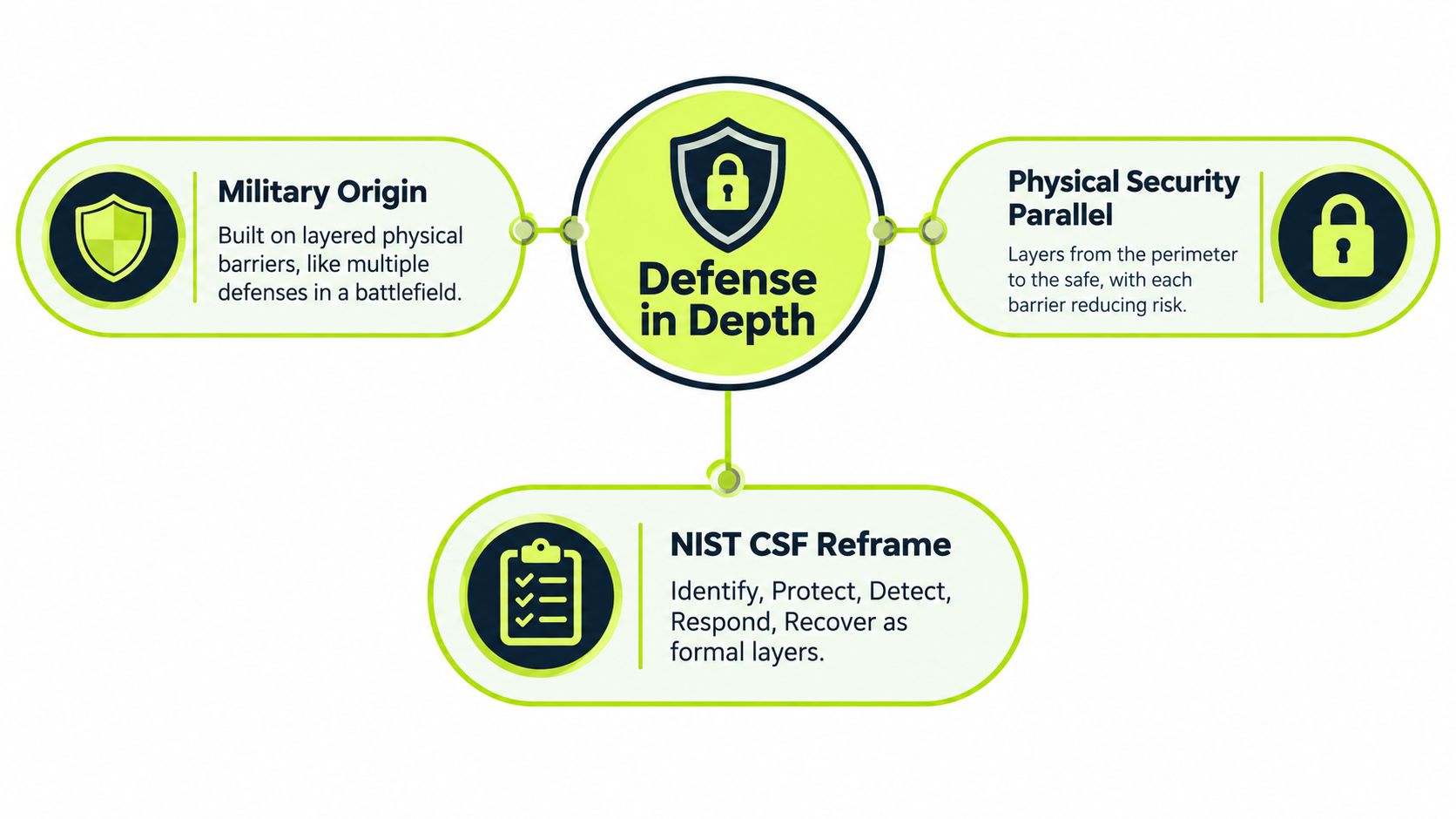
A castle doesn't rely on one wall. It uses distance, gates, guarded entrances, internal barriers, and protected rooms so that crossing the outer boundary doesn't grant access to everything inside. Each barrier buys time and creates another opportunity to identify the intruder.
Defense in depth applies the same logic to information systems. NIST defines it as “the application of multiple countermeasures in a layered or stepwise manner to achieve security objectives,” and describes the use of different security technologies across common attack vectors so an attack missed by one control can be caught by another. You can read the formal definition in the NIST defense in depth glossary.
The phrase security in layers doesn't mean placing identical controls beside one another. Two tools that depend on the same indicator, data source, or assumption can fail together. Resilience improves when the controls are diverse. A mail filter, conditional access rule, endpoint sensor, application authorization check, and data loss prevention policy can all examine the same attack from different angles.
Diversity matters more than product count
Consider a stolen password. MFA may challenge the login. Device posture may reject an unmanaged endpoint. Network policy may restrict access to internal services. Application authorization may prevent an export. Data controls may detect sensitive content leaving the environment. Those controls overlap, but they aren't duplicates. Each one addresses a different failure mode.
A layered stack commonly includes:
- Identity: Authentication, authorization, session conditions, and privilege boundaries.
- Endpoint: Device health, process behavior, patching, and application execution.
- Network: Segmentation, traffic policy, name resolution, and east-west visibility.
- Application: Secure design, runtime protection, and transaction-level authorization.
- Data: Classification, encryption, access monitoring, and exfiltration controls.
- Human: Judgment, escalation, verification, and reporting.
NIST's control guidance makes the same architectural point. Controls should be allocated across system layers and designed to operate in a coordinated, mutually reinforcing way, rather than treated as isolated checklist items. The NIST SP 800-53 control reference gives that principle a practical governance shape.
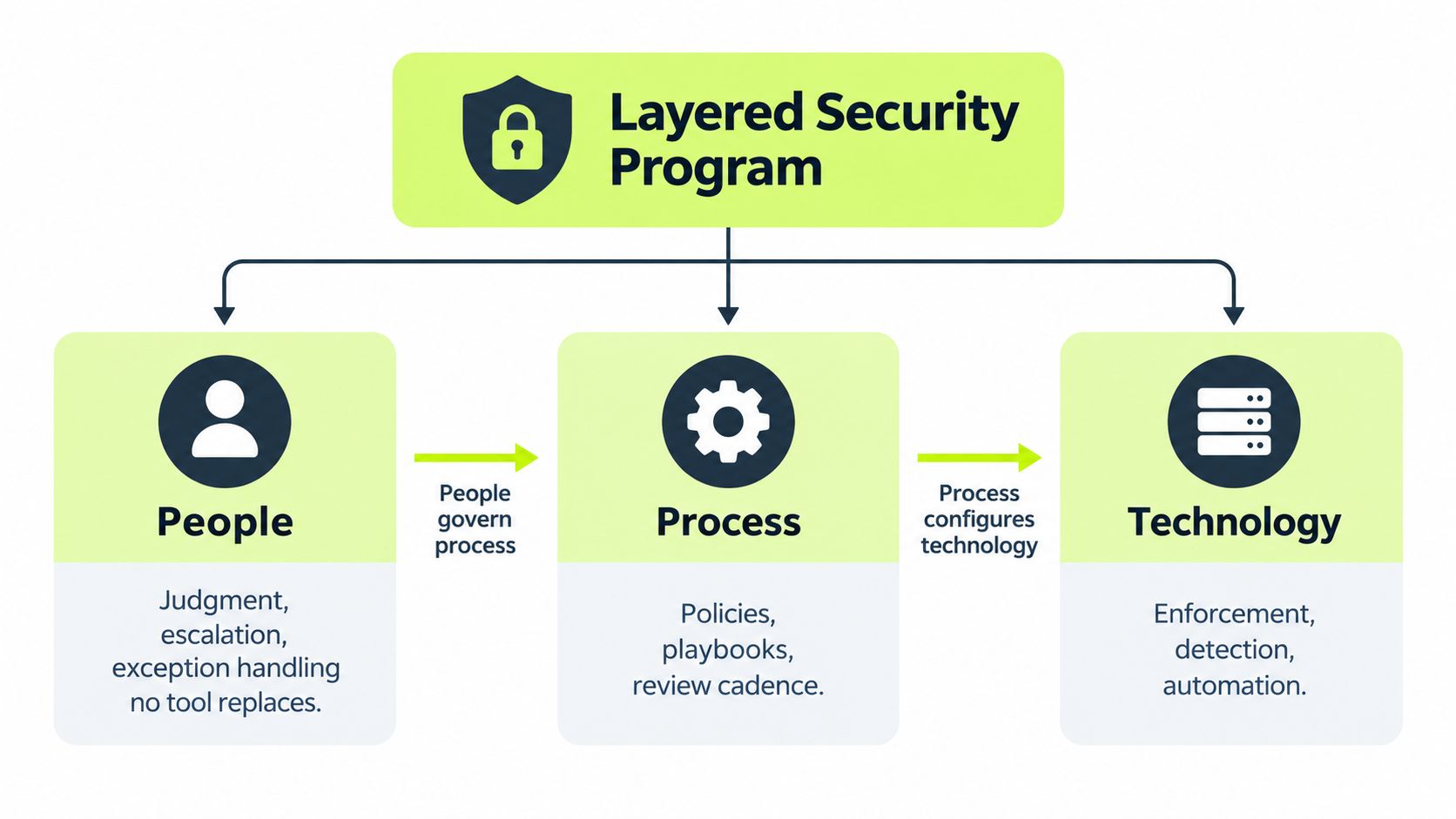
A diagram is only useful when the organization assigns owners, defines signals, and rehearses the response between layers. That requires attention to people, process, and technology, the three domains that determine whether the model runs in daily operations.
The Three Domains Every Layered Program Covers
A security architecture can contain excellent products and still fail because nobody knows who acts when a signal appears. People, process, and technology form the governance scaffolding around every technical layer. Each domain has a different job, and removing one leaves the other two carrying responsibilities they can't handle alone.
People supply judgment
Security tools can identify an unusual login, a new process, or a sensitive upload. They can't always determine whether a senior executive approved an unusual payment, whether a developer has a legitimate reason to access production, or whether a supplier's urgent request is genuine.
People handle ambiguity. A service desk analyst may ask the employee to verify a request through a known channel. A finance manager may reject a bank-detail change until a second person confirms it. A security engineer may decide that a suspicious alert needs immediate containment even though the automated score is inconclusive.
The human role also includes escalation. Employees need a visible report button, a known contact, and permission to pause a risky action without fearing that they'll be criticized for slowing work.
Process turns signals into action
Processes connect controls that would otherwise operate as disconnected alarms. They define who reviews a high-risk sign-in, how a privileged account is suspended, which approvals are required for sensitive changes, and how evidence is preserved during an investigation.
A runbook should answer practical questions:
- Who owns the alert? Name a team or role, not a vague department.
- What happens first? Specify the containment action and the time-sensitive decision.
- What evidence matters? Identify logs, tickets, messages, and approvals investigators should retain.
- When does the incident escalate? Define the conditions that move a case to legal, privacy, leadership, or an external responder.
Tabletop exercises expose process gaps that dashboards hide. A team may discover that the identity administrator can disable an account, but nobody knows who authorizes the action when that administrator's own account is under suspicion.
Technology enforces and observes
Technology provides consistent enforcement at speed. Identity services evaluate sign-in context, endpoint agents inspect processes, network controls restrict paths, applications check authorization, and data systems record access or block unsafe transfers.
Remove technology and people face too many decisions to make manually. Remove process and the tools generate alerts without reliable follow-through. Remove people and automation struggles with exceptions, business context, and attacks that fall outside predefined rules.
A control becomes part of a security layer only when someone owns it, a process tells the organization how to use it, and technology supplies dependable enforcement or evidence.
Five Operational Layers That Turn the Model Into a Stack
NIST's OT security guidance describes defense in depth through distinct domains including security management, physical security, network security, hardware security, and software security. In a modern cloud-first environment, teams can translate that principle into an operational stack built around identity, endpoint, network, application, and data controls. The labels may vary, but the design question stays the same: what failure does this layer catch when another layer misses?
Identity limits what a stolen session can do
MFA, conditional access, and least privilege reduce the value of a compromised password. A device compliance rule can reject a sign-in from an unmanaged endpoint, while just-in-time elevation can prevent a standing administrator session from remaining active longer than necessary.
Identity doesn't stop every phishing attempt. It can, however, prevent a captured password from becoming unrestricted access. Teams that need a deeper treatment of access boundaries can review least privilege access in the context of everyday permissions.
Endpoint contains activity on the device
EDR looks beyond whether a file arrived. It observes processes, command execution, persistence attempts, and other behavior on the host. Application control and patch management reduce the number of ways an attacker can turn a successful login into code execution.
If an employee approves a malicious OAuth request, endpoint telemetry may still reveal an unusual browser process, a suspicious token-handling event, or activity inconsistent with the device's normal use. The endpoint layer can isolate the host while the identity team revokes sessions.
Network restricts movement
Segmentation separates users, servers, development systems, and operational technology so that a compromise in one area doesn't automatically open every route. Zero Trust policies, DNS filtering, and east-west inspection add context to traffic that a perimeter firewall may never see.
A network layer is especially valuable after initial compromise. It can block a workstation from reaching administrative interfaces or prevent a user subnet from communicating directly with a protected service.
Application checks intent at the transaction
Application controls include secure software development practices, web application firewalls, runtime protection, and authorization checks inside business workflows. These controls catch abuse that looks like a valid network connection but violates the application's rules.
A user may have permission to access a finance system but not to change a vendor account and release a payment in the same workflow. Transaction-level separation can require an independent approval even when the underlying account is valid.
Data limits the impact
Classification, encryption in transit and at rest, access monitoring, and DLP policies protect the asset itself. If an attacker reaches a storage location, strong data controls can limit what they can read, export, or use.
NIST's OT security guide describes coordinated barriers across different failure domains. That coordination is the important part. Each operational layer should either block the attack, narrow its path, or produce telemetry that makes the next decision clearer.
Where the Human Layer Actually Fits
The human layer isn't a soft extra placed outside the architecture. It sits inside the stack because employees encounter attacks at the point where technical signals often become business decisions.
A person may notice that a supplier's writing style has changed, recognize that a request creates unusual urgency, or realize that a familiar colleague is asking for access they've never needed before. Employees also interpret automated warnings. A browser alert may be harmless in one context and a sign of account takeover in another. Someone still has to decide whether to proceed, verify, or report.
Three human jobs remain difficult to automate fully:
- Detection: Spot social engineering, unusual context, and pressure tactics.
- Judgment: Assess ambiguous alerts and exceptions using business knowledge.
- Escalation: Report quickly so identity, endpoint, and response teams can act.
Workflow beats a separate training destination
Training has more value when it appears where the decision occurs. A phishing warning in the browser can explain why a page is risky. A short prompt inside a CRM can remind a sales representative not to paste sensitive customer information into an external tool. A report button in email or chat can reduce the distance between suspicion and escalation.
Awareness and behavior aren't the same outcome. A 2025 meta-analysis covering 69 end-user training studies found larger effects on knowledge, attitudes, and intentions, with an overall effect size of d=0.75, than on observed behavior, where the effect was d=0.36 and the confidence interval crossed zero. The figures and interpretation are documented in this analysis of cybersecurity awareness training evidence.
The finding doesn't make training useless. It changes the design requirement. A course can explain what phishing looks like, but the surrounding workflow must make the safe action easy when the employee is under pressure.
AI introduces another example. Staff may approve an automated agent's request because the request appears routine, even when the action has an unusual scope or destination. Guidance on AI agent governance and security helps security leaders treat human review, delegated authority, and runtime controls as connected parts of the same decision system.
Design test: If an employee spots a risk during a busy task, can they report it, understand the feedback, and continue safely without leaving the workflow?
Why Annual Training Breaks the Layered Model
Annual training is usually treated as a completion event. An employee watches a module, answers questions, and receives a compliance record. The organization then assumes the human layer is present until the next assignment arrives.
That assumption creates a long gap between instruction and exposure. Attackers don't wait for the annual training cycle, and employees don't retain every warning equally across changing tools, roles, and attack patterns. A yearly course can establish vocabulary, but it rarely supplies the just-in-time reinforcement needed for a decision made during a rushed payment, login, file share, or support request.
Continuous microlearning works differently. It uses short prompts, role-specific examples, simulations, and immediate feedback to reinforce a behavior near the moment it matters. A report button, a contextual warning, or a brief explanation after a simulated mistake can connect policy to action.
| Behavior | Annual Training | Continuous Microlearning |
|---|---|---|
| Recognition | Teaches common warning signs in a scheduled session | Reinforces signals as employees encounter relevant workflows |
| Decision-making | Tests knowledge in a controlled course environment | Practices verification and escalation in realistic contexts |
| Reporting | Gives a general instruction that may be forgotten | Keeps reporting mechanisms visible and easy to use |
| Feedback | Often arrives after a quiz or completion event | Appears immediately after a risky choice or report |
| Evidence | Shows that training was assigned and completed | Shows recurring participation, response, and follow-up activity |
Field evidence described in the earlier training analysis reported phishing failure rates moving from 11.2% to 7.5% and reporting rates moving from 14% to 28% when embedded microlearning was combined with periodic reinforcement. Those figures come from the same field evidence summary.
The point isn't to replace formal training. Annual modules can support policy and compliance requirements. They shouldn't be mistaken for a continuously active control. A human layer must be available when the adversary is active, not only when the compliance calendar says it's time to learn.
Teams looking to define the difference between completion and behavior can use this guide to security awareness training as a starting point for program design.
Designing Layers That Reinforce Each Other
Start with the account, not the firewall. Identity is where many modern control decisions begin, especially when employees, contractors, services, and automated agents access cloud applications from changing locations.
Use phishing-resistant MFA where the environment supports it. Add conditional access that evaluates device posture, session context, and application sensitivity. Keep administrative privileges separate from everyday accounts, and make privileged access temporary rather than permanently available.
Build an observable path from identity to endpoint
Endpoint controls should receive identity context and return useful telemetry. EDR with tamper protection can detect suspicious activity, while managed application allowlists reduce unapproved execution. Patch management should have a defined service expectation and an owner who can explain exceptions.
The handoff matters more than the product label. When a device shows suspicious behavior, the identity layer should be able to revoke sessions or require reauthentication. When identity detects an unusual sign-in, endpoint policy should help determine whether the device is trustworthy.
Reduce movement and protect the asset
Segment user, server, development, and OT or IoT environments according to business need. Add east-west inspection and DNS filtering so internal traffic and outbound resolution receive attention, not just traffic crossing the internet edge.
Data controls then protect what remains reachable. Apply classification when information is created or shared. Encrypt stored and transmitted data. Configure DLP to recognize risky destinations, unusual volumes, and sensitive combinations rather than relying only on file extensions.
A practical design review can ask:
- Can identity revoke access quickly? Test the action, not just the policy screen.
- Can endpoint telemetry explain the event? Confirm that alerts include enough context for triage.
- Can network rules contain a compromised host? Verify paths between real business systems.
- Can the application require an independent approval? Separate access from high-impact transactions.
- Can data controls limit the result? Test export, sharing, and external collaboration scenarios.
- Can an employee report the event immediately? Put the action inside email, chat, ticketing, or another daily tool.
The human layer closes the loop with contextual prompts and one-step reporting. When a control fires, the employee should know what happened and what to do next. The security team should receive the signal, the relevant telemetry, and a defined response path.
That's mutual reinforcement. One layer doesn't merely duplicate another. It gives the next layer better information and a narrower problem to solve.
Common Myths That Weaken Layered Security
Myth one, the perimeter is dead, so layers no longer matter. The old perimeter has changed, but the need for boundaries hasn't disappeared. Identity providers, managed devices, application gateways, APIs, and data stores now form multiple edges. Security in layers begins at those edges and continues through the transaction.
Myth two, more controls automatically mean better security. More products can create more blind spots when they produce disconnected alerts, inconsistent policies, or duplicate signals. A small number of well-integrated controls can be more useful than a crowded dashboard if each control has a defined failure mode and a reliable handoff.
Myth three, annual compliance training is the human layer. A once-a-year module demonstrates that an assignment occurred. It doesn't guarantee that an employee will recognize a new social-engineering tactic during a busy task. The human layer needs recurring practice, visible reporting routes, and feedback tied to real workflows.
Myth four, if the firewall holds, the network is safe. An attacker may use valid credentials, move through allowed paths, exploit an application, or abuse an insider's access without defeating the perimeter in the traditional sense. Network controls work best alongside identity restrictions, endpoint visibility, application authorization, and data protection.
Replace duplication with coordination
A coordinated program asks a sharper question than “What tools do we have?” It asks:
- What does each layer detect or prevent?
- What does it miss?
- Which layer receives its signal?
- What response can happen automatically?
- Where does a person need to make a judgment?
NIST's defense-in-depth work has treated layered architecture as a way to increase an attacker's work factor, improve detection, and limit damage when a control fails. The historical development of that approach is summarized in this defense in depth architecture guide.
The strongest design is not a perfect wall. It's a system where a missed email indicator still encounters conditional access, a valid session still faces application authorization, a compromised endpoint still meets segmentation, and an employee can report the uncertainty before the incident grows.
Vigil Security delivers short, interactive security awareness and compliance lessons inside Slack, with recurring refreshers, phishing simulations, workflow-triggered training, and audit-ready evidence synchronization for tools such as Vanta and Drata. If you're building a human layer that operates inside daily work rather than once a year, visit Vigil Security to see how the platform can support that program.