GRC means governance, risk, and compliance, an integrated way for an organization to set direction, manage uncertainty and prove it meets its obligations.
If your company has security policies and passes an audit, how do you know its safeguards work on an ordinary workday? That gap between documented intentions and reliable action is where GRC matters most. A useful program connects business decisions to named owners, working controls and evidence, rather than treating audit preparation as a separate job.
What GRC Stands For and Where the Term Came From
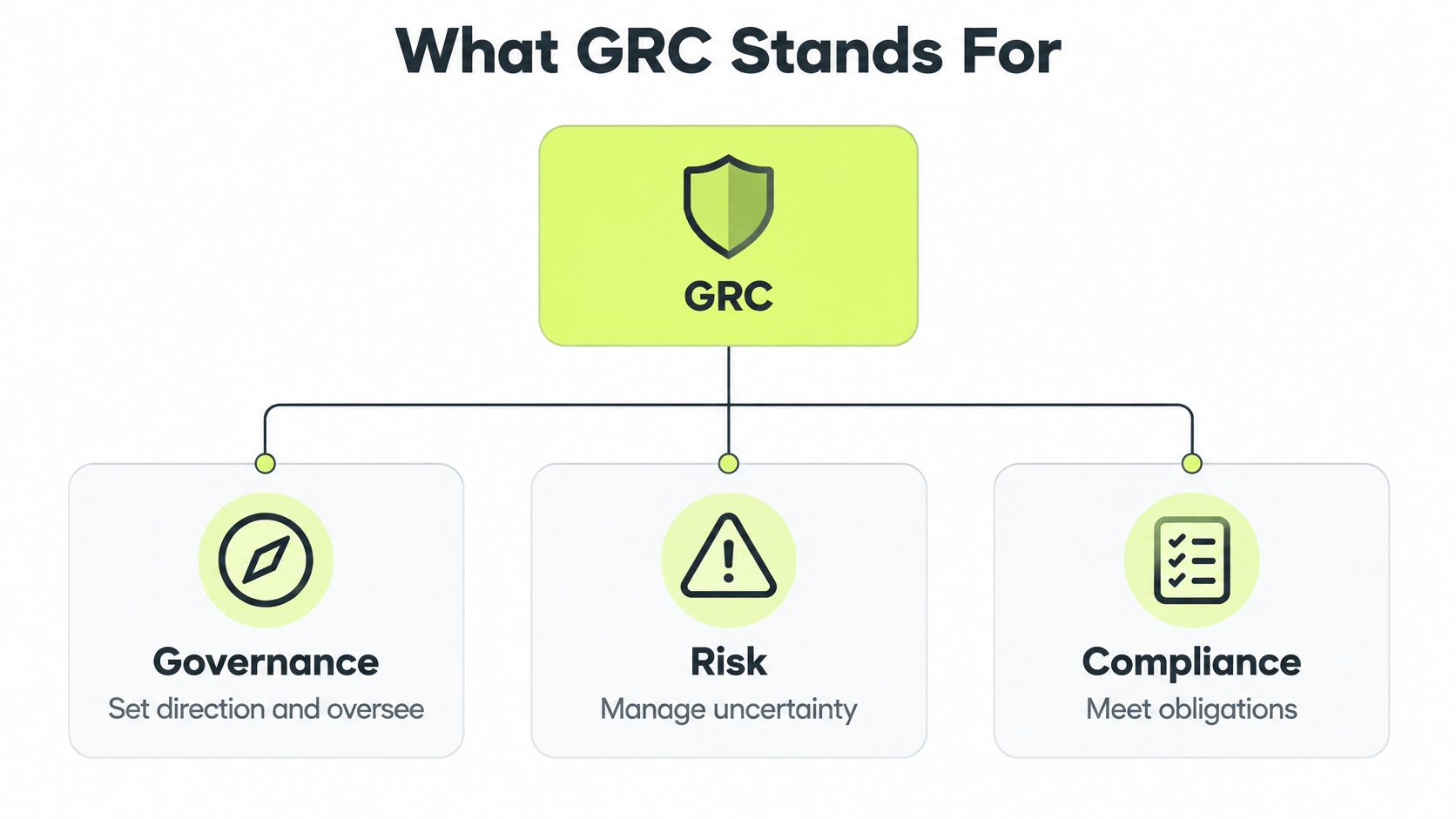
GRC stands for governance, risk, and compliance. Think of the parts as different questions about the same organization, not interchangeable names for its security department.
A building offers a useful analogy. Governance is the blueprint and the authority to approve changes. Risk management considers the weather, ground conditions and expected loads that influence the design. Compliance checks whether the building meets applicable requirements and retains the inspection records.
The three GRC elements at a glance
| Element | Core question | Typical artifacts | Example |
|---|---|---|---|
| Governance | Who decides, and against which objectives? | Policies, board charters, decision rights | The board approves a security policy and names its owner |
| Risk | What could stop us, and how bad would it be? | Risk register, impact ratings, risk appetite statement | A cloud outage rated high impact and medium likelihood |
| Compliance | Do we meet our obligations, and can we prove it? | Control mappings, test results, audit evidence | Quarterly access reviews kept as evidence for a SOC 2 audit |
The access-review example describes a hypothetical company's chosen schedule, not a universal audit requirement. The organization must define the review scope and frequency against its own obligations and risks.
An old set of activities with a shared discipline
Organizations governed their operations, considered uncertainty and followed rules long before anyone used the acronym. GRC formalized their coordination so that policies, assessments and assurance work could support the same objectives.
The Open Compliance and Ethics Group originated the acronym in the early 2000s, with accounts dating it to 2002 or 2003, and released its Red Book in 2004, described as the first GRC standard. The important development wasn't the invention of oversight or compliance. It was a shared model for connecting those activities with performance, assurance and ethics.
The diagram separates the responsibilities without suggesting they should operate independently.
Consider security awareness training. Leadership decides which employees need training and who owns the program. Security practitioners identify the behaviors that could expose customer information, while compliance staff establish which records demonstrate that required learning occurred.
Those aren't separate reasons to run unrelated training programs. They're complementary reasons to operate a coordinated process.
Practical rule: If a process sets direction, weighs uncertainty and leaves proof, it belongs within GRC.
How Governance, Risk, and Compliance Connect
Say a customer contract requires encrypted backups. Filing the contract doesn't protect the data, and switching on encryption doesn't prove the organization can recover its service.
The connection between business objectives and risk decisions is central to COSO's enterprise risk management framework, which integrates risk with strategy-setting and performance. In practical terms, teams need a traceable path from the requirement to the action taken when something fails.
Follow a requirement through the business
For the backup scenario, that path could look like this:
- Obligation: The customer contract requires backups to be encrypted.
- Risk: An unauthorized person could read exposed backups, or the business could fail to recover because backup files or encryption keys are unavailable.
- Control: The infrastructure team encrypts backups, restricts key access and tests restoration.
- Owner: The infrastructure lead is accountable for the control.
- Test procedure: For this example, the team schedules a quarterly restore test and verifies encryption settings and key availability.
- Evidence: The team retains dated configuration records and restore logs showing scope, results and reviewer.
- Remediation: A failed restore creates a tracked action with a deadline based on business impact.
Notice that encryption and recovery address related but different problems. An encrypted backup can still be unusable. A useful control description must be precise enough for someone to test what it promises.
This chain also helps leaders prioritize. A failed backup for a critical customer service deserves a different response from an incomplete record for a retired test environment.
Make accountability usable
Give every control a named owner, define when evidence must be collected, put expiry dates on exceptions and tie remediation deadlines to severity. An exception without an expiry date can become an undocumented permanent decision.
For directors clarifying oversight and decision rights, Lighthouse Consultants' corporate governance guidance for UK directors provides a board-level companion to operational control ownership. Teams translating those decisions into application requirements can also use this explanation of software compliance risk.
Finally, apply an evidence test. Records should be attributable, time-stamped, reproducible and mapped to a stated control objective. An access-review spreadsheet or training record is useful only when an assessor can establish who did what, when it happened, how the result was produced and which requirement it supports.
Frameworks Behind Modern GRC Programs
Common GRC framework references
| Framework | Origin | Core structure | Role in a GRC program |
|---|---|---|---|
| NIST Cybersecurity Framework | NIST guidance developed with government, industry and academic stakeholders | Identify, Protect, Detect, Respond, Recover in the original structure | Common language that maps security risk to controls and evidence |
| NIST Risk Management Framework | NIST risk-management guidance | Prepare, Categorize, Select, Implement, Assess, Authorize, Monitor | Links risk decisions to control testing and ongoing monitoring |
| COSO Enterprise Risk Management | COSO model for ERM and internal control | Strategy-linked risk management, with operations, reporting and compliance objectives in its internal-control model | Integrates risk into objectives and performance decisions |
| ISO/IEC 27001 | International standard for information security management | Certifiable management system with controls and audit cycles | Gives an auditable structure for information security obligations |
Frameworks provide shared vocabulary and structure. They aren't substitutes for understanding your services, customers or contractual commitments, and they don't all serve the same purpose.
Following Executive Order 13636 in 2013, NIST developed its Cybersecurity Framework through a collaborative process and issued CSF 1.0 in February 2014, organized around Identify, Protect, Detect, Respond and Recover, as documented in the original NIST Cybersecurity Framework.
That original structure helps practitioners connect an activity to its purpose. Employee training supports protection, monitoring supports detection, and restoration exercises support recovery. Always record the framework version used in your mappings rather than assuming every customer or assessor means the same edition.
Choose against obligations, not familiarity
Start with what a customer, regulator or certification objective requires. If a customer contract names a standard, establish its scope and required deliverables before adopting a different framework because your team already knows it.
Then use other references where they add something useful. A cybersecurity framework can help organize security outcomes, while an enterprise-risk model helps leadership consider the business consequences of uncertainty. A certifiable management system provides another kind of structure, including management review and audit expectations.
For a practical comparison of obligations and assessment approaches, consult this guide to security compliance standards.
Map once and preserve the differences
Build a central control description, then map it to relevant framework requirements. For example, a joiner-and-leaver access process may support several assessment needs, but the underlying owner and operating procedure shouldn't change with every questionnaire.
Don't assume overlapping requirements are identical. One may require broader scope, different evidence or an additional approval.
Maintain a shared control where the work is genuinely shared. Record the extra requirement where the expectations differ.
This approach avoids parallel programs without pretending that every framework asks the same questions. The goal is a coherent operating model, not the largest possible collection of framework labels.
How GRC Works in Daily Work
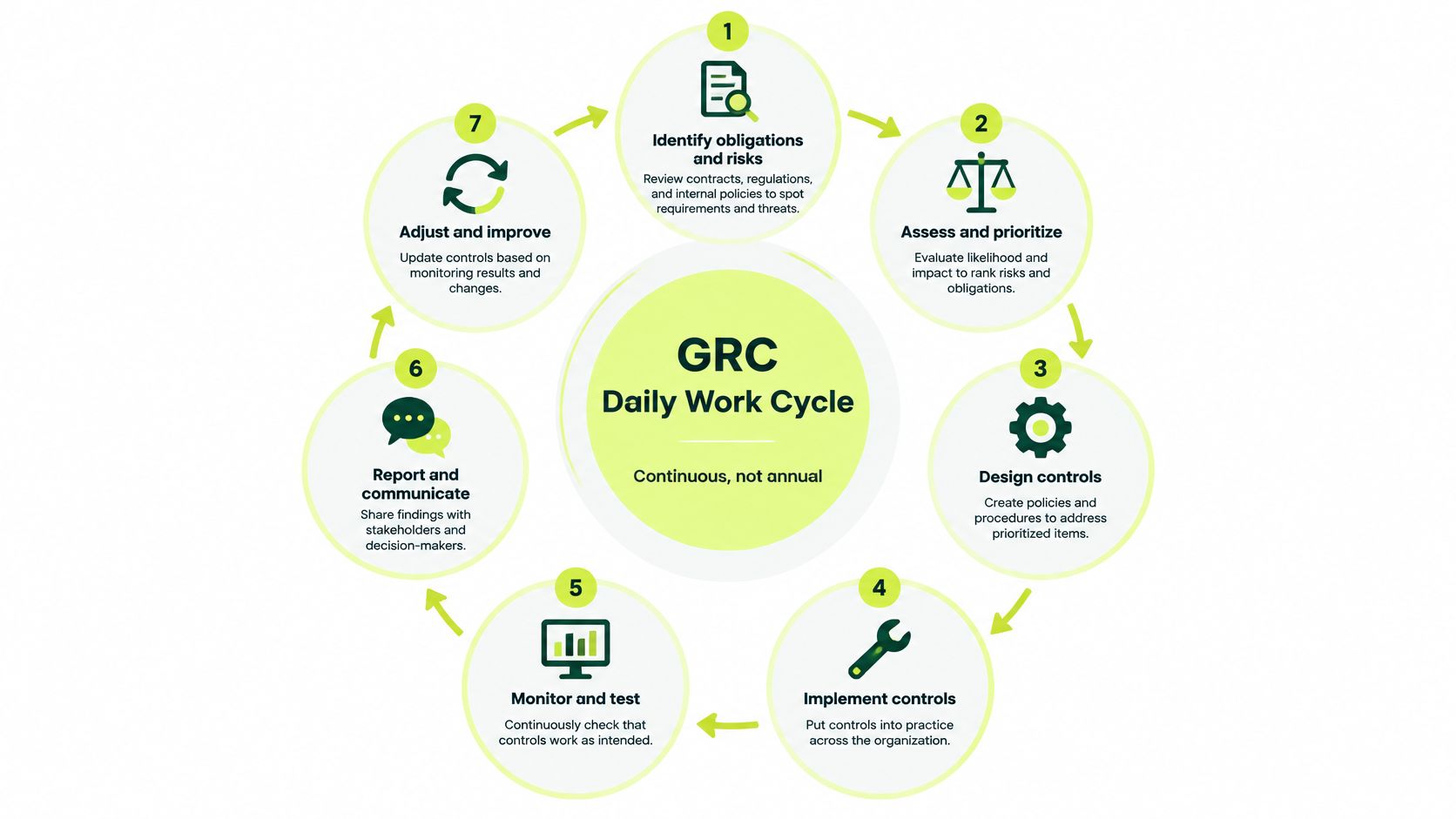
Daily GRC means putting risk decisions into the workflows employees already use. The following working cycle translates that idea into tasks a team can assign and review.
Identify obligations and risks. Review customer contracts, applicable regulations, internal policies and risk assessments. Write requirements clearly enough that a control owner can explain what successful performance looks like.
Assign accountable owners. Name the person responsible for each control, not just the department associated with it. Give that person authority to request evidence, resolve gaps or escalate decisions they can't make themselves.
Embed controls in existing workflows. Put access approval into the access-request process and required learning into onboarding. A control that requires everyone to remember a separate procedure is harder to operate consistently.
Collect evidence on a defined schedule. Retain records with timestamps, relevant identifiers and version history. For learning activities, a documented compliance training program should specify which records administrators retain and how they handle incomplete assignments.
Test operation, not just documentation. Check both design effectiveness, whether the proposed safeguard could address the risk, and operating effectiveness, whether people and systems performed it. An approval policy may be well designed while sampled access requests show that staff bypassed approval.
Escalate exceptions and missing evidence. Send the issue to the owner with an explicit deadline and a clear description of the exposure. If the deadline passes, escalate to whoever can accept the risk or authorize corrective work.
Use the results in business decisions. A failed control might justify delaying a launch, restricting access or funding a technical fix. Leadership should receive the decision needed, not just a red status indicator.
The visual summarizes the broader cycle of assessment, implementation and improvement.
Why the cycle stays open
NIST's Risk Management Framework specifies seven repeatable stages: Prepare, Categorize, Select, Implement, Assess, Authorize and Monitor. These are the formal RMF stages, rather than the practical task list above.
Their sequence explains the reasoning. Categorization establishes impact, which informs control selection; assessment checks safeguards; authorization addresses residual risk; and monitoring identifies changes that require another decision.
An annual assessment can't substitute for that ongoing work. A control may have passed its last test before a system migration changed its configuration or a supplier gained additional access.
Say procurement onboards a vendor that will process customer support data. Before enabling the integration, the team should reassess the access controls, permissions and monitoring relevant to that data flow, rather than relying on approval of the previous architecture.
Misconceptions That Stall GRC Programs
A program can produce plenty of documents without helping anyone make a better decision. The problem often starts with what leaders expect GRC to deliver.
The belief that GRC is a compliance checklist
A checklist can tell an administrator whether a task is marked complete. It can't, by itself, establish whether the task reduced the intended risk.
Consider a policy acknowledgment. The record may demonstrate that an employee acknowledged the policy, but it doesn't establish that the employee can recognize a suspicious request. Choose a test that matches the claim you're making.
The measurable alternative is performance against the control objective, not the volume of completed paperwork.
The belief that buying software creates maturity
Software can organize ownership, reminders, evidence and reporting. It can't decide who has authority to accept risk or make a manager act on an overdue issue.
McKinsey's 2025 Global GRC Benchmarking Survey found an average capability score of 2.6 out of 4.0, with respondents citing limited technology enablement, insufficient oversight resources and changing regulation as common pain points.
That finding doesn't mean tools are unimportant. It means tool selection must accompany decisions about staffing, authority and how people will use the system.
Before a purchase, ask a control owner to demonstrate how they would receive a finding, investigate it and document closure. If nobody can describe the process, configure the workflow before automating it.
The belief that more frameworks will fix adoption
Another mapping exercise won't resolve unclear ownership or persuade employees to follow an impractical process. Adding requirements can increase administrative work while leaving the original weakness untouched.
Use operational measures instead:
- Evidence timeliness: Are records available when scheduled, or assembled retrospectively?
- Remediation speed: How long do unresolved findings remain open relative to their assigned deadlines?
- Control effectiveness: Do tests demonstrate the intended safeguard, including exceptions?
- Decision quality: Can leaders identify what changed because of the findings?
A documented control is a promise. An operating control is a promise supported by observable work.
When someone asks, what is GRC, a software demonstration is therefore an incomplete answer. Show the decision, the responsible person and the result of the latest test.
Where GRC Is Heading With AI and Technology Change
A 2025 global survey of 383 GRC practitioners across 87 countries found that only 1.6% had fully integrated AI into GRC processes, while 32% had not adopted AI for GRC at all. Those findings concern using AI within GRC, which isn't the same as governing employees' and business systems' use of AI.
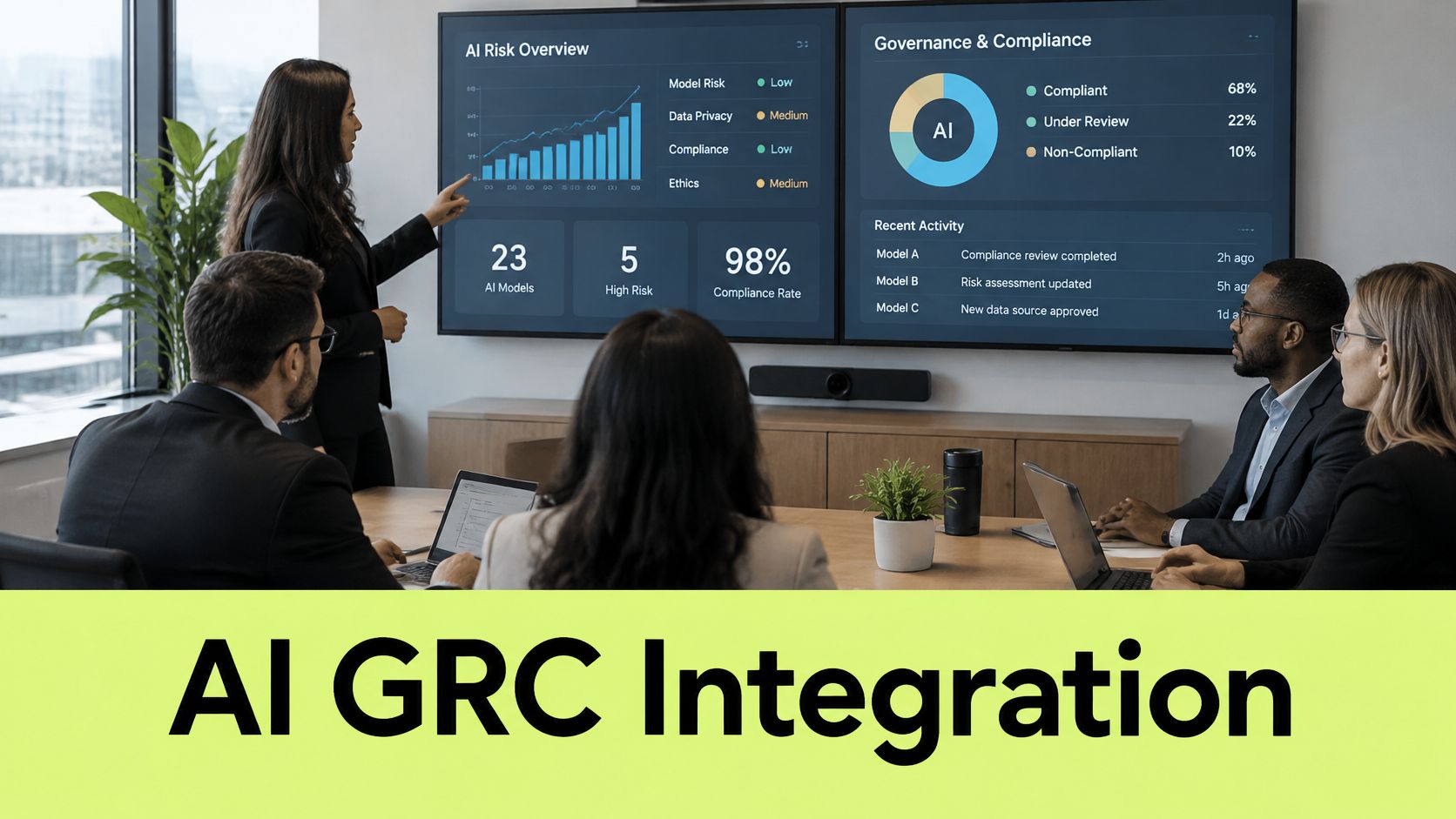
Both activities require accountable oversight. A dashboard discussion should connect individual AI uses to business risks and decisions.
Integrate AI oversight into existing work
Don't build a disconnected register that privacy, security and procurement teams never consult. Establish a common record and link it to the processes those teams already operate.
- Inventory AI uses. Record the tool or model, business purpose, affected process and third-party dependencies, including AI features inside existing software.
- Assign ownership. Identify who approves the use case, who operates it and who can suspend it.
- Record data provenance. Document where inputs originate, what sensitive information they contain and which permissions govern their use.
- Define human review and monitoring thresholds. Specify which outputs require approval, what failure looks like and when staff must escalate.
- Connect existing controls. Link the use case to risk assessment, privacy review, security requirements, incident response and evidence retention.
For example, an AI assistant drafting customer responses needs a different review process from a system recommending access changes. Assess the possible consequence of an incorrect output, not whether both tools use AI.
The accompanying video provides another format for considering the topic.
AI may increase GRC work before it reduces it. Teams must first discover use cases, resolve ownership and establish monitoring. Automating a fragmented process without resolving those questions can make its gaps harder to inspect.
Choose Your First GRC Step This Quarter
Pick a control that a customer, auditor or regulator already asks about. Choose something narrow enough that you can inspect its operation this week, rather than starting with a company-wide framework redesign.
Security awareness training is a useful candidate because it involves a requirement, a responsible owner, employee activity and records. The point isn't to assign learning. It's to establish whether the learning process supports the behavior your organization needs.
Set up a control you can repeat
Use this checklist to make the first decision concrete:
- Write the obligation. State who must complete which learning and what policy or external requirement establishes that expectation.
- Name the risk. Identify the behavior you're addressing, such as employees approving unexpected sign-in requests.
- Assign the owner. Specify who maintains the content and who follows up on incomplete work.
- Choose the evidence and frequency. Define the records you'll retain and when you'll inspect them.
- Schedule the next test. Set a review date and describe how you'll check completion and understanding.
Recurring learning and phishing exercises answer different questions. Completion records show participation; assessment responses and exercise outcomes help you examine comprehension and behavior. Don't present either as proof that employees will never make a mistake.
At Vigil Security, our administrators can access learner assignments, attempts, scores and completion records. Before designating any training system as the evidence source, inspect an export against your control's required identity, timing, results and traceability fields.
Keep the initial scope manageable. Resolve a missing record, test the follow-up process and confirm that another administrator could reproduce your review. Then apply the same disciplined approach to the next control.
Vigil Security offers security awareness and compliance training inside Slack, helping teams make required learning part of daily work. Visit Vigil Security to explore how training and learner records can support your control ownership, testing and audit-evidence process.