A remote employee sees a green presence dot beside a colleague's name, a read receipt on a message, and an automated nudge asking for a reply. None of those signals is a camera, but together they can reveal when someone is online and how they interact with work.
What Surveillance Big Brother Really Means in 2026
That employee might assume the signals are just conveniences built into a chat tool. A security leader might see them as useful context for investigating an incident. An HR manager might wonder whether the same information can be used to assess responsiveness. Those different interpretations point to the central question behind surveillance Big Brother: who can observe behavior, what can they infer, and what are they allowed to do with the information?
Today, the phrase describes more than a government camera network. Surveillance can combine state monitoring, corporate systems, and platform data to collect information about behavior, location, identity, and communication patterns. CCTV is one visible part of it. Workplace logs, biometric identification, online tracking, and service records can add information that a camera never captures.
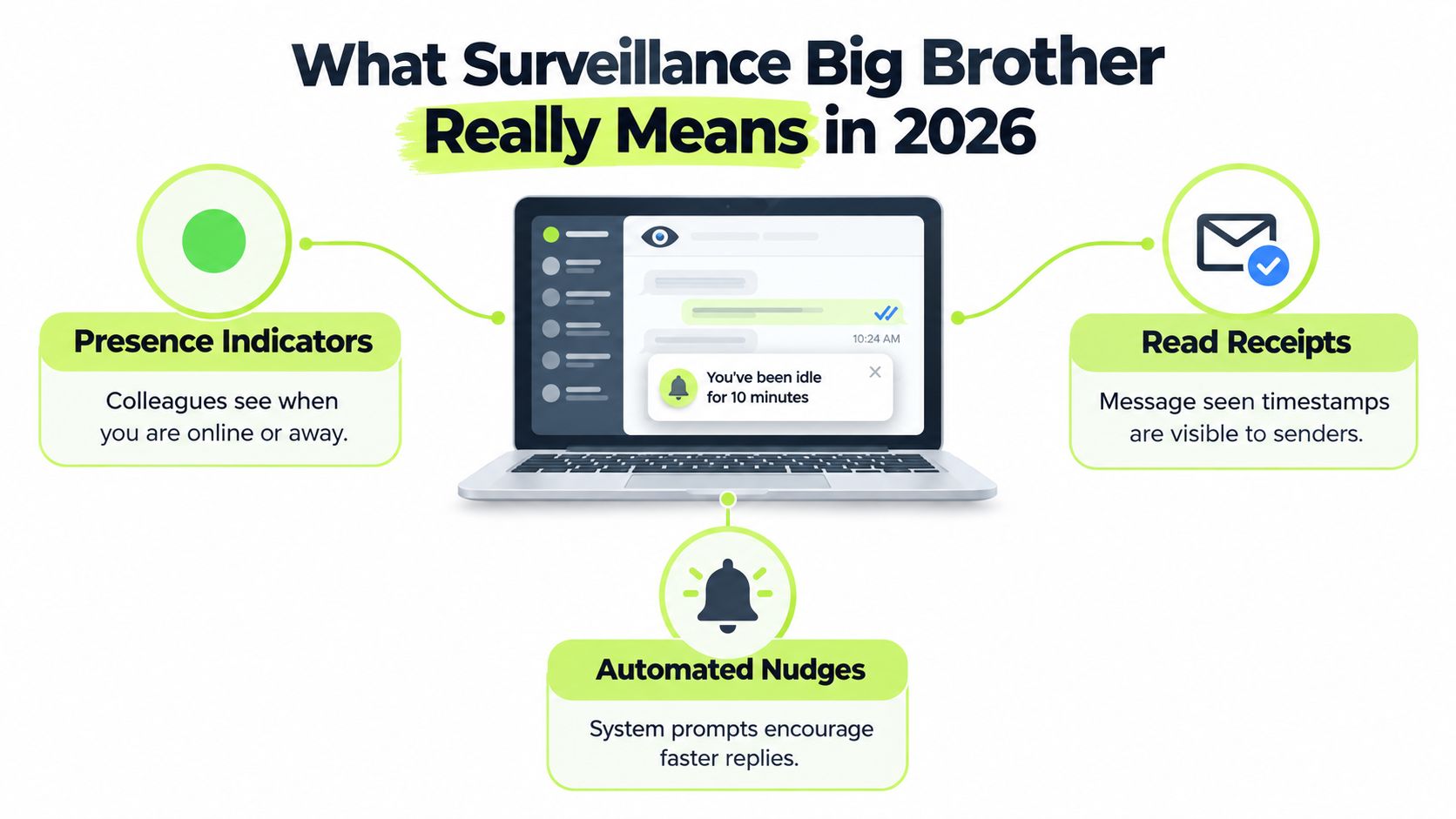
The workplace version is often difficult to recognize because the same data can serve different purposes. Security teams may use logs to investigate account misuse or confirm that required training was completed. Managers may see activity indicators as evidence of availability. Employees may experience those indicators as pressure to remain visibly active, even when no one has announced a formal monitoring program.
A useful starting point: Don't ask only whether a tool monitors people. Ask what it collects, who can see it, and which decisions it can influence.
The distinction matters to security and compliance leaders because legitimate protection can drift into behavioral control. Access logs used to investigate a compromised account have a clear security purpose. The same logs repurposed to rank employees by response speed raise a different question about fairness, transparency, and worker control.
The phrase can encourage an all-or-nothing debate, as if every form of monitoring were either protective or oppressive. A more practical view examines purpose, proportionality, access, and retention. That approach helps organizations protect systems without treating every signal of ordinary work as a measure of employee worth.
From Orwell's 1949 Novel to Modern Monitoring
George Orwell's Nineteen Eighty-Four gave modern debates a durable image: a state that watches people and polices not only behavior but private thought. Published on June 8, 1949, the novel depicts Oceania, where citizens live under the gaze of telescreens and the threat of the Thought Police. Its slogans, including “Big Brother is watching you,” became part of political and cultural vocabulary, as The Conversation's account of Orwell's continuing influence explains.

The metaphor lasted because Orwell's warning wasn't limited to a particular device. It described surveillance as a means of social control. The novel was reportedly smuggled behind the Iron Curtain during the Cold War and used by the CIA as counterpropaganda. The phrase “Big Brother” later became a way to criticize intrusive monitoring by governments, corporations, and institutions.
What Orwell's model captures
In the novel, the telescreen is a powerful symbol because it makes observation feel constant and one-directional. The state sees citizens, while citizens can't know when they're being watched. The fear of observation changes how people behave, even when no one is visibly intervening.
That logic remains relevant to contemporary debates about consent and control. A monitoring system can affect behavior even when its operator doesn't act on every record. People may avoid a conversation, location, or online activity if they don't understand who can access the data or how it may be used.
What has changed
Modern monitoring doesn't usually depend on one central screen. It can draw on CCTV, biometric systems, workplace software, online tracking, and information gathered by commercial services. Unlike Orwell's mostly one-way model, today's systems can be distributed and interactive: people generate data through routine activity, while organizations combine those records to identify patterns.
That difference doesn't make the metaphor obsolete. It makes it a useful prompt, rather than a complete description. The question isn't whether a modern system exactly resembles Oceania. It's whether people can understand the monitoring around them, challenge its use, and retain meaningful control over the consequences.
How Modern Surveillance Actually Works at Scale
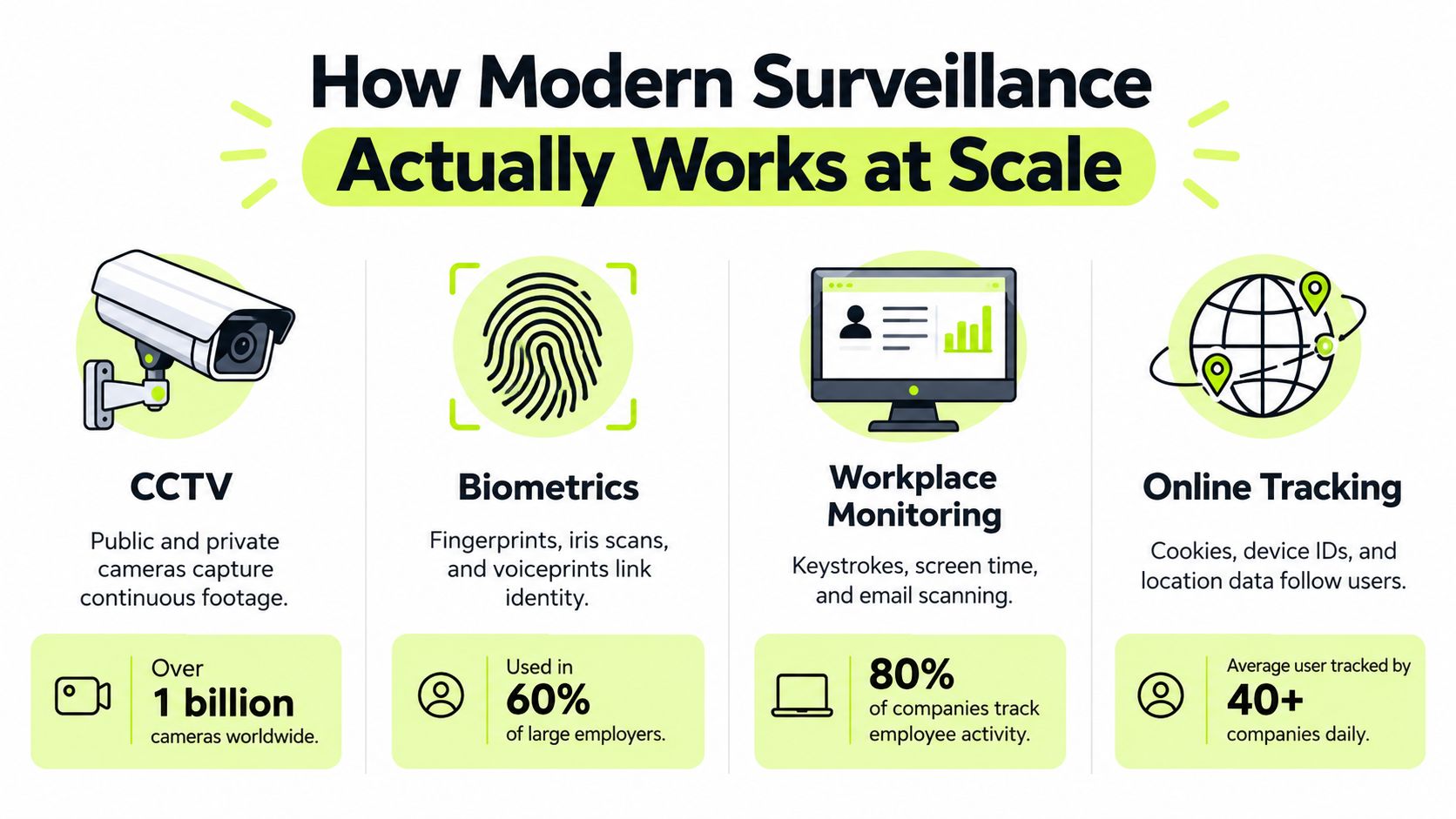
A modern surveillance system is often a network of tools rather than one device. Public and private cameras collect footage; biometric systems attempt to connect images to identities; workplace platforms record activity; and online services gather information about devices, accounts, and location. When organizations connect those sources, they can move from observing an event to linking it with a person and other records.
China illustrates how video monitoring can operate at large scale. Research and academic sources have cited estimates of more than 200 million public and private security cameras installed through the Sharp Eyes program, while other estimates projected approximately 626 million cameras nationwide by 2020. A reported example from Chongqing described 2.58 million cameras monitoring 15.35 million people, roughly one camera for every six residents. The figures differ by source, date, and definition, so they're best treated as estimates, not precise counts. The research discussion of China's social-credit framework and surveillance infrastructure also cautions against imagining social credit as one uniform national score controlled by a single algorithm.
The important point isn't the camera count alone. Video can become more consequential when organizations connect it to facial recognition, biometric records, or administrative databases. China's proposed social-credit framework has been described as an effort to assess aspects of civic, social, and financial integrity, but it isn't a single nationwide score governed by one consistent system.
For businesses, the lesson extends beyond state surveillance. Whenever a company combines persistent monitoring, identity matching, and automated decisions, data practices can affect privacy, access, reputation, and compliance. Organizations planning physical security can use a practical guide to CCTV installation for businesses, but camera placement is only one part of governance. Teams also need policies covering who can view footage, how long they keep it, and when they may connect it with other data.
For cloud-first organizations, the same governance questions apply to hosted services and workplace tools. This overview of cloud computing security concerns provides related context on managing security risks in cloud environments.
This video offers another visual introduction to the way surveillance systems are discussed:
Facial Recognition and the Accuracy Trap
Facial recognition can answer two different questions. One-to-one verification checks whether a face matches a single claimed identity, such as someone trying to access an account. One-to-many identification searches a reference database for possible matches to an unknown person. The tasks differ, so a result from one shouldn't be treated as proof that the other works safely in practice.
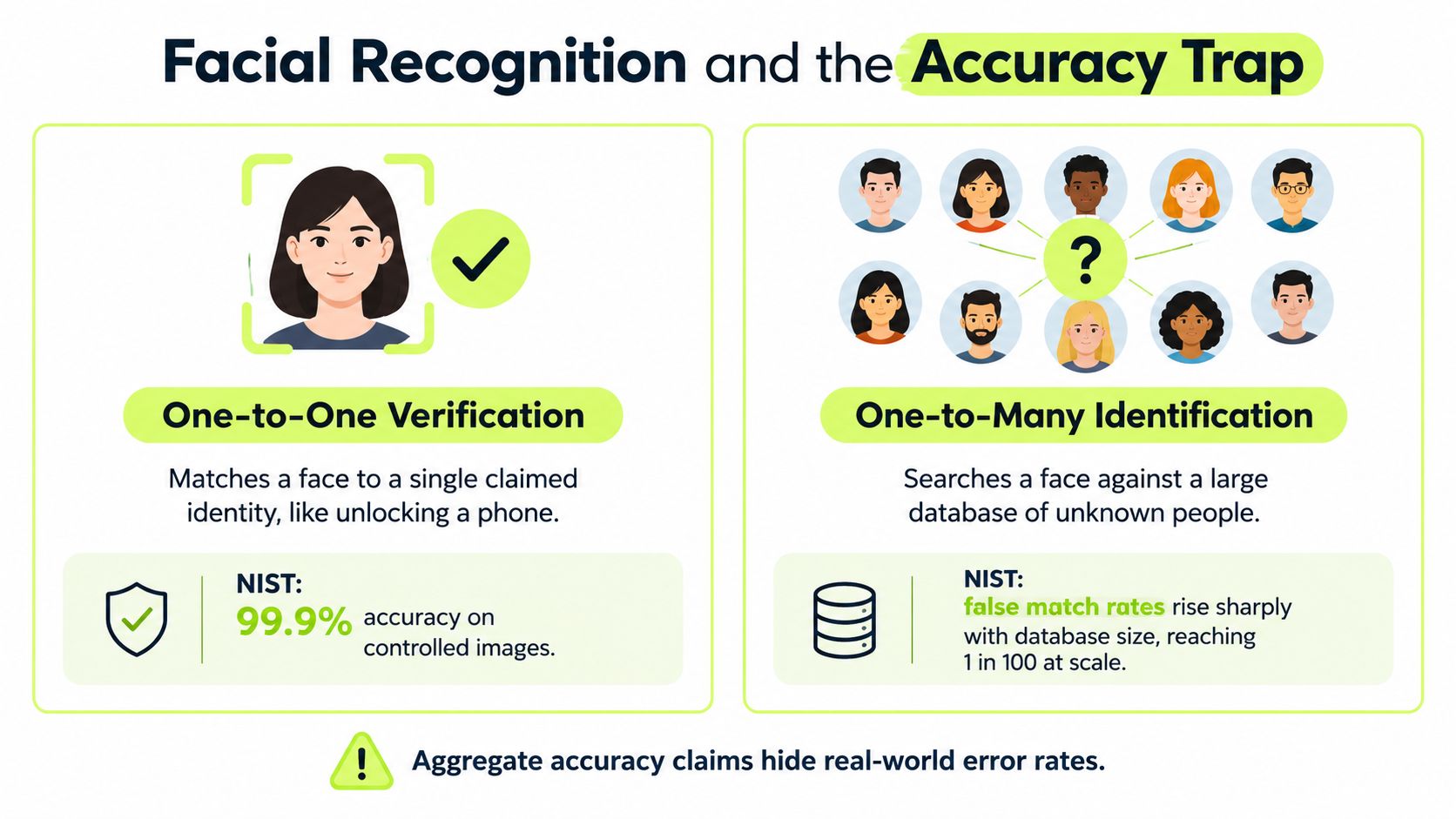
The National Institute of Standards and Technology evaluated 189 algorithms from 99 developers using 18.27 million images representing 8.49 million people. Its facial-recognition testing and transparency findings showed that false-positive rates, where the system incorrectly associates two different people, often differed by factors of 10 to more than 100 across demographic groups. NIST reported higher false-positive rates for women, younger and older people, and several racial or geographic groups, including African American and East and West African populations. False-negative differences were generally smaller.
A vendor's single accuracy figure can obscure these differences. It may not tell a buyer whether the system is being used to verify a claimed identity or search many people, how the images were captured, or whether the database resembles the people who'll be scanned.
Why the search task changes the risk
One-to-many searches create a practical problem even when the error rate for an individual comparison appears low. If a system scans a large camera feed or image database, it performs many comparisons. Those comparisons can produce false alerts that require human attention and, in high-stakes settings, can lead to mistaken intervention.
That's why buyers should be wary of applying a controlled test result to a different setting. A system may behave differently when cameras, lighting, image quality, or database composition differ from the conditions used in an evaluation.
Controls before deployment
Before adopting facial recognition, organizations should:
- Test the actual setup. Benchmark the specific algorithm under the camera and operating conditions where it will run.
- Measure group differences. Track false positives by demographic group rather than relying on one aggregate score.
- Match thresholds to consequences. A system used for a consequential decision needs more caution than one used for a low-risk administrative check.
- Require trained review. A human reviewer should examine a potential match before the organization takes consequential action.
Organizations considering facial recognition for warehouse security should use these questions to assess deployment risks, not treat recognition as an automatic identity check. A match is a lead to review, not a conclusion about a person.
Why Metadata Surveillance Matters More Than Content
People often picture surveillance as someone reading a message or watching a video. But metadata, information about a communication rather than its contents, can also reveal sensitive details. IP addresses, timestamps, and location-associated records can show patterns of contact and movement, even when an organization never sees the words exchanged.
The Electronic Frontier Foundation explains that communication metadata can reveal whether two people spent the night in the same place. It can also expose visits to medical specialists, religious services, political meetings, and other sensitive locations. Its analysis of communications metadata and privacy makes the central point clear: a record can be revealing even when it contains no message text.
The pattern develops through ordinary technical records. A service logs device or account activity. Repeated observations connect that account with places, people, and times. Later, an analyst or automated system may infer relationships, health concerns, beliefs, or political activity from those recurring patterns. The risk lies not just in what was collected, but in what becomes inferable when records are combined.
Encryption protects content, not every trace around it. A private message can still leave metadata that reveals who communicated, when, and from where.
Put limits on the data trail
Organizations can reduce the risk without abandoning useful security telemetry. Keep raw metadata only as long as there's a documented need. Separate identity information from telemetry where practical, so routine analysis doesn't expose named individuals by default. Limit access according to a specific purpose, and record which uses are legitimate.
When a precise location isn't necessary, use aggregated or coarser location data instead. These choices help teams preserve records needed for security investigations while reducing the chance that routine logs become a map of employees' private lives.
Security reviews should therefore ask two questions: whether someone accessed message content, and what the organization can infer from logs without opening a message at all. That wider view is essential for encrypted communications, collaboration platforms, and cloud services.
The Workplace Monitoring Question Most Coverage Skips
A manager checking a team's activity dashboard may see message counts, availability, and document edits in one place. Those records can help coordinate work, yet they do not all measure performance. Organizations may use one system to log activity, another to show availability, and a third to create performance signals. Treating those signals as equivalent can turn routine records into judgments about employees.
A meta-analysis covering 94 independent samples and 23,461 participants (research on electronic performance monitoring) found no evidence that electronic performance monitoring improves performance and associated it with greater worker stress. More transparent and less invasive practices were associated with more favorable attitudes. A separate study of 539 employees and supervisors at a multinational company (research on remote work and monitoring) found that remote work alone did not increase supervisors' ability to monitor. Frequent computer-mediated communication did increase surveillance indirectly by making work more visible.
| Study | Sample | Finding | Implication |
|---|---|---|---|
| Meta-analysis of electronic performance monitoring | 94 independent samples, 23,461 participants, research on electronic performance monitoring | Found no evidence that monitoring improves performance and associated it with greater worker stress | Don't assume activity tracking will improve results. Consider transparency and intrusiveness |
| Research at a multinational company | 539 employees and supervisors, research on remote work and monitoring | Remote work alone did not increase surveillance ability, but frequent computer-mediated communication made work more visible | Collaboration tools can create monitoring signals even without dedicated tracking software |
These findings help explain ambient surveillance, the visibility created by ordinary tools rather than a conspicuous tracker. Message frequency, presence indicators, document activity, and workflow metadata may help managers coordinate work. The same signals can become productivity scores, even when employees do not know how they are being interpreted.
Test the purpose, not just the tool
An activity log cannot explain why someone stepped away from a keyboard, whether a message needed an immediate reply, or how much useful work happened outside the tracked system. For a compliance lead, the distinction determines whether a record serves as incident-response evidence or an unreviewed performance score. Set out who may access each kind of data and which decisions it can support.
For example, monitoring lone employees with real-time escalation can serve a clear safety purpose, such as responding when a worker needs help. That is different from measuring message activity to rank employees. Teams can also connect monitoring choices with insider threat awareness practices, while avoiding the assumption that routine collaboration is evidence of misconduct.
The practical question is what normal workplace records reveal, and who is allowed to use them.
When Workers Accept Monitoring and What Makes It Legitimate
Workers don't necessarily reject monitoring in every form. A 2025 deliberative poll of 1,800 U.S. workers found broad support for transparency about what employers collect and why, employee access to collected data, limits on off-hours surveillance and location tracking, and restrictions when monitoring harms physical or mental health. Many participants also accepted monitoring when it served a clear purpose, such as protecting workers or company property.
The findings suggest that legitimacy depends on more than whether a tool is switched on. Employees need to understand the purpose, the limits, and their ability to question a record or inference. The deliberative poll on workers' views of workplace monitoring offers a practical basis for turning those expectations into policy.
Questions leaders can put into a policy
- Explain collection. Can employees see what the organization collects and why? Does the notice distinguish access logging from productivity analysis?
- Give workers access. Can an employee view the data attached to their account and correct inaccurate information?
- Set off-hours boundaries. Does monitoring continue outside working hours or track location when a worker isn't on duty?
- Assess health effects. Could the system create pressure to remain constantly available or cause physical or mental strain?
- Limit secondary use. Can activity data collected for security be used for discipline or performance scoring? If so, under what policy?
- Specify access and retention. Should managers see message metadata? How long should the organization keep logs, and who can approve an exception?
A phishing simulation, access log, or incident investigation can be easier to explain when the organization connects it to a documented protective purpose. Covert productivity scoring is harder to justify because employees may not know what data is collected, how it's interpreted, or whether they can challenge a conclusion.
Security, HR, and compliance teams should document that distinction together. A clear policy doesn't guarantee workers will agree with every control, but it gives them something concrete to assess: the purpose, boundaries, access rules, retention period, and process for correcting errors.
Building a Monitoring Program People Actually Trust
Start with each data source, not with the vendor's dashboard. For every log, indicator, or alert, document the legitimate purpose and decide whether it serves protective security or behavioral control. Keep the policy specific enough that an employee can tell the difference.
Next, separate identity data from behavioral telemetry where practical, restrict managers to aggregated information unless an approved need requires more detail, and set explicit retention limits. Require trained human review before consequential action, and publish a short employee-facing summary describing what's collected, who can access it, and how workers can challenge an inaccurate inference.
For records used in audits, teams should define what they retain and how they handle access and retention obligations. This overview of archiving and compliance can help frame those decisions. Vigil Security is one option for delivering security-awareness lessons, phishing simulations, reminders, and compliance evidence inside Slack, where distributed teams already work.
The Big Brother metaphor remains useful when it asks the watcher to explain themselves. For a cloud-first organization, the next step is practical: choose one everyday data source, write down its purpose and access rules, and share those rules with employees before expanding monitoring.
If you're reviewing how security training, phishing simulations, and compliance evidence fit into your Slack workflows, visit Vigil Security to see how its lessons and audit-ready records support distributed teams. Use the visit to assess whether the training and reporting approach fits your organization's monitoring boundaries and governance needs.